An epidemicmodel is a mathematical framework that describes how an infectious disease spreads through a population over time. It translates biological and social processes—how people contact each other, how long they remain infectious, how immunity develops—into equations that can be solved or simulated. These models are essential for predicting the trajectory of an outbreak, evaluating the impact of interventions like vaccination or social distancing, and understanding why some epidemics explode while others fizzle out.
History
The first mathematical model of epidemics is often attributed to Daniel Bernoulli, who in 1760 analyzed the effect of smallpox inoculation on life expectancy. The modern compartmental framework was developed in the early 20th century by William Ogilvy Kermack and Anderson Gray McKendrick in 1927.
How it works
Most models divide the population into compartments, such as Susceptible, Infected, and Recovered (the classic SIR model). The rates of movement between compartments are governed by parameters like the transmission rate and recovery rate. More sophisticated models add spatial structure, age groups, or behavioral feedback—for example, people changing their contacts in response to perceived risk. The models are then run forward in time to generate curves of cases, hospitalizations, or deaths, and can be fitted to real data to estimate key quantities like the basic reproduction number R0.
In practice
Epidemicmodels guide public health policy during outbreaks, such as deciding when to impose lockdowns or how to allocate vaccines, and are also used to study the spread of computer viruses and misinformation in social networks.
Fun fact
The famous 'flatten the curve' phrase comes directly from epidemicmodel outputs, which show that slowing transmission reduces peak healthcare demand even if total cases remain similar.
A watchdog that yawns and turns away instead of barking at an intruder is a bad guard. That is roughly how CD8+ T cells behave in people with type 2 diabetes. These cells are professional killers: they patrol the body, find infected or cancerous cells, and destroy them. But in diabetes, something breaks in the recognition system itself, and the watchdogs stop recognizing the enemy.
A stroke is like a bridge that suddenly collapses: part of the road gives way at once, while neighboring spans still hold but are already creaking. In the brain, this zone is called the penumbra, the tissue around the core where blood flow is reduced but cells are still alive. They can be saved if blood supply is restored quickly.
A sheet of paper tears where tension exceeds strength. Epithelium, the cell sheet lining our organs, behaves similarly, but until recently models could not show how tears appear in it. The classical vertex model describes tissue as a network of polygons tightly packed together and forbids cells from detaching.
A courier carrying a package enters a dense forest of intertwined ropes. He needs to deliver the cargo deep inside, but along the way he loses strength, and each step becomes harder. This is what an enzyme looks like as it degrades a dense gel of biological molecules. Until recently, no one could simultaneously see how the courier moves and how the forest thins out.
A crowd of pedestrians in a square moves chaotically: each person goes their own way, occasionally bumping into others. If every third person in that crowd wears a protective suit that blocks the pathogen, the rhythm of disease spread changes abruptly. That is exactly the scenario scientists reproduced by simulating 3000 self-propelled particles that repel each other and become infected upon close contact.
In March 2020, France emptied out: people stopped going to work, school, and cafés, and the streets filled with silence. Epidemiologists stared at the graphs and understood that the virus was not spreading on its own, but through handshakes, conversations, and metro rides. But how could they predict how many contacts a person would keep if the government announced new restrictions?
The orchestra starts playing, but each musician has their own tempo. If everyone plays at roughly the same speed, the music flows in a continuous stream. But if one group of instruments plays noticeably slower than the rest, the sound gathers into a dense clump that slowly moves forward.
A forensic examiner arrives at a crime scene and lifts fingerprints. Epigenetic clocks work the same way: from chemical marks on DNA they determine how much a cell has aged. A tumor leaves its own "fingerprints," and almost always they point to decrepitude.
The researchers took 5528 samples from the TCGA database, which holds DNA methylation data for eight cancer types.
A Greenland shark swims through cold water in its fourth century, and with every passing year its odds of dying do not rise but fall. This is not a miracle, but the result of an evolutionary trade-off that has so far eluded theory. An organism is like a family budget that cannot be spent twice: every unit of energy can go into reproduction, growth, or body repair.
Every winter, hospitals fill up, and by summer they seem to empty. Epidemics breathe like the tide. But why do waves of disease keep rolling in, even without new mutations? Mathematicians found an answer in a tug-of-war between two strains.
Within a single epidemic, two virus variants often coexist.
Two people agree to meet, but each has their own things to do. One hesitates: what if the other doesn't come? And decides not to go. The other thinks the same. The meeting doesn't happen. That's the simple mechanism the authors dissect: a joint endeavor requires everyone to invest time, but the payoff depends on whether the partner participates.
In the model, each person keeps a to-do list ordered by importance.
A mail carrier delivers letters along one-way streets. As long as he only drives forward, the route is simple and predictable. But if U-turns are suddenly allowed, he'll start doubling back, crossing his own tracks, and the delivery pattern gets tangled. That's roughly how an infection behaves when people can get sick more than once.
The quantum world does not forgive forgetfulness. Throw a stone into a pond — the ripples spread and vanish, the information about the impact dissipates without a trace. In quantum mechanics, everything is different: the evolution of a system is reversible, and the past is never completely erased.
A mosquito swarm resembles a living cloud — hundreds of bodies circle together, but no one lines up or mimics a neighbor's movements like starlings or fish. For a long time, it was unclear what held such unity together. The authors of a new study suggested that the insects communicate by sound.
A stadium packed with fans hears the announcer’s voice for the first time, and instantly the whole place erupts. The message sounds again and again. Only a handful of people in nearby rows respond. That’s roughly how neural networks behave in brain organoids — tiny lab-grown replicas of the brain.
A jazz ensemble: at first, a cacophony of random notes. Then — a catchy riff that plays over and over. Such is the riddle of the origin of life — only in the language of chemistry.
A bacterial biofilm is like a city made of slime. The houses are the microbes themselves. The streets and bridges are long polymer molecules that bacteria secrete outside. This whole construction is not static: the bridges are constantly breaking and re-forming.
The authors built a "toy" computer model of such a city.
A disease outbreak is like a wildfire: the fire runs through dry grass, and its speed depends on wind and humidity. But an infection has its own 'wind'—how often people infect each other. When this rate changes along with the fraction of already infected, the epidemic wave can behave differently.
A subway train races through a tunnel, yet passengers in the last car barely sway. Blood flow in the lungs works much the same way: the heart pumps blood in powerful spurts, but by the time it reaches the veins, the pulsation has almost vanished.
A dengue outbreak is like a wildfire in the savanna: the flames leap from person to person via mosquito bites. Authorities respond in two ways — sending the sick to hospitals and spraying chemicals that kill the insects. But in reality, a hospital has only a limited number of beds, and fogging doesn't start immediately; it begins only when the number of infected crosses a critical mark.
Usually, the complexity of systems, from satellite motions to heart rhythms, is assessed with averaged entropy (a measure of unpredictability, as understood by Boltzmann). But that's like evaluating the ocean only by wave height: the average figure hides the full richness of underwater currents.
Ordinary models assume that infection is like a steady flow of water that washes over everyone equally. In reality, the stream from a sick person fluctuates: right after infection it barely trickles, then turns into a raging downpour, and later subsides. The chance of catching the virus depends on the strength of this flow at the moment of contact.
When a pipe bursts in the basement, a plumber acts step by step: locates the leak, measures the pressure, determines the cause, patches it up, and checks if it's dry. The same recipe — the standard model DMAIC — is being proposed against epidemics.
First, they determine the scope — how many hospital beds are occupied, which industries are sagging.
In the web of life, predators and prey exchange carbon and water, and each act of eating slightly increases the universe's disorder. But the intrusion of disease turns this system into a giant seesaw. When a mid-level predator gets sick, its hunting abilities decline, and it becomes easy prey.
Every tumor writes its own cosmology. Its cells are galaxies, and mutations are stellar flares marking the branches of a genealogical tree. The key to its history is the rhythm of accumulating genetic typos.
Mathematicians confirmed: the ideal response to a pandemic is the 'hammer and dance' strategy. First, a sharp lockdown smashes the wave of infections like a hammer blow. When hospitals empty, the dance begins — a cautious, step-by-step return to normal life.
A runner loses on both a smooth track and sticky sand. Seems hopeless. But if the surface underfoot starts changing every few seconds (track, then sand) the runner suddenly stops falling behind. He doesn't get faster; the environment just doesn't get a chance to 'crush' his weakness.
That's exactly what the authors found when studying a simple predator–prey model.
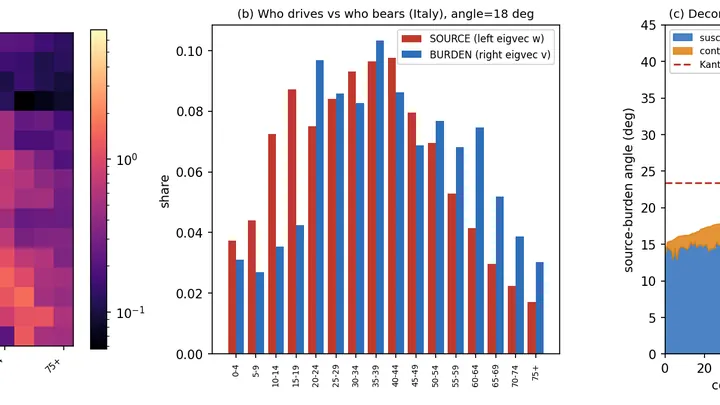
The orchestra plays without a conductor. We know the overall volume: that's the basic reproduction number R0, the spectral radius of the epidemic. But the score itself, the contact matrix between people of different ages, holds the melody: who spreads the infection and who takes the main blow.
DNA methylation consists of tiny chemical marks on our genes. Over the years, they change on a fairly strict schedule. Standard epigenetic clocks look at these marks and output a single number: biological age. But a number can't tell you how the pattern of marks rearranged day by day, year by year. The authors of this work decided to turn a static photograph into a continuous film.
Biological complexity has long eluded us: you can count genes, cells too, but how do you grasp the organization of the proteome itself — a multi-thousand ensemble of proteins woven from carbon, oxygen, and hydrogen?
A person reaches out to a stranger across town. That stranger will never return the favor: they'll never meet. So why help? Biologists call this indirect reciprocity: kindness comes back not from the person you helped, but from someone else, down the line.
In a new study, two variants of this idea were pitted against each other.
A tightrope walker inches across a chasm. As long as they keep their balance and avoid sudden moves, they're safe. But one overcorrection, and a fall is inevitable. Life works much the same way at every level — from proteins inside a cell to entire ecosystems.
A drop of ink in a glass of water spreads quickly and evenly. But if the water is squeezed between tightly packed spheres, the ink cloud crawls slowly and erratically: it dodges obstacles and gets stuck in narrow necks. Water molecules in living tissue move in much the same way.
A doctor holds a stack of test results taken at different times. Each sheet on its own is just a snapshot of a single day, but what you want is a whole movie of how the disease unfolded. A neural network called Tempo learns to glue these scattered frames into a smooth reel.
Each vowel sound is a distinct shape of the mouth, tongue, and throat. When you say 'ah,' 'ee,' or 'oo,' not only does the air inside your head change, but so does the way radio waves pass through it. Researchers peered into this process using MRI scans taken right during speech and built a precise computer model of the head — from bones to soft tissues.
In a solid piece of tin-lead alloy, the layers of the two metals lie like pages in a book. When heated from one side, the layers don't melt uniformly but in whimsical tongues and fingers. Scientists studied this process using a transparent alloy that can be seen through under a microscope and compared it with a computer model.
For 800,000 years, ice ages have occurred every 100,000 years. The rhythm matches the elongation of Earth's orbit. But the orbit changes the flow of solar heat so subtly — as if the conductor barely moved the baton, yet the orchestra thundered. It remained a mystery how this weak signal controls the ice sheets.
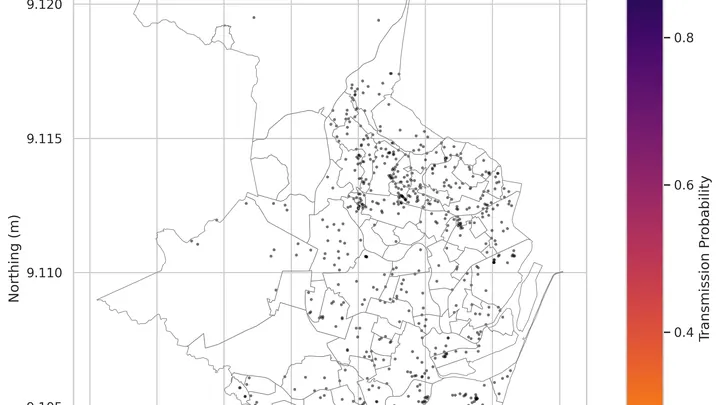
In the Brazilian city of Recife, three viruses (dengue, Zika, and chikungunya) are spread by mosquitoes. Scientists collected data on thousands of cases and built a model that assesses how infections in different parts of the city influence each other. The model looks at two things: how close cases are in space and how much time passes between them.
A typical medical neural network sees a patient as a point on a map: there's height, blood pressure, a blood test, and the model places a single label: "healthy" or "sick." But in a real hospital, the map is always torn. One test is done on Monday, another a month later, and the CT scanner is a different brand altogether. A point on such a map is self-deception.
An epidemic is not just a virus: it's millions of personal decisions. One person keeps riding the subway; another locks themselves at home. Classical models describe the average behavior of a crowd but don't ask why each individual acts that way.