Digital Twin Instead of a Control Group express
The old paint on one board has already dried, and the new coat hasn't been applied yet, but you need to know which one protects better against rain. Usually, you'd paint two boards and wait a year. The researchers did something different: they taught a computer to predict, from old photographs, how the same board would look under a different paint. No real experiment needed.
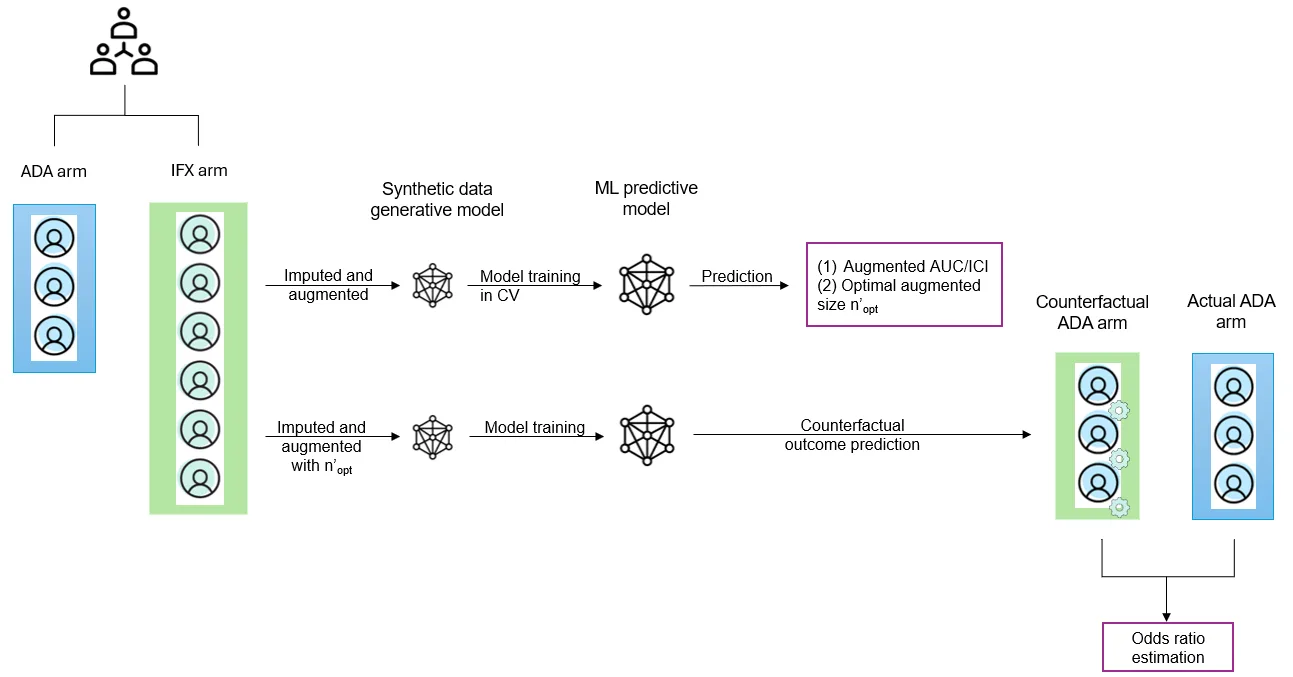
In medicine, this trick is called a virtual control. Instead of hunting for children with Crohn's disease who would agree to a year of treatment with an older drug, the scientists took medical records from those who had already received infliximab (IFX). On this data, they trained five machine learning models — five different ways to peek into the future. Then they asked each model: what would have happened to the patients who actually received adalimumab (ADA) if they had been given IFX?
This approach is especially valuable when assembling a control group is ethically impossible or too costly. A computer trained on historical data becomes a "digital twin" of an entire patient group. The model still needs validation on new data, but the first step is done: virtual helping hands are already reaching into clinical trials — almost like that board painted without a single brushstroke.
Original abstract
as written by the authors arXiv:2604.23465
Single-arm trials accelerate study timelines by reducing the number of patients that must be recruited for a concurrent control group. However, these designs require an alternative comparator to estimate treatment effects. One approach is to construct a virtual control arm using a machine learning (ML) model trained on external control data to predict the counterfactual outcomes of the treatment arm. Our aim in this study was to leverage virtual controls by developing and evaluating ML-based counterfactual outcome models trained on IFX-treated patients to predict 1-year steroid-free clinical remission (SFCR ) and a composite of C-reactive protein remission plus steroid-free clinical remission (CRP-SFCR) for ADA-treated pediatric Crohn's disease patients, and to compare the resulting IFX-versus-ADA treatment effect estimates with those obtained using propensity score matching to external controls. Five ML models were used to train counterfactual models on the observed IFX cohort data. The resulting models were used to predict the counterfactual outcomes for the ADA arm patients. LGBM yields the best OR closest to the propensity score matched reference, and all 95% CI results align with the conclusion from the reference study that no statistical difference in the primary and secondary outcomes has been observed between the patients treated with ADA or IFX. Our study supports virtual controls as a viable and effective substitute for expensive, lengthy or unethical patient recruitment in an inflammatory bowel disease (IBD) trial. The developed gradient boosted prediction model can be used as a pretrained model to generate IFX counterfactual predictions in future studies, pending external validation and assessment of transportability.
The study used data from children with Crohn's disease who needed to achieve remission without steroids — meaning the body had to maintain a healthy state on its own, without powerful anti-inflammatory drugs.
In the novel "Minority Report," crimes were predicted; here, drug responses are. Both ideas rest on the notion that the past can stand in for the future if you analyze it correctly.