A control group is a baseline group in a clinical trial or experiment that does not receive the treatment being tested. Instead, it receives a placebo, a standard existing treatment, or no intervention at all. Its purpose is to provide a reference point so that any changes observed in the treatment group can be attributed to the treatment itself rather than to other factors like the natural course of a disease, the placebo effect, or random chance.
History
The concept of a control group became formalized in the early 20th century, notably with the 1948 British Medical Research Council trial of streptomycin for tuberculosis, which is widely considered the first properly randomized controlled trial.
How it works
Participants are randomly assigned to either the treatment group or the control group. The control group is treated identically to the treatment group in every way except for the intervention under study. By comparing outcomes between the two groups at the end of the trial, researchers can isolate the specific effect of the treatment. Blinding—where participants and sometimes researchers do not know who is in which group—further reduces bias.
In practice
Control groups are the gold standard in clinical trials for new drugs, vaccines, and medical procedures, and are also used in psychology, agriculture, and other experimental sciences.
Fun fact
The placebo effect is so powerful that even when people know they are taking a placebo, they can still experience real physiological improvements in some conditions.
Two people agree to meet, but each has their own things to do. One hesitates: what if the other doesn't come? And decides not to go. The other thinks the same. The meeting doesn't happen. That's the simple mechanism the authors dissect: a joint endeavor requires everyone to invest time, but the payoff depends on whether the partner participates.
In the model, each person keeps a to-do list ordered by importance.
Inside each of us, invisible clocks are ticking. They control the release of cortisol — the hormone that helps us wake up in the morning, cope with anxiety, and keep our immune system on its toes. In adrenal insufficiency, these clocks break down: the body can't produce the right amount of cortisol on its own.
Inside every cell, a complex network of genes determines what it will become — a nerve cell, a muscle cell, or part of the skin. This choice often resembles flipping a toggle switch: two stable positions, and the cell decides which way to tip. But cells have a feature rarely considered in such models: they divide.
In a car, the steering, brakes, and accelerator gradually fail. At first, you can still swerve around a pothole, but each year the maneuver takes more effort. At some point, even a perfect road becomes impassable — the car no longer obeys the driver.
That's exactly how the authors describe aging: not as the accumulation of rust or wear and tear, but as the loss of "controllability" of the body.
Two specialists look at the same breast image. One is an experienced doctor, the other is an artificial intelligence program. Sometimes their opinions match, sometimes they diverge. How often they agree determines how accurately they can together distinguish healthy tissue from a tumor.
An epidemic is like a fire in a dry forest: a spark flares up, the flames leap from tree to tree, and within a week the whole area is burning. A hundred years ago, scientists devised a simple mathematical model for such a fire: they divided people into those who had not yet fallen ill, those who were ill, and those who had already recovered.
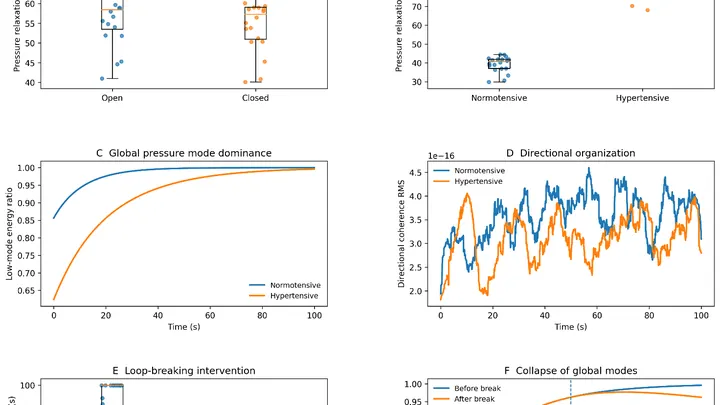
Water in a circular hose, pumped around by a pump, won't stop even if you pinch one section: the flow finds a detour and keeps going around. That's roughly how some parts of our circulatory system are arranged — not as single pipes but as closed loops.
Scientists built a computer model of blood flow and compared two scenarios: an open vessel and a closed loop.