Stepping to the Metronome: How Rhythm Breaks the Memory of Walking express
The room is quiet, just footsteps and an internal count: “one-two, one-two.” After a minute, the gait stiffens, legs move like pistons. Forget the count and just walk — the body relaxes, the step becomes smooth. The difference between these two states is not just a feeling. It's written in numbers, and those numbers tell the story of how the brain controls movement.
For thirty years, we've known that when you walk on your own, the fluctuations in step length resemble a fractal pattern — slow waves layered on fast ones, with the past influencing the future. This rhythm is called “persistent.” But turn on a metronome or ask someone to step on glowing markers, and the picture flips. Steps start to run away from themselves — a long step is immediately followed by a short one, as if the system is in a hurry to correct an error. This is “antipersistent.” But what exactly causes it — long-term memory in the nervous system or just a quick reaction to the previous step? Old methods couldn't tell.
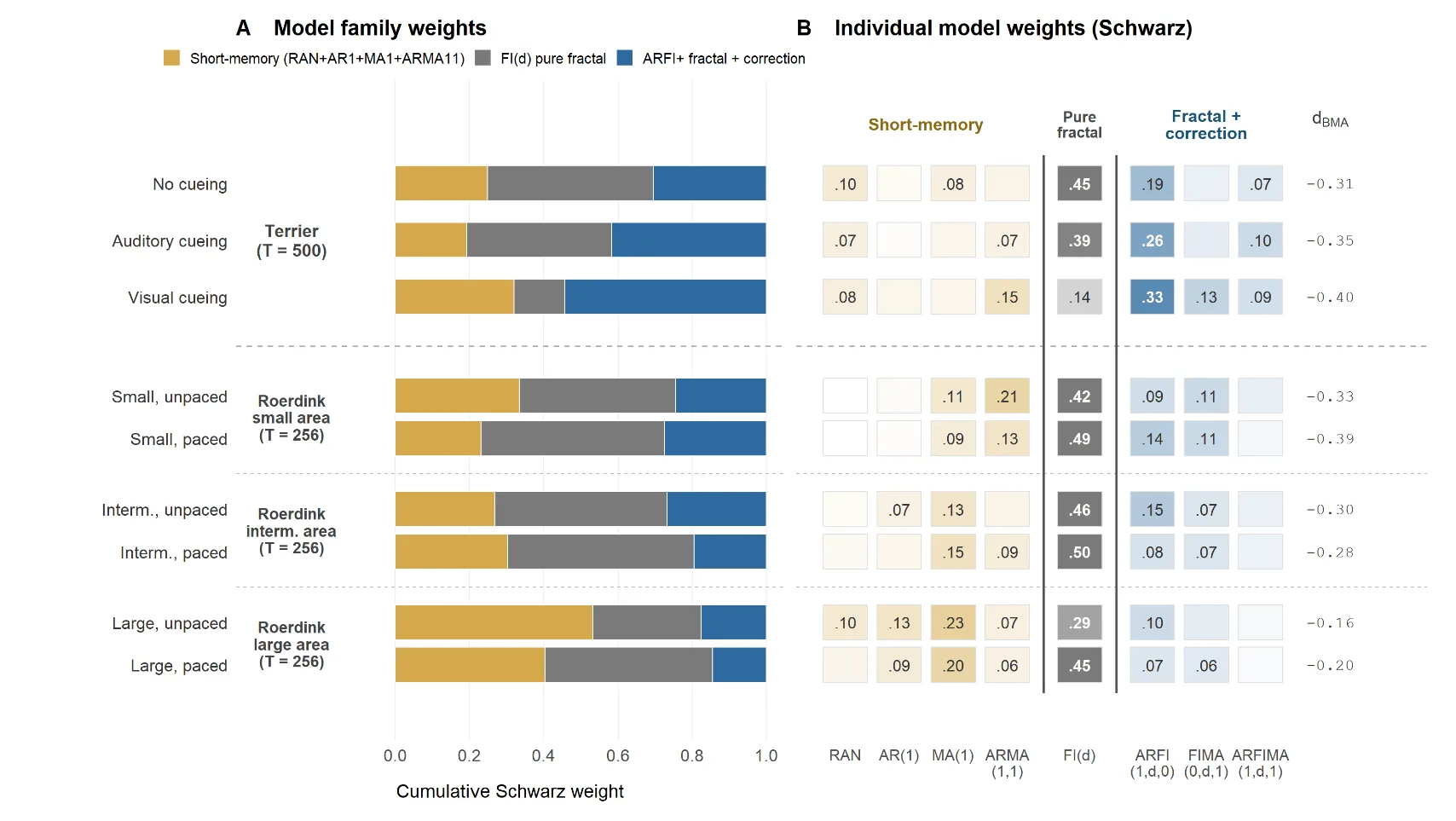
The authors of the new study took three datasets (walking on the floor, on a treadmill, and under rhythmic cues) and applied a full family of models that can separate long-term memory from short-term reactions. It turned out that antipersistence under a metronome is not just a quick correction. It's a true fractal phenomenon, but with the opposite sign: the brain doesn't lose memory of past steps; it actively suppresses it. The old metric (DFA alpha) overestimated the contribution of long-term memory by a quarter: it confused it with short-term adjustments.
The final picture resembles three coordinated mechanisms. The first is an internal generator that on its own produces a fractal pattern with long-term memory. The second is reactive correction: “Oops, I lengthened that step — I'll shorten the next one.” The third is an unavoidable delay in the signal traveling from brain to muscles and back. Together, they explain why under a metronome we don't walk like robots but like living systems constantly balancing on the edge of order and chaos.
Original abstract
as written by the authors arXiv:2604.24365
Stride-to-stride fluctuations in human walking carry a fractal correlation structure that reverses sign under external cueing: self-paced gait is persistent, whereas metronomic or visually cued gait is anti-persistent. Three decades of detrended fluctuation analysis (DFA) have established this reversal as a scaling-exponent shift, but DFA cannot distinguish genuine long-memory dynamics from short-memory autoregressive moving-average (ARMA) processes that produce the same apparent exponent. We fit the full eight-model ARFIMA(1,d,1) family to stride interval and stride speed series from three datasets (N = 70 subjects) spanning overground walking, fixed-speed treadmill walking, metronomic and visual cueing, and graded positional constraint. Model evidence is aggregated through BIC-based Schwarz weights, and the fractional differencing parameter d together with the autoregressive and moving-average coefficients phi and theta are estimated by Bayesian model averaging. Three findings emerge. (i) Long-memory specifications decisively outweigh ARMA alternatives under both persistent and anti-persistent conditions, establishing cued gait anti-persistence as a genuine fractional phenomenon. (ii) DFA alpha overestimates d + 0.5 by 0.25 to 0.34 units, a discrepancy jointly attributable to short-memory components that DFA conflates with long-memory persistence and to a finite-sample negative bias inherent to exact ML-ARFIMA estimation. (iii) The estimated (d, phi, theta) parameters are consistent with a corrective sensorimotor model in which a fractal intrinsic generator, a reactive feedback correction, and a motor-delay component together shape stride-to-stride fluctuations. Whether a single mechanistic model can account quantitatively for the observed parameter ranges across rhythmic, spatial, and unconstrained conditions is a question that the present analysis motivates but cannot alone resolve.
If you walk to a metronome for a long time and then turn it off, your gait retains the antipersistent pattern for a few more minutes, the brain needs time to switch back.
In Peter Watts's novel Blindsight, people with modified consciousness lose the ability to make spontaneous movements: their gait becomes perfectly even but devoid of living variability, like subjects under a rigid external rhythm.