The centimeter is a unit of length in the metric system, defined as one hundredth of a meter. It is a convenient scale for measuring objects that fit in the human hand, such as a pencil, a smartphone, or a small fish. As part of the International System of Units (SI), it is derived from the meter, the base unit of length, and is widely used in science, engineering, and everyday life.
History
The centimeter emerged with the metric system during the French Revolution in the late 18th century. The meter was originally intended to be one ten-millionth of the distance from the North Pole to the equator, and the centimeter was simply a convenient subdivision.
How it works
The centimeter is defined purely by the meter: 1 cm = 0.01 m. The meter itself is defined by the speed of light in a vacuum, making the centimeter a derived unit with a precise, unchanging value. In practice, it is used with metric prefixes to express lengths that are too small for meters but too large for millimeters.
In practice
The centimeter is used in medicine (e.g., measuring tumor size), meteorology (e.g., rainfall depth), and everyday contexts like clothing sizes and ruler markings.
Fun fact
A cubic centimeter of water at its maximum density weighs exactly one gram, linking the metric units of length and mass.
Systems:SICGSOne hundredth of a meter, defined as 0.01 m.
The cosmic dawn is hidden behind a dense veil of time. To see beyond it, you need to catch the radio signal from clouds of neutral hydrogen — the so-called global 21 cm signal. But it is so faint that the receiver's own noise drowns it out.
Light needs space. A camera lens sits several centimeters from the sensor so the rays have room to focus. Now, that gap has been squeezed to the thickness of a sheet of paper, and light still behaves as if it had traveled its rightful centimeters. That's what 'spaceplates' do: flat elements that mimic free-space propagation.
In a particle accelerator, nuclei shatter into fragments like a porcelain cup dropped on the floor. Each fragment flies through silicon wafers, which register the impact and its strength. But to distinguish a real signal from random noise, you need a threshold: below it, readings are considered interference.
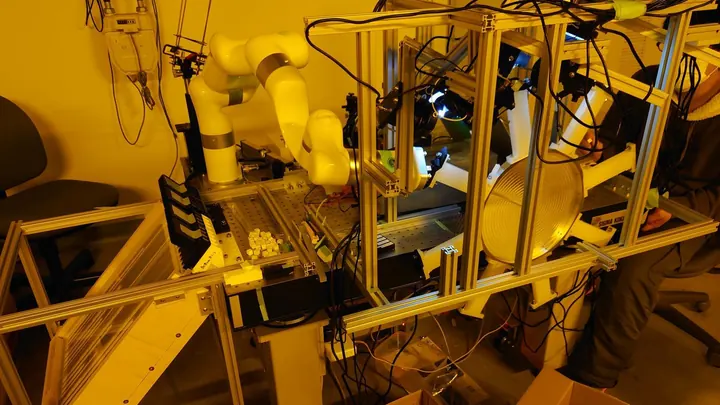
The future neutrino detector will contain millions of tiny plastic cubes: each the size of a die. They flash when a ghostly particle passes through, and that flash must be captured and measured. But if a cube is warped, has a burr, or a hole in the wrong place, the signal gets distorted, and the detector starts lying.
Checking each cube by hand is like sifting through sand on a beach.
A seismometer is the planet's ear. It picks up the faintest tremors in the ground and turns them into an electrical signal. But this ear isn't perfect: its sensitivity depends on temperature. In the cold and in the heat, the instrument hears slightly differently, and that introduces error into measurements.
A thin film of silicon nitride is stretched over a frame like the skin of a drum. The slightest nudge from gas molecules makes it tremble. A laser beam delivered through a glass fiber picks up that trembling and turns it into a pressure reading. The whole setup fits in a pocket, not on an optical table.
In a quiet lab, a device the size of a microwave oven sits on a table. Inside, a coil glides smoothly up and down while a computer reads electrical signals. This is the tabletop Kibble balance — a machine that links mass to quantum constants.
Previously, such balances occupied a whole room and required a team of engineers.
A tiny crystal flake rests on a substrate like an autumn leaf on a palm. It's thinner than a human hair, yet inside it quantum effects are simmering: superconductivity, magnetic order, quantum spin liquid.