Multifractal detrended fluctuation analysis (MF-DFA) is a statistical technique used to examine the scaling properties of a time series—a sequence of measurements taken over time—when those properties vary across different magnitudes or time scales. It extends an earlier method called detrended fluctuation analysis (DFA), which detects long-range correlations in a signal, such as whether a large value tends to be followed by another large value. MF-DFA goes further by quantifying how these correlations change depending on the size of the fluctuations, revealing whether the signal has a 'multifractal' structure, meaning it is composed of many interwoven patterns with different degrees of roughness or variability. This is common in natural phenomena like heartbeats, stock prices, and river flows, where small and large fluctuations behave differently.
History
MF-DFA was introduced in 2002 by Jan W. Kantelhardt and colleagues, building on the DFA method developed in 1994 by C.-K. Peng and co-workers. It quickly became a standard tool in econophysics and physiology for analyzing nonstationary data.
In practice
MF-DFA is used to analyze heart rate variability to distinguish healthy from diseased cardiac function, and to study volatility clustering in financial markets for risk assessment.
Fun fact
MF-DFA has been applied to seemingly unrelated signals, from earthquake seismic records to the rhythm of human gait, and can even detect subtle changes in a person's walking pattern that precede falls in the elderly.
The orchestra plays without a conductor. Each instrument follows its own schedule: the violin on Monday, the flute on Wednesday, the timpani on Saturday. Astronomers hear not music but isolated notes scattered across the calendar. A telescope sees a star only when it is above the horizon and when the schedule has allotted time for it.
An old water pipe hums differently from a new one. A pipe that has lost its flexibility answers every surge of water with a sharp echo that races back to the pump faster than in a young system. Something similar happens with our arteries: over the years their walls harden, and the pulse wave, having reached the small vessels, reflects back to the heart almost without delay.
A stone thrown into water quickly loses speed. A meteor entering the atmosphere should behave the same way: air slows it down, and friction burns up its material. But cameras of the Global Fireball Observatory network have captured hundreds of bright fireballs over ten years that streak across the sky with almost no deceleration.
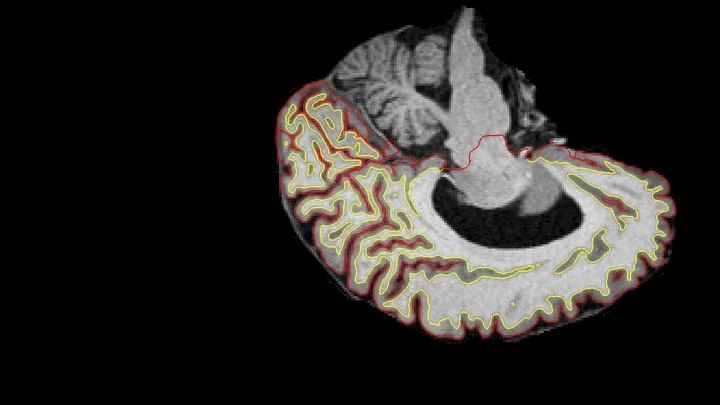
Two scans of the same brain taken at different times are like photographs of the same house before and after renovation. To see what changed, you overlay them and look at the differences. But an MRI scanner is not a perfect camera: it adds its own distortions, as if the photo were taken through slightly warped glass.
You're listening to the faint whisper of stars, and nearby someone keeps moving a chair. In gravitational wave telescopes, that role is played by scattered light: it reflects off trembling surfaces and creates false signals.
When you type 'salad' and the keyboard suggests 'Caesar,' behind the scenes millions of phones are jointly learning to predict words. They share not your messages, but only improvements to the common algorithm, like a coach who sends athletes only the tweaks to the plan: 'add 5 push-ups to yesterday’s routine.' Information entropy helps send only unexpected, valuable updates.
In the brain's white matter, the signal travels along axons — long neuronal processes wrapped in an insulating myelin sheath. Water fills the space inside axons and outside, in the narrow gaps between fibers.
Fast radio bursts — millisecond radio pulses arriving from distant galaxies — long remained a puzzle. Their colossal energy, compressed into instants, pointed to cataclysms on neutron stars, perhaps pulsars or magnetars.
A protein in a cell is not a frozen sculpture. It is constantly in motion: bending, breathing, jittering. This motion, its dynamics, determines how the protein works. But peering directly into the dance is hard, and computer simulations often demand enormous computing power.
A new approach, named DynaMode, views protein motion as a musical piece.
In the intricate dance of active turbulence, where invisible engines spawn chaos, a soft droplet takes on the role of a detective. Its shape is not merely an outline but a sensitive cipher: it reads the hidden signals of its environment.
The crumpled DNA thread in the cell nucleus is not a chaotic knot, but an intricate melody played on a polymer string. Modern experiments Hi-C, like highly sensitive microphones, capture the echo of contacts between distant genome regions, turning spatial organization into a two-dimensional probability matrix.
Two dead suns circle in an eternal dance. Their orbit is a perfect metronome, keeping time with the accuracy of atomic clocks. But even dead stars can tremble.
The river of time may not be a smooth flow but a sequence of minuscule steps, like a stop-motion film shot with an unimaginably fast camera. In 1964, Yu. A. Golfand suggested that time moves not continuously but in tiny jumps, and derived an equation that predicted an inevitable increase in disorder (entropy).
A tuning fork produces a pure tone, but if you strike it too hard, it starts to rattle, and a musician might mistake that rattle for complexity in the sound.
When the conductor leaves the orchestra, the musicians keep playing from memory for a while. But without a unified rhythm, each one starts to speed up or slow down on their own, and the harmonious symphony turns into disjointed noise. According to new research, the brain and heart behave much the same way in the last hours of a person's life.
Mountain river water doesn't flow smoothly: it churns, swirls into eddies, and suddenly accelerates. This chaotic motion is called turbulence. But even within it, there are hidden rhythms — rare and intense bursts that briefly alter the entire flow pattern.
The atomic nucleus is not a billiard ball but rather a hazy cloud that constantly changes its contours. Protons and neutrons inside are in continuous motion, and the nucleus can take on many different shapes: elongated, flattened, or pear-like. To describe this quivering diversity, physicists usually picked a few most probable shapes and mixed them, like an artist mixing paints on a palette.
A baker follows a recipe for a cake, but instead of a fluffy sponge, they get a hard crust. They start running through possible causes: maybe the flour was damp, or the oven heats unevenly, or the eggs were too cold.
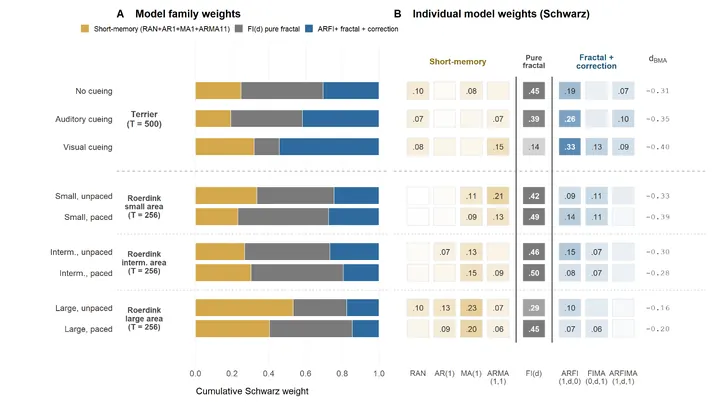
The room is quiet, just footsteps and an internal count: “one-two, one-two.” After a minute, the gait stiffens, legs move like pistons. Forget the count and just walk — the body relaxes, the step becomes smooth. The difference between these two states is not just a feeling. It's written in numbers, and those numbers tell the story of how the brain controls movement.
Imagine a city where streets are not straight but winding, with dead ends and hidden passages. A bike courier will take much longer to deliver a package than in a city with a regular grid of roads. Similarly, molecules inside living tissue: their path depends on how "tangled" the tissue structure is.
Scientists built a model that describes the movement of molecules in such a "tangled" environment.
A light pulse can be compared to a musical chord: several notes sound simultaneously, each with its own loudness and phase. In quantum optics, such 'chords' are called multimode squeezed states.
A regular camera captures the world as a series of frames: twenty-four, sixty, or even a hundred images per second. That's enough for filming a falling drop, but inside a living cell, events unfold a thousand times faster. Protein molecules carry cargo, membranes bubble, ions slip through channels — all in fractions of a millisecond.
A resting brain is not silent: its regions talk to each other, and these conversations can be eavesdropped on with a scanner. Usually, scientists track signal strength — how loudly each area 'sounds.' But a conversation also has rhythm: some areas light up simultaneously, others with a delay.
The Parker Solar Probe and Solar Orbiter spacecraft fly close to the Sun and measure the solar wind — the stream of charged particles that constantly blows from our star.
Old weather records hold surprises: the thermometer suddenly jumps by half a degree, not because of the weather, but because the station switched instruments. Such abrupt shifts in data are called changepoints, and separating them from genuine climate signals is a challenge statisticians grapple with.
An aneurysm is a weak spot in a blood vessel wall that bulges out like a bubble on an old bicycle inner tube. If the bubble bursts, blood floods into the brain. Doctors need to know how stressed the aneurysm wall is to decide whether to operate or just monitor.
Physicists built a chain of Rydberg atoms — atoms with electrons in enormous orbits, comparable to planetary paths. These giant atoms feel their neighbors intensely, turning the chain into a quantum analog of a string.
The wind blows steadily, but suddenly a gust hits, and leaves swirl up in a vortex. Inside such a gust, the air speed changes not smoothly but in jumps — sometimes sharply forward, sometimes sideways. These rare and strong bursts are called intermittency, and they are the main mystery of turbulence.
A microscopic gel bead or a tiny oil droplet squeezes through a narrow channel whose walls rhythmically contract and relax. The particle flattens and then recovers its shape, and by how quickly it does so, you can infer its internal elasticity and viscosity.
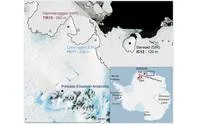
On the coast of Dronning Maud Land, two ice cores stand like two seismographs on one shore. One, FK17, was drilled on the crest of the Lokenryggen ice rise; the other, TIR18, on the crest of Hammaryggen. A hundred kilometers apart, they catch different tremors of the climate. One hears the Pacific, the other the Atlantic and Indian Oceans.
The ocean doesn't always stick to the same schedule. Sometimes the warm El Niño current strengthens, sometimes it weakens, and each regime dictates its own reaction speed to the past. These hidden regimes are like shifts in currents that remember their path with different depths.
In 1960, a meteorologist at a station in Peru records water temperature, while a farmer in India watches the sky waiting for the monsoon. There is no direct link between these two events, but months later one will echo in the other.
The ocean remembers its past. Heat given to the water off the coast of Norway does not vanish without a trace: it embarks on a long journey across the Atlantic, only to return decades later and alter the temperature at those same shores once again.
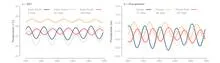
It takes eight years for a wave to circle Antarctica. It carries warmth and cold in turn, and sea ice advances and retreats with its crests. Previously, researchers caught this wave using different methods and saw either a propagating signal or a frozen dipole. Now it's clear: the dipole is just a snapshot of the wave when it stretches between two oceans.
The Paglia River behaves like a pendulum that resists being pushed. If a sudden influx of water pours in, the river does not keep gaining strength but quickly swings back to its usual level. This behavior is called antipersistence, and it was found in a twenty-two-year record of half-hourly discharge measurements near the Italian town of Orvieto.