Why Banana Disease Won't Give Up express
A banana plantation is covered in rusty streaks. This is black sigatoka — a fungus whose spores travel through the air like invisible pollen. It strikes the leaves, sapping the plant's strength. The farmer reduces the infection, but the disease suddenly returns, like a weed that was playing dead.
The mathematical model revealed a trap: infection can drop below one, yet the outbreak still smolders. So quarantine alone isn't enough. The calculations point to two levers — breeding resistant varieties and protecting young leaves during the rainy season. The model also accounted for random infection spikes (e.g., due to weather) by testing thousands of scenarios. The picture is clear: you can only beat the fungus by hitting it from both sides at once.
Original abstract
as written by the authors arXiv:2604.26060
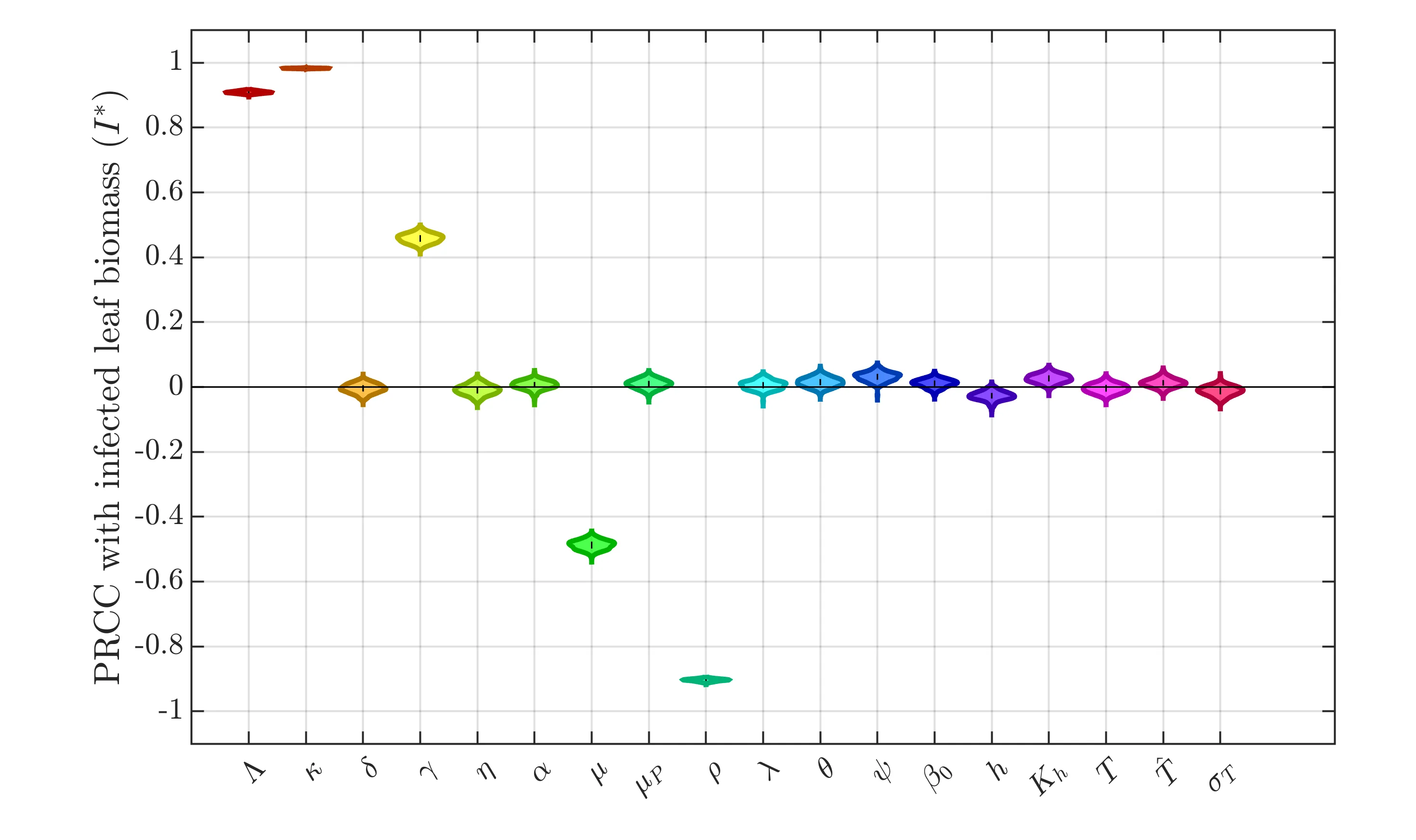
Black Sigatoka disease (BSD), also known as black leaf streak disease, is an airborne fungal infection caused by \textit{Pseudocercospora fijiensis} that severely impacts global banana and plantain production. Its persistence and resistance to eradication make it one of the most challenging plant diseases to manage. In this paper, we propose a deterministic pathogen-host model to describe BSD dynamics. Due to dual transmission pathways (ascospores and conidia) and mate limitation in sexual reproduction, the model exhibits a backward bifurcation: a stable endemic equilibrium coexists with the disease-free equilibrium for certain parameter values in which the basic reproduction number, $$\mathcal{R}_0$$, is less than 1. This phenomenon explains why control strategies that solely reduce $$\mathcal{R}_0$$ below one may fail. For the backward bifurcation regime, we perform sensitivity analysis of the endemic equilibrium using normalized forward sensitivity indices, Latin Hypercube Sampling, and Partial Rank Correlation Coefficients. Results indicate that effective control must extend beyond $$\mathcal{R}_0$$ reduction and prioritize (1) limiting production of new susceptible leaves during high-risk periods and (2) developing and deploying disease-resistant plant varieties. To incorporate transmission variability, we also formulate a stochastic version of the model using the Stochastic Simulation Algorithm (SSA). Extensive numerical simulations compare stochastic realizations with deterministic predictions and quantify variability in disease dynamics. To identify the principal drivers of persistence and variability, we analyze the endemic equilibrium using Sobol's variance-based sensitivity method, which highlights the role of nonlinear parameter interactions in shaping variability.
One square centimeter of an infected banana leaf can release up to 20,000 spores into the air in a single day — enough to infect an entire plantation.
In Geraldine Brooks's novel 'Year of Wonders', isolating a village doesn't save it from the plague — same with bananas: as long as there's one hidden hotspot, the disease bides its time.