Dynamical Systems math.DS

53 articles

Dynamics of differential equations and flows, mechanics, classical few-body problems, iterations, complex dynamics, delayed differential equations.

articles

Noise as Glue for a Broken Climate Vase
For thirty years, climatologists have been gathering the shards of a broken vase. Each climate model is its own shard, and they all promise different warming by 2100, from 1.5 to nearly 6 degrees. The spread does not shrink no matter how much the models are improved.
Climate as a Road Map: Bifurcations and Resonances of El Niño
The Pacific Ocean does not breathe evenly but in bursts. Every few years, its warm waters stir, and then Australia suffocates from drought while Peru is flooded with rain. This phenomenon is called El Niño, and it resembles a traveler wandering along an invisible road map.
Forecasting Without a Model: Nonparametric Prediction of Chaos and Climate
A translator learns not from a dictionary but from speech. They listen to native speakers and pick up rules that are written in no textbook. Similarly, a new method for forecasting complex systems such as climate or turbulence does not require knowing their equations. Instead, it looks at data and learns to predict their behavior.
Rhythm Thrown Off by Wind: How Noise Blurs Oscillations
A pendulum swings steadily until gusts of wind disturb it. Each push shifts the rhythm slightly, and soon the beats no longer match the metronome. Natural oscillators live the same way: the heart, populations, climate cycles—they all oscillate, but randomness constantly interferes.
The Pacific Pendulum: Why El Niño Erupts Once a Decade
The Pacific pendulum swings irregularly. Sometimes it barely trembles near the bottom, and sometimes it suddenly makes a giant sweep that disrupts weather across the planet. El Niño, the warm current in the equatorial Pacific, recurs every few years, but truly strong events happen once every 10–20 years, and until now no one could explain why they appear so irregularly.
How an Orchestra Falls Apart: Chenciner Bubbles in a Climate Model
The conductor of an orchestra gradually loses control of the tempo. First, the second violins fall slightly behind, then the cellos speed up, and soon every musician is playing in their own rhythm, even though a minute ago they all followed the same melody.
The Pendulum That Forgets How to Swing
In 2014, forecasters expected a strong El Niño, but it arrived only a year later. The ocean seemed to change its mind. Researchers studied a simple model of the tropical Pacific and found that the system has two distinct "personalities": one regularly generates powerful El Niños, while the other oscillates chaotically without them. This model resembles a pendulum that sometimes jumps to a different swing.
Relay of Chaos: How Warm Pacific Waters Make Weather Unpredictable
In the 1960s, meteorologist Edward Lorenz discovered that the air above our planet behaves like a crowd at a sale: the slightest nudge can change everything. His famous question about a butterfly in Brazil causing a tornado in Texas became a symbol of chaos in the atmosphere. But Lorenz only looked at the air. He left the ocean, which covers seven-tenths of the globe, out of the picture.
Ocean Memory Quenches El Niño Chaos
A warm current off the coast of South America shifts weather across the planet every few years. This is El Niño, and its behavior resembles a pendulum that sometimes swings too far. In 1986, meteorologist John Vallis described the process with three equations in which the ocean and atmosphere exchange heat and momentum.
Echo in the Ocean: How the Past Drives El Niño
A wave travels westward, reflects off the coast, and returns six months later to alter temperatures along the eastern Pacific. This journey of Rossby and Kelvin waves Mori-Zwanzig formalism turns into an equation with memory. Previously, climatologists added delays to El Niño models by intuition, relying on physical insight.
Noise Smooths the Devil's Staircase
The devil's staircase is what mathematicians call a graph that looks like steps leading upward, but the steps are infinitely thin and packed without gaps.
The Noise That Conducts the Ocean
Every few years, the Pacific Ocean rearranges itself: warm water from the east flows toward the coasts of South America, and weather goes haywire for six months. This is El Niño, and its arrivals cannot be predicted precisely, even though there is a rhythm to them. A model with 930 variables shows that noise is to blame—random gusts of wind acting like an invisible conductor.
Echoes in a Smaller Room: How to Hear the Signal in the Noise
In a large concert hall, sound bounces off the walls, and even if you stand in a corner, the echo can reveal the shape of the room. That is essentially the problem the authors tackle: how to recover a system's hidden rhythms from the 'echo' in data collected from only part of the system.
Echo in the Ocean: Why the Atlantic Breathes with a Sixty-Year Rhythm
The ocean remembers its past. Heat given to the water off the coast of Norway does not vanish without a trace: it embarks on a long journey across the Atlantic, only to return decades later and alter the temperature at those same shores once again.
Mapping Bifurcation Landscapes: How Numerical Continuation Reveals Hidden Mechanisms in Delay Systems
A cartographer charting a route through a mountain range notes not only peaks and valleys but also passes where the trail sharply changes direction.
Hidden Rhythms of El Niño: Chaos in the Delay
The ocean off Peru is not just warm: it pulses. Every few years, the winds die down, warm water creeps eastward, and fishermen are left empty-handed. This is El Niño, and its arrivals do not follow a simple schedule. Some researchers blamed random weather gusts, others sought chaos in the climate system itself.
El Niño in a New Light: Operator Spectroscopy of Climate
The ocean off the coast of Peru warms and cools, and with it the whole planet runs a fever: rains flood deserts, and tropical forests dry out. This is El Niño, the most noticeable climate oscillation after the changing seasons. For half a century, it has been described by a single number: the water temperature in a small square of ocean.
math.ST2022-06-272 minarXiv:2206.13659
A Translator That Never Loses the Meaning
A meteorologist stares at a pressure map, trying to figure out where the cyclone will go. They have a model, but it is flawed, and fresh measurements, but they are incomplete. Merging the two so that the forecast remains physically meaningful is harder than it seems: classical methods sometimes produce negative temperatures or impossible probabilities.
El Niño's Three Tempos: How the Ocean Plays with Three Hands
The ocean plays with three hands. One hand is fast: the surface temperature of the Pacific Ocean changes over weeks. Another hand is medium: the depth of the warm layer rearranges over months. The third hand is slow: the entire system tilts toward warm El Niño or cold La Niña, and that takes years.
Reservoir with a Correction: How to Predict Noisy Chaos
A translator who learns to correct their own slips works more accurately. In the world of forecasting noisy processes, a new method takes on this role: a reservoir computer that adds a random correction to its prediction at each step.
Points of No Return in El Niño: How Delay Breeds Climate Chaos
The Pacific Ocean remembers. Water warmed off the coast of Peru drifts slowly westward, and six months later its heat returns to South America. Scientists call this six-month journey the delay. It turns a simple climate model into a maze where the route depends not only on your current position but also on where you were half a year ago.
A Sieve for El Niño: How an Algorithm Finds the Minimal Model of a Fickle Climate
Every few years, a huge pool of warm water in the western Pacific Ocean shifts eastward, like water in a bathtub when you tilt it sharply to one side. That is El Niño. But each tilt is different: sometimes the water sloshes against the shores of Peru, sometimes it stalls in the middle, sometimes it pours out in a powerful surge, and sometimes it barely creeps.
Trees Predict Chaos Without Tuning
An orchestra without a conductor: the musicians take their seats, tune their instruments, and begin to play in harmony because each one hears the common rhythm. That is how TreeDOX works, a method that predicts chaotic time series without requiring the user to choose parameters or fine-tune anything.
Multi-Day Rainstorms: How Dynamics Teaches Statistics to Keep Its Story Straight
In February 2022, the eastern coast of Australia was hit by rains that lasted several days in a row. Water inundated towns in Queensland and New South Wales, insurers paid out 3.35 billion dollars, and the flood became the costliest in the country's history.
The interpreter that learned chaos's dialect
An interpreter at a conference hears the noise of the hall but keeps translating. They don't repeat every word; instead, they find an intermediate language where complex phrases become simple, yet meaning is preserved.
A Bridge Between Ocean and Atmosphere Rhythms
The tropical Pacific breathes in two rhythms. One lasts several years: the water off the coast of Peru warms and cools, which fishermen call El Niño. The second rhythm is fast: every month or two, a giant cloud wave is born over the warm waters of the Indian and Pacific Oceans, creeping eastward at a runner's pace and dying out near South America.
Four Notes of the Ocean: Squeezing an El Niño Model into Your Pocket
The Pacific Ocean, ten thousand kilometers wide, breathes: warm water shifts eastward, cold water retreats, and this in-and-out repeats every few years. A model that captures this breathing takes weeks of computation even on a supercomputer.
Ulam's Billiard: Classical vs. Quantum
In 1961, Stanislaw Ulam proposed a simple model: a particle bounces between a fixed wall and a wall that oscillates according to a piecewise-linear law. It seemed like just another billiard. But behind this simplicity lay a question that troubled physicists for decades: can the particle accelerate to infinity? The answer turned out to be paradoxical. In the classical version, almost never.
How to Predict Chaos When Everything Is Noisy
Imagine a translator in a noisy hall, trying to catch a speech through the buzz of voices. The usual approach is to memorize a set of phrases and slot them into templates. But when the noise cranks up, the template falls apart.
A Bridge Between Typhoon and Current: How El Niño Is Born
The tropical Pacific Ocean lives in two rhythms. The first is fast: a wave of thunderstorms born over the Indian Ocean races eastward and dies out off the coast of the Americas within a month or two. The second is slow: every few years, the ocean surface warms enough to alter weather across the entire planet. That is El Niño. Between these rhythms lies a bridge, and building it took climatologists decades.
A Switchback Pendulum: How Seasons Drive El Niño
Imagine a pendulum that is pushed in time with the seasons: harder in winter, softer in summer. But this pendulum has a quirk: a switch that operates with a delay. When the pendulum passes through zero, the switch clicks and changes the direction of the push. That is exactly how the simplified El Niño model built by mathematicians works.
Chaotic Dynamics2026-02-072 minarXiv:2602.07660express
How to Tell Chaos from Order by a Particle's Trail
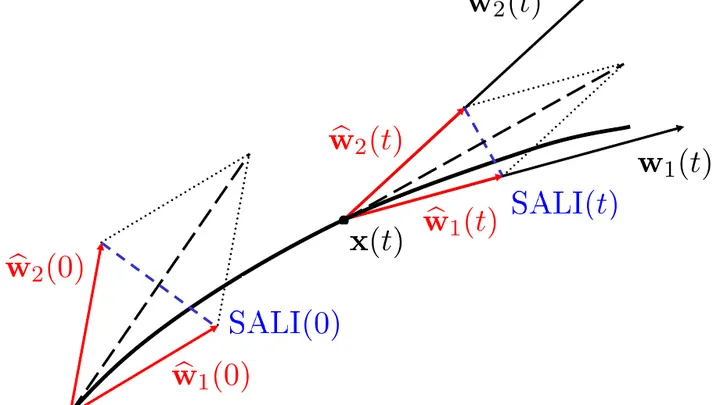
Drop a stone into a calm pond — the ripples spread evenly. Drop it into a churning stream — the water swirls unpredictably. Scientists have long wrestled with a similar question: how can you tell from a single particle's path whether its motion is chaotic? Previously, this meant comparing the particle's path with neighboring ones, which is complicated and time-consuming.
Dynamical Systems2026-02-281 minarXiv:2603.00709express
How to Pick the Best Model Without Reading Tea Leaves
To understand a mechanism, you have to poke it. A child taking apart an alarm clock doesn't just stare at the gears: they turn the wheel and listen to how the ticking changes. Scientists do the same: instead of passive observation, they feed specially chosen signals into the system and watch the response.
Chaotic Dynamics2026-03-142 minarXiv:2603.13789express
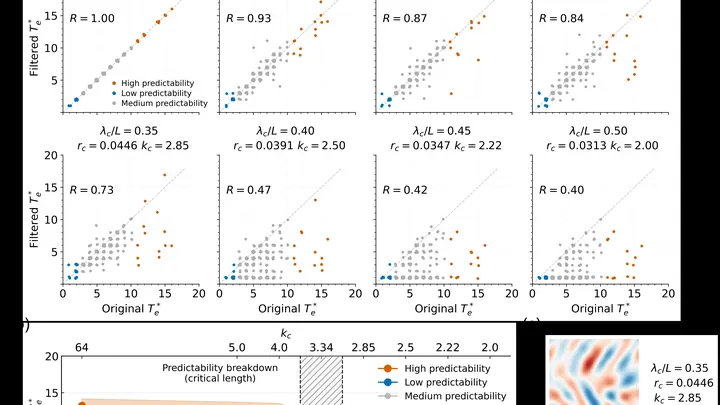
Why Some Vortices Are Predictable and Others Aren't
In a turbulent flow, like a raging river, energy constantly cascades from large whirlpools to small ones. Occasionally, particularly powerful bursts occur, resembling sudden waves crashing against the shore. Scientists asked: can we know in advance when such a "wave" will strike? It turns out the answer depends on which vortices are present in the flow at that moment.
Fluid Dynamics2026-03-141 minarXiv:2603.13996express
How Flow in a Reactor Splits into Islands
When you stir sugar into a glass, the water seems to move every which way. But inside a chemical reactor with an impeller, the liquid isn't just churning: it forms hidden "islands" that barely exchange their contents. Scientists found a way to see these islands by following the paths of tiny particles.
Medical Physics2026-03-152 minarXiv:2603.14562express
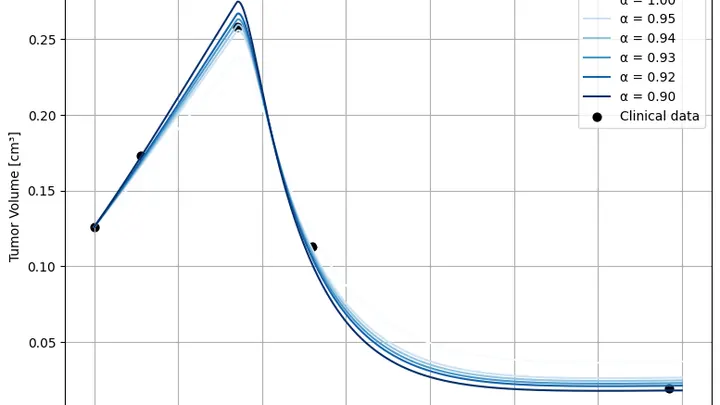
Tumor Memory: How Fractional Order Changes the Prognosis
A tumor doesn't grow like a tree; it grows like a city: today's skyline is shaped by yesterday's construction and the fires of the day before. Standard tumor growth equations don't account for this: they only look at the current moment, as if the city were rebuilt from scratch every day. The authors added "memory" to the model: now the equation remembers what came before, and that changes the forecast.
Instrumentation2026-03-172 minarXiv:2603.16982express
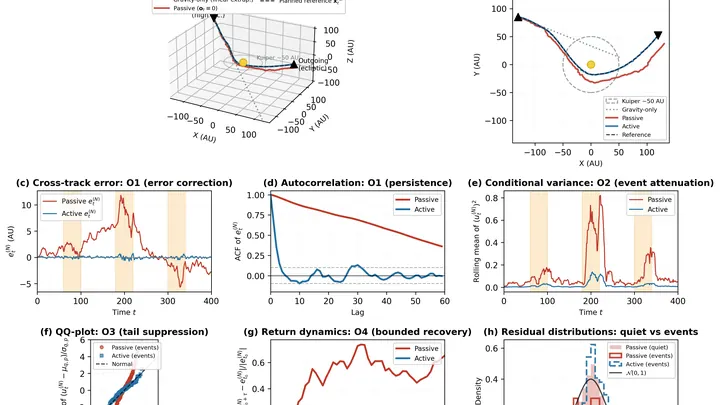
A Spaceship Made from a Comet
A comet hurtling through space is a mountain of ice and dust that carries itself across the Solar System. If you mount small engines on such a mountain, it becomes a ship with its own fuel: gas from the interior can be vented through nozzles to change course.
Dynamical Systems2026-04-111 minarXiv:2604.10225express
Which Phases of Matter Are Real, and Which Are a Mirage
Water can be ice, liquid, or steam. Physicists call these states phases. In theory, each phase has its own measure — a way to describe how likely it is. But not every measure you can imagine occurs in nature. Some phases are real, while others are just mathematical illusions. Scientists have found a simple criterion that separates reality from mirage.
Fingerprints of Chaos: How Trajectory Geometry Reveals the Moment of a Regime Shift
The heart beats steadily, then slips into arrhythmia. The climate holds its familiar rhythm for decades, then shifts to a new state over a single summer. Such regime shifts are like a flick of a switch, but in real data we see only a noisy one-dimensional signal in which the moment of the break is hidden.
Dynamical Systems2026-04-192 minarXiv:2604.17528express
Five Faces of the Same Randomness
In a big city after rain, water collects in the same low spots no matter where the first drops fall. An hour later, the pattern of puddles hardly depends on where the downpour started. That is equilibrium — the outcome a system reaches regardless of its start, once the details are forgotten.