Antibiotic resistance is the ability of bacteria and other microorganisms to survive and grow in the presence of antibiotics that would normally kill them or inhibit their growth. This resistance can be intrinsic or acquired, and it is a major global health concern because it makes infections harder to treat, leading to longer illnesses, higher medical costs, and increased mortality. The spread of resistance genes, often carried on plasmids, can occur between different bacterial species, accelerating the problem.
History
The phenomenon was recognized soon after the introduction of penicillin in the 1940s, with the first reports of resistant strains appearing in the 1950s. The term 'antibiotic resistance' became widely used as the problem grew.
How it works
Resistance mechanisms include enzymatic inactivation of the antibiotic, alteration of the drug's target site, reduced permeability of the cell membrane, and active efflux pumps that expel the drug. Plasmids are small, circular DNA molecules that can replicate independently and be transferred between bacteria via conjugation, transformation, or transduction. They often carry multiple resistance genes, allowing bacteria to become resistant to several antibiotics at once.
In practice
Understanding resistance is essential for developing new antibiotics, designing combination therapies, and implementing stewardship programs to preserve the effectiveness of existing drugs.
Fun fact
Some bacteria can become resistant to antibiotics by acquiring genes from completely unrelated species, even from bacteria that produce the antibiotics themselves.
A crowd of pedestrians in a square moves chaotically: each person goes their own way, occasionally bumping into others. If every third person in that crowd wears a protective suit that blocks the pathogen, the rhythm of disease spread changes abruptly. That is exactly the scenario scientists reproduced by simulating 3000 self-propelled particles that repel each other and become infected upon close contact.
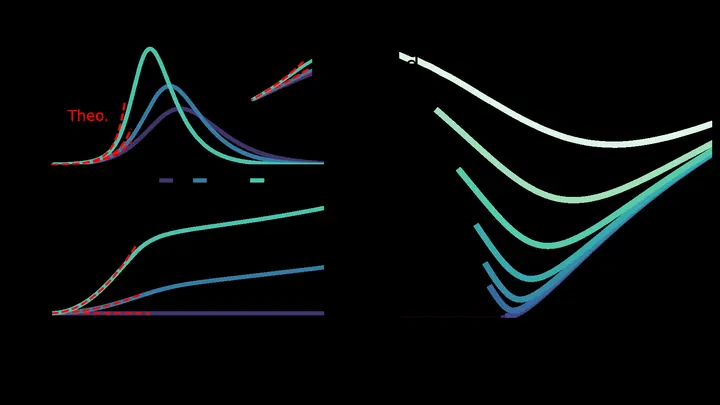
A bacterium hit with a dose of ampicillin behaves like a runner pushed to the limit: first it gasps out acid, then falls out of rhythm. Scientists measured this breakdown with sensors thinner than a human hair: they detect pH changes right at the bacterial surface.
Ampicillin doesn't just break the bacterial wall.
A bacterium hit with a dose of ampicillin behaves like a runner pushed to the limit: first it gasps out acid, then falls out of rhythm. Scientists measured this breakdown with sensors thinner than a human hair: they detect pH changes right at the bacterial surface.
Ampicillin doesn't just break the bacterial wall.
Every winter, hospitals fill up, and by summer they seem to empty. Epidemics breathe like the tide. But why do waves of disease keep rolling in, even without new mutations? Mathematicians found an answer in a tug-of-war between two strains.
Within a single epidemic, two virus variants often coexist.
When an antibody meets a virus, it doesn't latch on with a single death grip. Rather, it's like two bunches of grapes tumbling in water, catching each other with dozens of short tendrils. Each tendril is weak on its own, easily torn by the thermal jitter of water molecules, but together they hold tight.
Ordinary models assume that infection is like a steady flow of water that washes over everyone equally. In reality, the stream from a sick person fluctuates: right after infection it barely trickles, then turns into a raging downpour, and later subsides. The chance of catching the virus depends on the strength of this flow at the moment of contact.
In the web of life, predators and prey exchange carbon and water, and each act of eating slightly increases the universe's disorder. But the intrusion of disease turns this system into a giant seesaw. When a mid-level predator gets sick, its hunting abilities decline, and it becomes easy prey.
Imagine a packed subway car at rush hour. Passengers don't just stand there: they breathe, release moisture, squeeze toward exits, and sometimes get stuck in doors, blocking movement. Now imagine these passengers can remodel the car's walls, add handrails, or turn the floor into gel.
A runner loses on both a smooth track and sticky sand. Seems hopeless. But if the surface underfoot starts changing every few seconds (track, then sand) the runner suddenly stops falling behind. He doesn't get faster; the environment just doesn't get a chance to 'crush' his weakness.
That's exactly what the authors found when studying a simple predator–prey model.
In the freshwater lakes, cyanobacteria Microcystis often cause toxic blooms. They gather into colonies — elastic little spheres, like dense jelly. The cells are glued together by a special substance based on carbon, acting as a powerful natural adhesive. Scientists tested these "jelly balls" for the first time and found their strength astonishing.
A crowd in a city square behaves differently depending on whether people hold hands. If each person only lightly touches a neighbor's elbow, people easily spread out in all directions — the crowd expands as a smooth carpet. But if they interlock fingers, movement slows down and the crowd breaks into clumps: dense clusters form here and there, with empty corridors between them.
A banana plantation is covered in rusty streaks. This is black sigatoka — a fungus whose spores travel through the air like invisible pollen. It strikes the leaves, sapping the plant's strength. The farmer reduces the infection, but the disease suddenly returns, like a weed that was playing dead.
The fungus has two ways to reproduce.
An ordinary phone battery breathes — not with air, but with contact. Inside a solid body, where there are no liquids, lithium presses against the electrolyte (the ion-conducting substance) during charging and pulls away during discharging, like a lung on inhale and exhale. This 'breathing' is not poetry but physics: each cycle creates and destroys the contact points through which current flows.
The microbial community in the gut is like an orchestra: what matters is not only the musicians but how they play together. When disease strikes, it's not just the lineup of microbes that changes: their interconnections shift too. Researchers built interaction networks of microbial genes in healthy and sick individuals.
A pot of water sits on the stove. The temperature drops: plus one degree, zero, minus one — the water stays liquid. But at some point, a light breath is enough to make the whole mass instantly freeze into ice. Physicists call such jumps first-order phase transitions.
Yeast are trapped in a clear gel, like raisins in jelly. They can't move on their own, but soon they start rising to the top. The secret lies in their own homemade fizz.
During fermentation, yeast release carbon dioxide. In a thick medium, the gas doesn't escape but accumulates until bubbles form.
An epidemic is like a fire in a dry forest: a spark flares up, the flames leap from tree to tree, and within a week the whole area is burning. A hundred years ago, scientists devised a simple mathematical model for such a fire: they divided people into those who had not yet fallen ill, those who were ill, and those who had already recovered.
In a thin film of water squeezed between two glass plates, bacteria live. Oxygen reaches them only through one wall, like air entering a room through a single window. When bacteria are few, they pay no attention to this: some stick to one wall, some to the other, and the picture is symmetric. But once they multiply, everything changes.
Schrödinger's cat, according to quantum rules, can be both alive and dead at once. But a table can't pull that off. When a massive object tries to be in two places, its mass curves spacetime so drastically that instead of two points, a single deep depression forms, and the object rolls into it.
Bacteria don't just crawl across a surface: they collectively decide what shape their colony will take. Picture a crowd moving across a square: each person steps on their own, but together they form a flow. Bacteria are the same: each moves individually, but together they create patterns of branching trails.
Scientists took Enterobacter sp.
Two species of bacteria share a single Petri dish. Both eat the same food, and by all rules, one should outcompete the other. But in reality, they often live together for years. The secret lies in knowing when to leave.
Bacteria don't stay put. When a stranger appears nearby, they start moving faster.
A drop of oil in water behaves like a tiny ball: it seeks the spot with the least energy. If a wall is nearby, the drop often sticks to it, just as a raindrop spreads on glass. In a mixture of two immiscible liquids, such as polyethylene glycol and dextran, tiny droplets of one liquid form inside the other.