Mini

Invisible Drums: How Gravitational Waves Give Birth to Black Holes

Original: "Primordial Black Hole from Tensor-induced Density Fluctuation: First-order Phase Transitions and Domain Walls"
· Utkarsh Kumar, Anish Ghoshal
Gravitational waves from phase transitions themselves carve inhomogeneities out of space — and these collapse into black holes, potentially making up all of dark matter.
Links in the knowledge graph 1

In the first moments after the Big Bang, the universe simmered like a giant cauldron, shifting through phases. Each transition sent out gravitational waves — a drum roll across the fabric of spacetime. These waves, like sound painting patterns on sand, themselves created clumps that collapsed into black holes. Perhaps dark matter is just invisible black holes, born from the beat of cosmic drums. Future gravitational-wave observatories will hear this melody.

🎯 Primordial black holes of asteroid mass (about 10⁻¹⁵ M⊙) are comparable in size to an atomic nucleus but weigh as much as a small mountain, and their Hawking evaporation makes them practically invisible to modern instruments.

🎬 The idea that a new universe could hide inside a black hole resonates with Lovecraftian horror 'The Shadow Out of Time' and Stephen Baxter's novels, where black holes serve as gateways to other worlds.

M_{\rm PBH} \approx 10^{-6} M_{\rm eq} \left(\frac{T_{\rm eq}}{T_\star}\right)^2
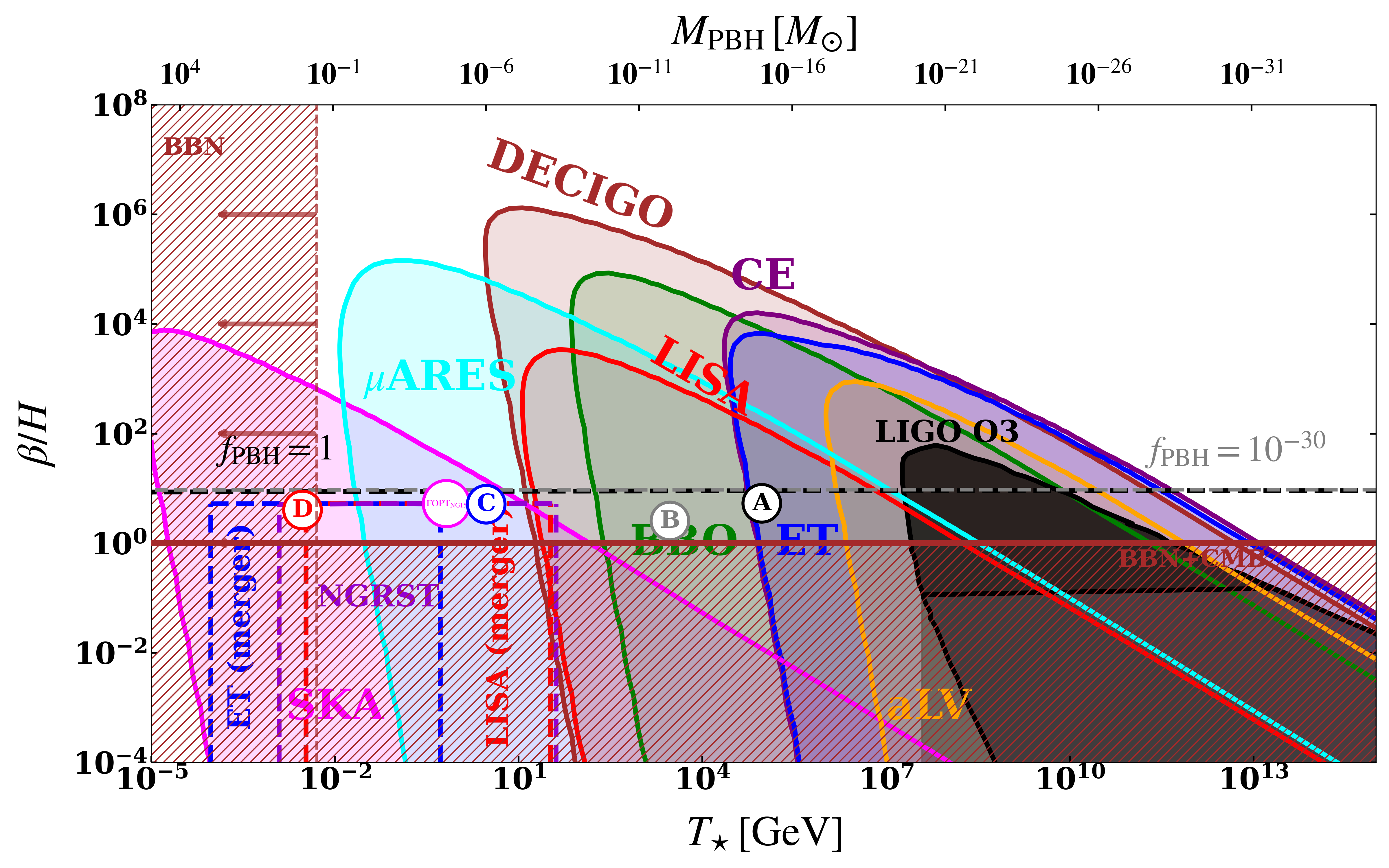
Here M_eq ≈ 3×10¹⁷ M⊙ is the horizon mass at matter-radiation equality, T_eq ≈ 0.8 eV is the temperature at that epoch, and T_⋆ is the phase transition temperature. The formula shows how the hole's mass decreases as the transition temperature rises.
f_{\rm PBH} \propto T_\star
Numerical simulations confirm a direct proportionality between the abundance of primordial black holes and the phase transition temperature, simplifying the connection to observable parameters and making the model's predictions robust.
Scientists
Alan GuthAndrei LindeGeorges LemaîtreJames PeeblesAdam RiessBrian Schmidt
Tags
black hole dark matter gravitational waves spacetime curvature cosmic microwave background expansion of the universe big bang redshift
Laws
Friedmann equationsHubble's lawHawking radiationgravitational lensingBekenstein-Hawking entropyEinstein field equations
Original: arXiv:2605.15197v1 · CC BY · bridge42worlds