Theoretical particle physics and its interrelation with experiment: prediction of particle physics observables, effective field theories, calculation techniques, analysis of theory through experimental results.
In the US, the SoLID detector is being prepared for launch — a device that will peer inside protons and neutrons, creating 3D snapshots of their structure. It will study how the energy gluing particles together gives rise to almost all mass in matter. Additionally, SoLID will hunt for new particles
Researchers found that if Higgs particle collisions are required to always produce maximally entangled states, the Higgs potential automatically extends its global symmetry. This leads to an exact symmetry U(2)×U(2), spontaneously broken to U(1)×U(1), giving rise to six massless Goldstone bosons. A
Scientists have created the IAFormer neural network to analyze particle collisions. Instead of calculating all possible connections, it focuses only on the important ones — like an experienced chef who ignores unnecessary utensils. This speeds up data processing by tens of times without reducing acc
Particle collisions are usually chaotic due to their internal entanglements. But if you remove these entanglements, an elegant symmetry emerges, simplifying the description of the microworld. The discovery builds on ideas from quantum information science.
The Grand Unified Theory SO(10) allows describing the masses of all matter particles — from electron to top quark — with a single relation. New calculations accurately reproduce observed values and predict the existence of super-heavy neutrinos, which could be dark matter. This approach brings us cl
Physicists have turned a dust grain levitating in a vacuum into a detector capable of feeling the faint bump from a passing dark matter particle. The hunt for this mysterious substance that binds galaxies together has reached a new level: they've set record limits on its interaction with ordinary ma
The universe is expanding, but measurements of its speed give conflicting numbers. This puzzle is called the Hubble tension. A new model suggests that in the early universe, a phase transition occurred in a hidden dark sector. It’s like the sudden freezing of supercooled water: a burst of energy was
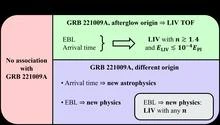
The brightest gamma-ray burst GRB 221009A produced a photon with the energy of a flying mosquito. It arrived an hour and a half late and didn't scatter on background light, although physics laws demand otherwise. Perhaps the speed of light changes with energy.
Physicists have found that in the extreme gravity of neutron stars and black holes, a Bose–Einstein condensate emerges — a quantum state where particles merge into a single whole, like droplets of mercury. If dark matter consists of ultra-light axions, it naturally turns into a cosmic glue that keep
Scientists have found a mechanism for the birth of primordial black holes from magnetic vortices in the early Universe. These invisible objects may make up dark matter, and their formation created gravitational waves detectable by future detectors.
Black holes are not always perfectly rigid. Under the influence of a field of matter particles (such as electrons), they bend, although it was previously thought that weak influences couldn't deform them. Ordinary fields, like light or gravity, leave them unperturbed, but matter does not.
Muon pairs are born with strictly linked properties. It turns out the link holds even if one particle disintegrates before the other is measured. Our observations aren't a snapshot of reality, just a handy tool.
Physicists have proposed a way to test the hypothesis of a fifth dimension the size of a bacterium. If right-handed neutrinos live in it, then by measuring the energy of electrons in KATRIN, we will see sharp steps — one or more. Their number and position will reveal the properties of the hidden wor
Using a simulation, scientists studied how the force strings connecting quarks break. The rupture turned out to be more complex: entire families of particles are born, and in a dense environment the process slows down. This discovery will help understand the microworld and can be tested on special d
Two cosmic mysteries—the excess of radio waves in the sky (ARCADE2) and the anomalously weak signal from the earliest hydrogen (EDGES)—have received a common explanation. The culprit could be axions, ultralight dark matter particles. In primordial magnetic fields, axions turn into radio waves, creat
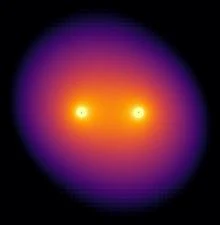
Simulations show that a cloud of dark matter around two stars takes the shape of a molecule. The elongated orbits of the stars knock particles out of the cloud, causing their trajectories to round out. This process could leave a noticeable imprint in the gravitational-wave background, helping to rev
By analyzing the final 'plunge' of matter, scientists search for spectral signatures of impostors. The fakes produce a ringing: a comb of resonances at low frequencies and a sharp cutoff at high ones. Stacking signals from many events lets them hear even the quietest notes.
Scientists have created a detector that catches axions—candidates for dark matter. The device, made of layered material in a magnetic field, turns axions into light particles. Resonance, like that of a musical instrument, amplifies the faint signal, and tilting instead of moving parts lets you tune
New theoretical research reveals how the weak interaction—normally imperceptible—gets massively amplified during crystal growth. The amplification depends on a critical number of atoms in the seed of the new phase. This mechanism might have played a decisive role in the early universe, turning a mic
Analysis of years-long records of Earth's magnetic field has set the tightest limits on dark photons — dark matter particle candidates. Using the ionosphere as a giant resonator, scientists amplified faint magnetic fluctuations hundreds of times, but no direct signal has been found yet.
In particle theory, there’s a puzzling phenomenon that usually calls for a new particle. But the authors found that this role falls to ordinary hydrogen and antihydrogen, forming a special combination. The discovery brings the atomic world and fundamental forces closer together.
Like a stadium emptying, a fluorescent dye dims quickly, then slows to a trickle. The lingering glow isn't uniform: its pace depends on which color you watch. This quantum oddity reveals hidden exit routes for escaping light.
After neutron stars merge, a ringing clump of ultra-dense matter remains. Analyzing how fast this gravitational chiming fades relative to the spin-down rate allows, for the first time, measurement of matter’s elasticity in the interior, where densities are 5–6 times nuclear. Paradoxically, it can be
Scientists have theoretically demonstrated that the information accumulated by a black hole (its “memory burden”) affects its oscillations under external perturbations. Two black holes of identical mass but with different information loads emit different gravitational wave spectra. This discovery pr
ArgoLOOM is an AI-based program that builds a bridge between calculations from cosmology, particle physics, and nuclear science. It combines different computational methods into a single platform, enabling scientists to construct a unified picture of fundamental forces. Early tests suggest that this
Simulations show that if dark matter could clump, its lumps would explain perturbations in the stellar stream GD-1, the mysterious object from the gravitational lens, and the origin of the Fornax 6 cluster.
Physicists simulated a collision of charged particles. Contrary to expectations, instead of chaos, a plasma emerged, expanding as a shock wave and retaining memory of the initial charge clumps. The reason — plasma oscillations akin to a pendulum. This discovery helps understand matter under extreme
When particle rays collide in space, they can create microscopic black holes that instantly evaporate into a stream of neutrinos. Already, by studying neutrinos from a distant galaxy, scientists have tested energy limits where gravity changes the rules. Upcoming observatories will search even deeper
Scientists have proposed a model where the universe didn’t explode from a point but first contracted and then bounced. Quantum effects during the bounce smooth out any distortions, making space uniform and the same in all directions. This is a natural explanation for the cosmos’s smoothness, requiri
An electric dipole moment has been spotted in the tantalum nucleus — like a spinning top’s center of mass suddenly shifting. This imbalance, measured with record precision, sheds light on the mystery of missing antimatter and aids the hunt for dark matter.
By turning Earth into a gravitational lens, scientists found a way to focus dark matter particles into a single point. There, a laser makes them instantly convert into light, which is then caught by detectors. The method promises to detect even ultralight particles from thousands of light-years away
As it fades, the electromagnetic field leaves a permanent record in the quantum state of particles — like a photograph capturing a moment. Using gravity, physicists have learned to take such 'snapshots' inside a falling conductor and develop them with a superconductor. A tabletop experiment will for
Dark stars, shining from collisions of dark matter particles, became the progenitors of the largest black holes in the Universe. They grew to millions of solar masses, then collapsed, leaving behind seeds for future giants.
JWST data on massive galaxies at the dawn of time threatened to overturn dark matter theory. But new work shows the reason: systematic errors when converting brightness to mass. With those accounted for, 'impossible' galaxies vanish.
Clouds of ultra-light particles turn black holes into gravitational atoms. New calculations show that after black hole mergers, such clouds noticeably change their ring, which can be detected by gravitational wave detectors.
Physicists have built a model where the number of dimensions isn't fixed but a quantum property that changes with heat. This approach could shed new light on black holes and the behavior of materials.
An excess of particles with energies at which they should have disappeared was detected in gamma-ray burst GRB 221009A. Probably, at such energies, the speed of light is slightly higher, which suppresses their absorption. This violation of Lorentz symmetry may open the way to a quantum theory of gra
Astrophysicists have shown that hypothetical boson stars—clumps of the lightest particles—can act as gravitational lenses with their own rhythm. The breathing lens oscillates its focus, and any light source caught in it begins to blink rhythmically. This can be tested with modern telescopes, offerin
Physicists have proposed a hypothesis: once, dark matter particles paired up and abruptly cooled, like vapor turning into ice. This scenario explains the coldness of modern matter and predicts a distinct pattern that can be compared with the afterglow map of the Big Bang and the panorama of galaxies
Scientists have built a dark matter detector out of sponge-like porous crystals. When an invisible particle flies into such a sponge, it creates a twisted sound wave with magnetic properties. This faint signal is picked up by a built-in magnetic sensor. A nice surprise: the sensitivity barely depend
The collapse of boson stars triggers the formation of true vacuum bubbles that expand at light speed, altering the properties of all space. This new mechanism shows that even a stable vacuum is vulnerable to astrophysical catastrophes.
Physicists have revisited the idea of neutrino superradiance—a laser-like effect where these ghost particles escape not randomly but in a coordinated stream. For a long time, atomic noise was thought to prevent this. New work shows how to tweak a cold atomic cloud to make the collective effect emerg
Observations show that dark energy in the early Universe behaved unusually, as if gaining strength. The KMIX model explains this as a visual trick, eliminating the 'Big Rip' scenario. A fast machine learning method helped compare the theory with data — and the result is encouraging.
The muon's magnetic strength slightly exceeds predictions. MUonE will probe if the vacuum's own churning is to blame — and whether unknown particles lurk within.
Invisible dark matter could have fueled the first stars. As its particles collided, they released heat and ignited giant luminaries that later collapsed into black holes. Calculations show their collective gamma-ray glow should be noticeable, opening a new way to hunt for dark matter.
The equivalence principle states: all objects fall at the same rate because the mass that creates gravity equals the mass that resists acceleration. To test this at the quantum level, scientists place weights in a state where their mass is as if blurred. Supersensitive torsion balances capture not o
New research shows that tiny black holes don't explode; instead, like a cooling kettle, their own radiation creates a 'blanket' and slows the process. This heat should have warmed ancient hydrogen, altering its 21-cm radio signal. But observations say the signal is colder. So black holes can't be da
A fraction of a second after the Big Bang, the entire cosmos resembled a fizzy drink: bubbles of new vacuum swelled and rapidly expanded everywhere. Their collisions, racing to nearly the speed of light, unleashed energy that no laboratory device can achieve. In this cosmic crucible, super-heavy par
In the hot early Universe, much like bubbles in boiling water, regions of a new state of space emerged. Some of them possessed an enormous number of microscopic states, rendering them quantum-entangled. The merger of such bubbles generates gravitational waves that carry information about their quant
The first stage of ALPS II, a setup to search for axions—dark matter candidates—has concluded at DESY. No particles were detected, but the instrument's sensitivity proved 20 times better than previous records. The system is now being upgraded to boost accuracy another 100-fold.
A network of quantum detectors, working as a single organism, catches elusive dark matter. The collective effect yields supersensitivity and noise resilience. Along the way, the system also detects gravitational waves.
Solar neutrinos change their type on the way to Earth — theory predicted this, but directly observing the transition has been elusive due to background noise. A new filtering method in the JUNO detector will make it possible to see this process for the first time, strengthening our current picture o
In a five-dimensional space, gravity behaves differently, and a tiny cloud of dark matter inside a neutron star can compress it into a black hole. The hole grows, devouring the star, thereby ruling out many possible compositions of dark matter.
The expansion rate of the Universe — the Hubble constant — is key to the age and fate of the cosmos. The 'peak siren' method compared distances from galaxy light and gravitational waves. A match was found with 5.9 sigma confidence: H₀ = 67 km/s/Mpc. This is a new way to measure without relying on tr
Physicists have produced a directed stream of muonium — an atom where the nucleus is replaced by an antimuon, while the electron remains ordinary. Superfluid helium allowed them to achieve nearly identical velocities for all particles, paving the way for wave experiments and precise measurement of g
A new hypothesis: dark matter acted like a sound amplifier. Its rhythmic oscillations, like microphone feedback on stage, turned faint magnetic seeds into the fields that shrouded galaxies. This explains the origin of cosmic magnetism without exotic additions.
The Sun’s gravity creates an invisible funnel where dark matter particles not only accumulate but occupy strictly defined energy levels — like electrons in an atom. It turns out that over long observations, some of this matter regains wave synchrony, greatly amplifying the potential signal in detect
The stretching cosmos can conjure particles from nothing. But new simulations find that if those particles tug on each other, they slam the door on further creation—challenging the idea that more expansion means more particles. The early universe may have been far less crowded than we thought.
In the first moments after the Big Bang, the universe boiled, spawning bubbles of a new reality. Their collisions accelerated particles more powerfully than any collider. This is how super-heavy neutrinos were born – particles that explain both dark matter and the mysterious excess of matter, and th
Scientists turned quantum qubits into dark matter hunters. Invisible particles, nudging electrons in a qubit, cause a jitter like a snapped note on a string. Analyzing this jitter yielded record constraints on dark matter properties.
A new type of detector uses a membrane inside an optical cavity to search for two substances at once: gravitational waves and dark matter. Light pressure stretches the membrane, and six such membranes cover frequencies from 0.5 to 40 kHz — from a low hum to a high squeak. Sensitivity to spacetime ri
In a neutron star, matter is compressed to the limit. But even that limit has a limit: physicists have calculated that the ratio of pressure to energy density never exceeds 0.385. This law holds for any ultra-dense matter in the universe.
Scientists have shown how sterile neutrinos were born in the hot young Universe. This explains why we don't see their X-ray glow and turns dark matter into a tool for measuring the temperature of the early cosmos.
In the early universe, giant black holes were born at a dizzying pace. The key lies in a dance of invisible fields: the trembling of the axion field and dark photons created vortex mixers that prevented matter clouds from fragmenting and whisked away their spin. Thus, quantum crumbs sculpted the see
Cosmology saw neutrinos as lighter than fluff, while lab experiments demanded noticeable weight. Decay into light invisibles resolves the conflict: some of the mass simply vanishes over time. Ordinary neutrinos, however, aren't fit for such a trick.
Physicists are hunting axions—light particles that might make up dark matter. They built a device with a levitating magnetized rod that should tremble if axions fly through it. In a new experiment, the rod stayed still, but the scientists set record constraints on how strongly axions interact with o
Scientists have proposed that dark energy affects the mass of dark matter particles. This energy exchange accurately reproduces the observed expansion of the Universe and alters the growth of galaxy clusters by 10% — a difference that new telescopes will test. If the connection is confirmed, our und
Dark matter may consist of invisible particles that clump into clouds. Once such a cloud finds itself in a magnetic field, it lights up with ordinary light — like a firefly in the night. This effect offers a new way to detect the mysterious substance that makes up 85% of the Universe.
Cosmic 'boiling' in the early universe spawned bubbles of new vacuum and gravitational waves. Previous calculations of these waves were flawed due to their dependence on the frame of reference. A new method, borrowed from neutrino physics, eliminates this arbitrariness and promises a clearer picture
Scientists have shown that atom-sized black holes might be dark matter. With their gravity, they rip apart hydrogen atoms, leaving flashes. These traces can be found in ancient radio waves and chemical anomalies — that's how the invisible mass will be discovered.
Scientists have built a model where dark energy loses its push. Instead of a shredding tear or a crunch into a point, the Universe’s expansion smoothly tapers off. The end result — a flat, table-smooth, empty space. Observations back this up.
Scientists have long debated: is dark energy constant or does it change? Fresh measurements point to a third path — it is conversing with dark matter. This turns a lone cosmic force into a duet of invisible interlocutors.
After rapid expansion (inflation), spacetime quickly restructures, triggering instability in the dark matter field. This kicks off an avalanche of particle creation — a purely gravitational mechanism. Calculations and computer simulations confirm that this can explain the observed density of dark ma
Like a fussy chef, dark matter can only 'cook' the Universe using certain particles. New work shows how strongly it prefers quarks (the building blocks of atomic nuclei) over leptons (electrons and their kin). Using the idea of culinary symmetries and their violations, scientists estimated how far o
Physicists measured with unprecedented precision how the glow colors of different ytterbium isotopes differ. They compared these atomic 'voices' using a King plot—a tool for hunting unknown forces. It turned out that the anomaly previously thought to be a hint of a fifth force was due to inaccurate
In the first moments after the Big Bang, the Universe expanded at an enormous speed. If the expansion briefly paused, it generated powerful gravitational waves. Future detectors on Earth will be able to catch them, opening a window into an era hidden from any telescopes.
Some theories suggest dark matter interacts with ordinary matter in a special way. If this interaction is strong enough, Earth's atmosphere acts as a shield, limiting the signal in labs. Orbital experiments, like those with quantum clocks, could detect changes in fundamental constants caused by dark
Scientists have found a new explanation for why measurements of the universe's expansion rate don't match: a tiny fraction of information may be 'erased' from its visible edge. This shortage creates extra energy that slightly accelerates expansion in the last few billion years, without affecting the
The universe is expanding, but two measurement methods give different speeds—this puzzle was called the Hubble tension. Scientists have proposed a model in which dark matter and dark energy are not strangers but interact, like dance partners. This simple assumption smooths out the contradiction. Tes
Physicists have devised a way to spot the elusive T-quark, the top quark's heavy twin. To do this, they smash protons into muons (the electron's heavier cousins). The debris is then sifted by neural networks searching for decay signatures. This approach is far faster than current methods and promise
New research shows that small temperature fluctuations acted like well-timed pushes on a swing, amplifying the production of axions many times over. As a result, the likely mass of dark matter particles shifts into a region where they haven't been searched for yet. This changes the search strategy.
Superradiance is when billions of atoms, like musicians, simultaneously emit light, creating a flash brighter than a star. Astrophysicists believe that in interstellar space, especially near the center of our Galaxy, hydrogen and positronium stage these natural 'concerts'. This discovery promises a
Tiny black holes, born in ever-expanding pockets of the universe, may make up all dark matter. This scenario not only explains its abundance but also predicts a detectable hum of gravitational waves.
Sometimes the Large Hadron Collider registers unexplained glitches — UFOs. Perhaps they are caused by tiny clumps of dark matter made of antimatter. Flying through the Earth's crust nearby, such an object generates a sound wave that momentarily disrupts proton beams. Three coincidences within a coup
Scientists have discovered that after a collision, black holes don't immediately start to 'ring'. A hidden pause occurs — a phantom trap that holds back gravitational waves. The silence ends with a sudden burst. This discovery changes our understanding of how black holes settle down and provides new
In an experiment at the Large Hadron Collider, the CMS collaboration has for the first time measured quantum discord and steerability in top quarks. The main discovery is 'quantum magic,' a special state that cannot be reduced to ordinary correlations. This sheds light on the fundamental laws of the
When many gravitational waves overlap, special zones appear—like ripples on water freezing into predictable patterns. These structures aren’t random; they’re a regular feature of the cosmic background. By studying them, we can measure waves more accurately and glimpse the era of the universe’s birth
A new theory explains the dark matter puzzle: instead of gradually fading away, it underwent a grand explosion, leaving behind just a tiny fraction that now holds galaxies together.
Astrophysicists have shown: the merger of two non-spinning black holes always produces an object with maximally chaotic movement of light rays at the horizon. The discovery helps better decode gravitational waves and test general relativity.
Scientists have discovered how rapidly spinning black holes produce the lightest particles—axions. These particles accumulate and vibrate, emitting gravitational waves at a single constant frequency. The hum from millions of such holes in our Galaxy can already be 'heard' by existing detectors, open
Physicists have proposed a model where the universe is born alongside its reflection. In this twin, time runs backward and left and right are swapped. A slight difference in the properties of twin particles could have given a tiny edge to matter over antimatter—thus stars and planets emerged.
The invisible substance that makes up most of the cosmos might reveal itself through the faintest nudges. A new method uses a levitating superconductor that picks up the slightest influences. Analysis shows that the magnetic response will be especially bright – this opens the door to a laboratory se
A method for direct detection of axions — dark matter candidates — is proposed. The system, consisting of a layered resonator, a cloud of supersensitive atoms, and a superconducting nanowire, can catch single photons born from axions. This opens up a previously unexplored frequency range for dark ma
Adding a second type of early dark energy helps resolve a stubborn mismatch: the universe's expansion rate measured today versus the rate inferred from the Big Bang's afterglow. The two-ingredient model narrows the gap and fits the afterglow's fine details, hinting that the early universe was more i
Scientists swapped the electron in a hydrogen atom for a heavy muon. The new 'magnifying glass' revealed a more compact proton, challenging the principle that all light particles are equal. But an old data error was found. The size matched up, and physics held steady.
A recently caught ultra-high-energy particle may have been born not in distant space, but right after the Universe became transparent. This hypothesis resolves discrepancies with other experiments and predicts a barely perceptible trace in the afterglow of the Big Bang. The discovery forces a fresh
In ultra-strong fields, the vacuum births electron-positron pairs. By controlling the delay between laser pulses, physicists turn the birth into chaotic ripples or ordered vortex lattices resembling whirlpools. The pattern of whirlpools is dictated by the particles' spin — as if each whirlpool spins
New neutrino detectors promise to be tens of times more sensitive than existing instruments. They will catch the slightest glitch in the constancy of the speed of light—a violation that would rewrite our understanding of space and time.
Just as a strong electric field rips electron-positron pairs out of the vacuum, steep density "steps" deep inside neutron stars create neutrinos and antineutrinos. By catching these messenger particles, scientists can probe superdense matter beyond the reach of any telescope.
A crystal of charged atoms responds to the slightest jolts, like the calm surface of a pond to a pebble. Quantum squeezing makes it supersensitive, drowning out the noise. This is how we can detect elusive dark matter and gravitational waves, changing our understanding of the Universe.
Scientists explored theories with extra heavy particles. In the early Universe, these particles briefly lowered the pressure of matter, facilitating the formation of black holes. This gave rise to objects with asteroid masses that could fully explain dark matter. Standard theories without such parti
Scientists have calculated the gravitational radiation from a stellar-mass black hole radially falling into a thin-shell wormhole. The signal resembles rhythmic beats: a burst as the black hole approaches the throat from our side, and a deep silence as it plunges into another universe. Calculations
Black hole collisions transform the quantum whisper of spacetime into a roar that LIGO detectors can catch. Analysis shows that multi-particle graviton emission organizes into a generalized squeezed coherent state, exponentially amplifying fluctuations. Thanks to the double copy between QCD and grav
Schwinger pair production in gauge fields reveals the unexpected depth of the vacuum: instead of simple entanglement, nonlocal magic arises—correlations that cannot be described without a full-fledged quantum computer. Holographic duality links this magic to the geometry of strings and black holes,
A new leptogenesis scenario shows: heavy Majorana neutrinos, born from the vacuum by post-inflation expansion, gave rise to the entire baryon asymmetry. Their mass almost mystically matches the inflation scale — and it's no accident: the amplitude of primordial gravitational waves becomes a direct e
Astrons — hypothetical relics of the early Universe with a mass on the order of 10¹² solar masses and a gigantic electric charge — could explain dark energy. However, rigorous analysis crushes the simple hopes: ordinary accretion does not yield the required charge, and phenomenologically interesting
The cosmic microwave background not only brings a map of the early universe but also a subtle twist in polarization—just a few thousandths of a radian. For a long time, it was attributed to ultralight axions, but they clash with experiments. A new explanation is more elegant: the rotation arises whe
Dark matter is invisible, but its gravity gives it away. It might consist of axions—light particles that can turn into radio waves inside a magnet. The new detector acts like a full-band receiver: it scans a vast range of axion 'frequencies,' filtering out noise, and promises to catch their signal h
Hydrogen in space acts as a network of natural antennas that pick up gravitational waves. By comparing the observed brightness of the glow with the theoretical value, scientists determine how much energy went into gravity. This makes it possible to create a gravitational map of the Universe.
Primordial black holes (PBHs)—candidates for dark matter—were long thought impossible to produce during phase transitions due to the gauge dependence of density contrast. However, new research shows that slow reheating after the transition creates a matter-dominated era where even weak perturbations
Just after the Big Bang, the universe was a hot particle soup. Neutrinos, escaping from it, were supposed to cool down to 1.96 degrees above absolute zero. New research shows that tiny clumps in that plasma, as they faded, cooled the neutrino background a bit more. The PTOLEMY experiment will try, f
The weak equivalence principle has been tested with fantastic precision, but always with grounded samples — as if one string of the gravitational violin is deliberately muted. The κ parameter quantifies whether acceleration depends on electric charge: it is the ratio of the difference in acceleratio
The diagnostic parameter \(\tilde{\alpha}\) reveals that in galaxies and clusters, the post-Newtonian approximation loses reliability due to accumulated nonlocal gravitational correlations. Its value skyrockets precisely where dark matter is traditionally invoked—and this finding could overturn our
A new type of gravitational antenna will be built in Antarctica. It will capture low-frequency space vibrations that are inaccessible to current detectors, allowing us to hear the cosmic symphony in previously unheard notes.
Quantum gravity eludes experiments due to the Planck scale. But the 2026 Gravity Research Foundation award-winning work points to a natural super-amplifier: superradiant axion clouds around rotating black holes. This cosmic mechanism generates squeezed states with up to 10⁷ correlated gravitons, cre
A mechanism is proposed in which gravitational waves from bubble collisions during phase transitions and domain wall annihilation induce second-order scalar inhomogeneities. These inhomogeneities can collapse into primordial black holes of asteroid masses, fully accounting for dark matter. Model-ind
Bileptons — doubly-charged particles — are predicted by theories beyond the Standard Model. They give away a rare signal: four light particles (leptons) at once. New calculations show that the current collider is almost blind to them, but the future High-Luminosity LHC could discover them even if th
Physicists found that the connection between two points on a donut exactly equals the length of the shortest path in the curved space within. This strict equality holds even for simple fields. Such an 'exact dictionary' simplifies calculations and hints at a deep link between quantum information and
The future LISA detector will be able to catch distortions in gravitational waves from black hole mergers, caused by clouds of dark matter. If dark matter consists of ultra-light particles, their clusters act like a sound-absorbing fog. By changes in the 'ringing' of space, scientists will determine
Colossal charged clumps from the early universe might have replaced dark energy, but calculations show the opposite. Plasma strips the charge, repulsion fades, and black holes become 'naked' — the simple model doesn't withstand scrutiny.
Scientists analyzed the universe's ancient light—the afterglow of the Big Bang—and found imprints of extra dimensions curled into microscopic rings. A new way to test string theory through observation.
In the dark universe, two types of particles are connected. When a massive particle oscillates, it makes a light particle vibrate, which changes light's properties. This cascade resonance could betray dark matter. Plot twist: the mechanism doesn't distinguish the direction of light's wobble — left a
Inflation—the Universe’s rapid ballooning—could act as a detector for special neutrinos. A special interaction, like a filter, amplifies their signal in the ancient light. This could explain the mystery of neutrino mass and point to new physics.
The evaporation of primordial black holes was supposed to generate gravitational waves. But because of their inevitable mass spread, a loud signal becomes mere noise, restoring these objects' chance to be dark matter.
Light caught in the gravitational trap of a spinning black hole bounces around like a pinball and, under the influence of magnetic fields, turns into axions—prime dark matter candidates. This process betrays itself by a dimming of high-energy emission. Future telescopes could spot this 'dimming' and
Scientists are studying muon-catalyzed fusion: swapping light electrons for muons squeezes atoms so much that hydrogen nuclei fuse at room temperature. The main problem is that muons often stick to the newly formed helium. New ideas, such as an additional electric field, could boost the number of re
Researchers checked several types of triplet particles predicted by theory against astrophysical data. Almost all conflict with observations, except one. Future gamma-ray telescopes will be able to confirm or refute it.
Observations by the JWST have revealed a population of compact, anomalously red and bright sources in the early Universe — the so-called 'little red dots' (LRDs). Their nature remains a mystery: standard models of stars or active galactic nuclei cannot explain their spectra. One candidate is quasi-s
In the early Universe, the Big Bang could have spawned cosmic strings—one-dimensional defects whose enormous energy can still shake spacetime. Their decay through quantum tunneling dictates the gravitational signal that detectors will pick up. New lattice modeling has shown: the string's finite thic
The Hubble constant — the expansion rate of the universe — has become a bone of contention: data from the cosmic microwave background and the distance ladder diverge by 6 sigma. Astrophysicists have proposed a new arbitration by cross-breeding 142 gravitational-wave events from the GWTC-4 catalog wi
Weaving together NICER, LIGO, and heavy pulsar observations with neural networks and quantum chromodynamics equations, scientists have for the first time imposed a tight constraint on the color-flavor locking parameter (ΔCFL < 66 MeV) — half as wide as previous model estimates. It turns out that col
By colliding xenon and lead nuclei at the Large Hadron Collider, physicists reconstructed the true shape of the xenon-129 nucleus from the debris scattering, like splashes from an impact. It turned out to be a lumpy body, stretched in three directions—almost like an ordinary potato. The method turns
Scientists have rigorously described how gravity dampens quantum 'miracles'. The result: in terrestrial labs, superpositions die from molecular impacts, while the gravitational whisper remains inaudible. It grows only like a faint echo — each additional kilometer adds as much as the first meter.
Recent observations suggest that dark energy, the force accelerating the universe’s expansion, is not constant. Around 6 billion years ago, it crossed a critical threshold, making its behavior even more puzzling. Scientists came up with a simple idea: the dark energy field experiences a tiny amount
Dark matter is physics' greatest intrigue. Paleodetection opens a new chapter: million-year-old minerals, like laurionite (PbClOH), preserve traces of dark particles. Thanks to massive lead nuclei and exceptional purity, crystals can detect the Higgsino — the superpartner of the Higgs boson, whose s
Two unrelated puzzles of the Standard Model — the flavor hierarchy and the strong CP problem — find a common solution in a model with flavor gauge symmetry and an axion. Born in the early Universe, two types of cosmic strings after the QCD phase transition become efficient sources of gravitational w
Standard cosmology stumbles over a 120-order abyss: by quantum calculations, vacuum energy should incinerate the universe, yet we see only a smoldering ember. The Running Vacuum Model (RVM) bridges the gap: it teaches spacetime to “remember” the expansion rate. In curved geometry, quantum fluctuatio
The recent short gravitational-wave transients GW190521 and GW231123 have caused puzzlement: their parameters — extreme masses and spins — challenge the standard black hole merger scenarios. Scientists tested an exotic hypothesis: perhaps these bursts are not generated by cosmic catastrophes, but by
The next galactic supernova is a rare gift to astrophysics, capable of answering a key particle physics question in a fraction of a second. Analysis of two independent signals—the sharp peak of electron neutrinos in the first milliseconds and the rise rate of the electron antineutrino flux—points to
Imagine: after inflation, the Universe didn't ignite right away — it plunged into darkness. Nearly all the energy went into a dark sector, while ordinary matter got stuck in a false vacuum — a supercooled state, like liquid glass on the verge of crystallizing. Then a quantum nudge spawned bubbles of
Neutron stars are ultra-dense laboratories where matter is compressed to its limit, and hypothetical axions can reveal themselves through accelerated cooling. Even the addition of exotic baryons in the core hardly shifts the tight constraint on the axion mass; in some models, the limit brushes again
Axions are ghostly particles, candidates for dark matter, capable of explaining both the hidden mass of the Universe and the violation of strong interaction symmetry. In the monstrous magnetic fields of neutron stars, they can momentarily become light — a radio pulse at a precisely defined frequency
Electrons and muons act like tiny magnets. Their magnetic properties differ slightly from the predictions of a simple theory. Scientists have figured out how to combine these two numbers into a new one, where many complex interferences cancel out. Only the contribution from unknown forces or particl
Radio telescopes CHIME and FAST can detect high-frequency gravitational waves that, passing through magnetic fields, turn into radio signals. This method enables the detection of mergers of microscopic black holes and even clouds of invisible particles around black holes, paving the way to solving t
A spinning black hole accumulates a cloud of nearly weightless particles—a gravitational atom. A faint gravitational wave makes them synchronously "fall" from high orbits, creating a delayed burst. This flare is a key to detecting dark matter.
The Ph-ΛsCDM model describes the behavior of a special field that smoothly transitions from an attractive to a repulsive force. This resolves contradictions between different measurements of the expansion rate and predicts a stable future without the 'Big Rip'.
At a future collider, electrons and positrons collide, producing a top quark, an antitop, and a Z boson. Their spins form a single quantum system, where the overall connection is more noticeable than individual pairs. Physicists have shown that such triple entanglement can actually be measured, open
A new method will allow catching particles with a microscopic charge, born in supernova explosions. They arrive after neutrinos, like a delayed wave. Perhaps dark matter is made of exactly such particles.
Planets on the outskirts of star systems prove to be perfect scales for invisible matter. A drifting clump of dark matter nudges their orbit just enough— a shift we can now measure. This method could uncover the primordial invisible structures lingering from the Big Bang and let us chart the dark un
Scientists from the XENONnT collaboration have shown that ultrasensitive detectors built to hunt dark matter can spot neutrinos born from thermal motion in the Sun's core. The energy of these particles is like a dust speck tossed by the wind, once thought nearly invisible. The method lets us study t
Astronomers added a short-lived dark energy to the standard model, which appeared right after the Big Bang. This idea reconciled two methods of measuring cosmic expansion that previously gave different speeds—like two different thermometers. This approach strengthens the model without a major overha
The laws of physics forbid black holes from dividing: their total area cannot decrease, just like entropy. But rapid rotation changes the rules, allowing tiny fragments to break off. In worlds with extra dimensions, fragmentation is even easier, revealing secrets of primordial black holes.
Star S4714 orbits the supermassive black hole at the center of the Milky Way on an extremely tight path, dipping into a hypothetical dark matter density spike. Scientists have shown that elastic scattering of dark matter particles off hydrogen nuclei and electrons can transfer energy to the star com
Lattice simulations showed that a first-order cosmic phase transition — like a sudden sweep of a conductor's baton — causes the axion field to switch on abruptly rather than smoothly. This gives rise to two regimes: a fast transition enhances the axion abundance due to delayed oscillations, while a
The formation of primordial black holes requires extreme amplification of primordial curvature perturbations, which generates two types of gravitational waves: a low-frequency background (SIGW) from the perturbations themselves and a high-frequency signal from the mergers of the resulting binary sys
Recently, pulsar timing array collaborations detected a stochastic background of nanohertz gravitational waves. Scientists investigated whether a first-order phase transition in the simplest dark sector — an Abelian Higgs model — could have produced it. Precision thermodynamic analysis using dimensi
Black holes store more information than the infalling matter provides. This excess 'information load' shifts the frequency of gravitational waves during mergers, revealing their origin—stellar or quantum.
Scientists used an agnostic approach to study how dark matter affects neutron star structure. Light dark matter forms extended halos that boost tidal deformability, while heavy dark matter creates a dense core, making the star more compact. Constraints from NICER and GW170817 show that the fraction
Astrophysicists have proposed a method to search for ultralight axions — dark matter candidate particles — using high-precision polarimetric observations of close binary stars. In such systems, light reflected from the companion star's atmosphere creates a weak linear polarization strictly tied to t
The cosmic neutrino background is a ghostly echo of the Big Bang, billions of neutrinos permeating every cubic centimeter of space. Scientists have been hunting for its direct detection for years, but new work shows that measuring its anisotropy—the 'neutrino wind'—is a task orders of magnitude hard
Years of observations with XMM-Newton, Swift, and VLA showed how the changing-look active galaxy 1ES 1927+654 underwent a dramatic transition from a wind regime to a jet. X-ray spectra revealed oxygen emission lines and a broad iron line, while ionized absorption faded. Synchronously, radio emission
Using 13 years of data from the ANTARES telescope, scientists have set stringent limits on the interaction of dark matter with ordinary matter across mass scales from keV to GeV. Collisions of cosmic rays with dark matter particles in the Galactic Ridge produce neutrinos that are detected by deep-se
Researchers assessed the capability of the space-based gravitational-wave observatory LISA (launch in 2035) to detect ultralight dark matter interacting with Standard Model fields via quadratic coupling—a common mechanism in axion and dilaton models. Through this interaction, the signal emerges on t