The Birth of Black Holes from Cosmic Ripples ✛ ✎ ✦
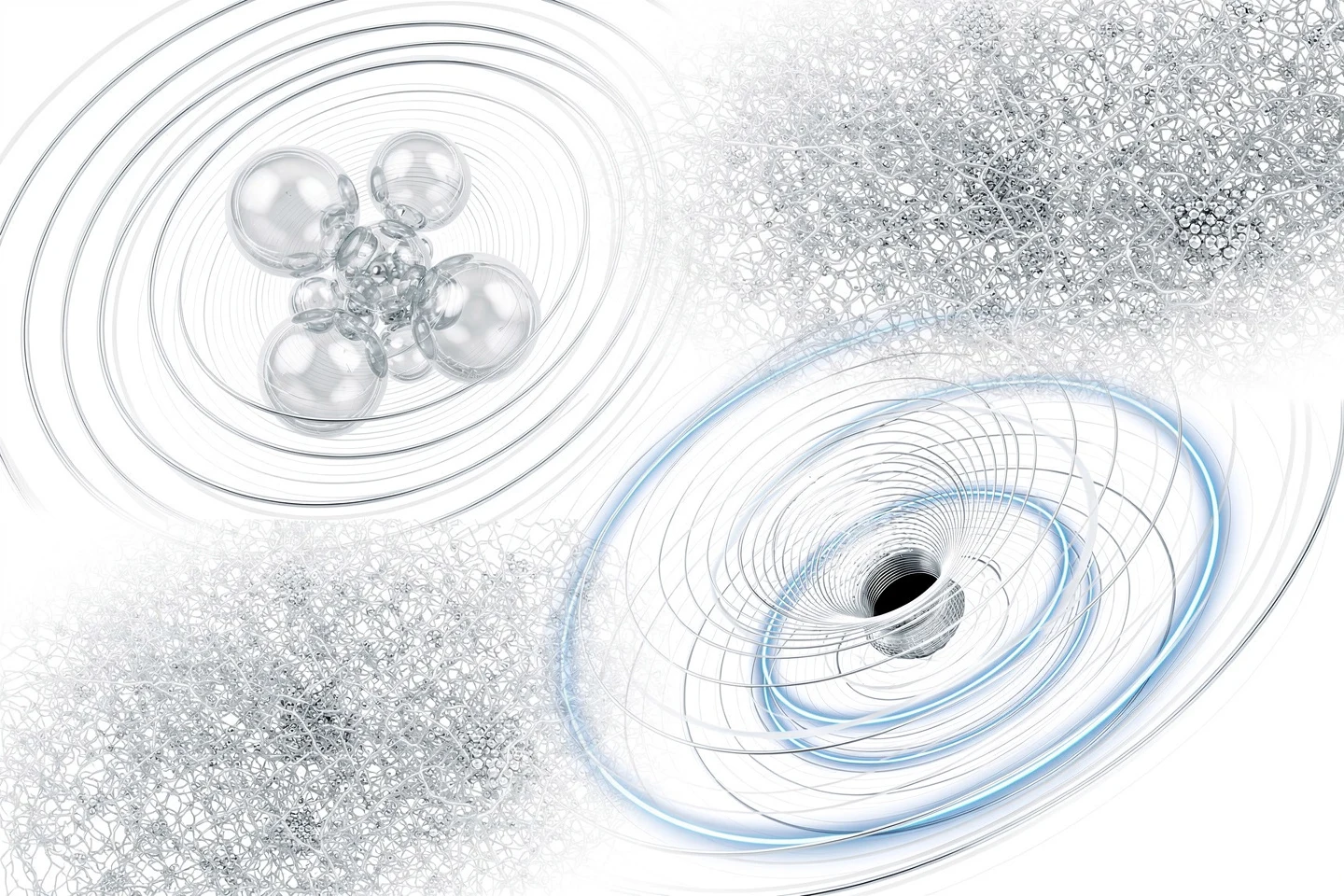
Immediately after the Big Bang, the Universe resembled a seething ocean. As it cooled, it changed phase: like a liquid turning into vapor, but on a cosmic scale. Giant bubbles of the new phase collided, shaking the fabric of spacetime — generating gravitational waves. Overlapping, these waves compressed matter to the point of birthing black holes — like whirlpools from converging waves.
Such holes turn out tiny: with the mass of a mountain squeezed into the size of an atomic nucleus. According to Stephen Hawking, they evaporate, but many have survived to this day. Modern calculations suggest they could make up all the dark matter, whose existence was suspected by Vera Rubin. The irony is that invisible points, each smaller than an atom, together weigh five times more than all visible matter. The waves themselves didn’t vanish: due to the expansion of the Universe, they have been stretched into a low hum. Future detectors, inspired by the work of Rainer Weiss, are tuned to catch this ancient whisper.
A primordial black hole with the mass of an asteroid is comparable in size to an atomic nucleus, yet weighs as much as an entire mountain.
Tiny black holes as gateways to other worlds — a recurring image in Lovecraft, for instance in 'The Shadow Out of Time'.