Invisible Drums: How Gravitational Waves Give Birth to Black Holes ✛ ✎ ✦
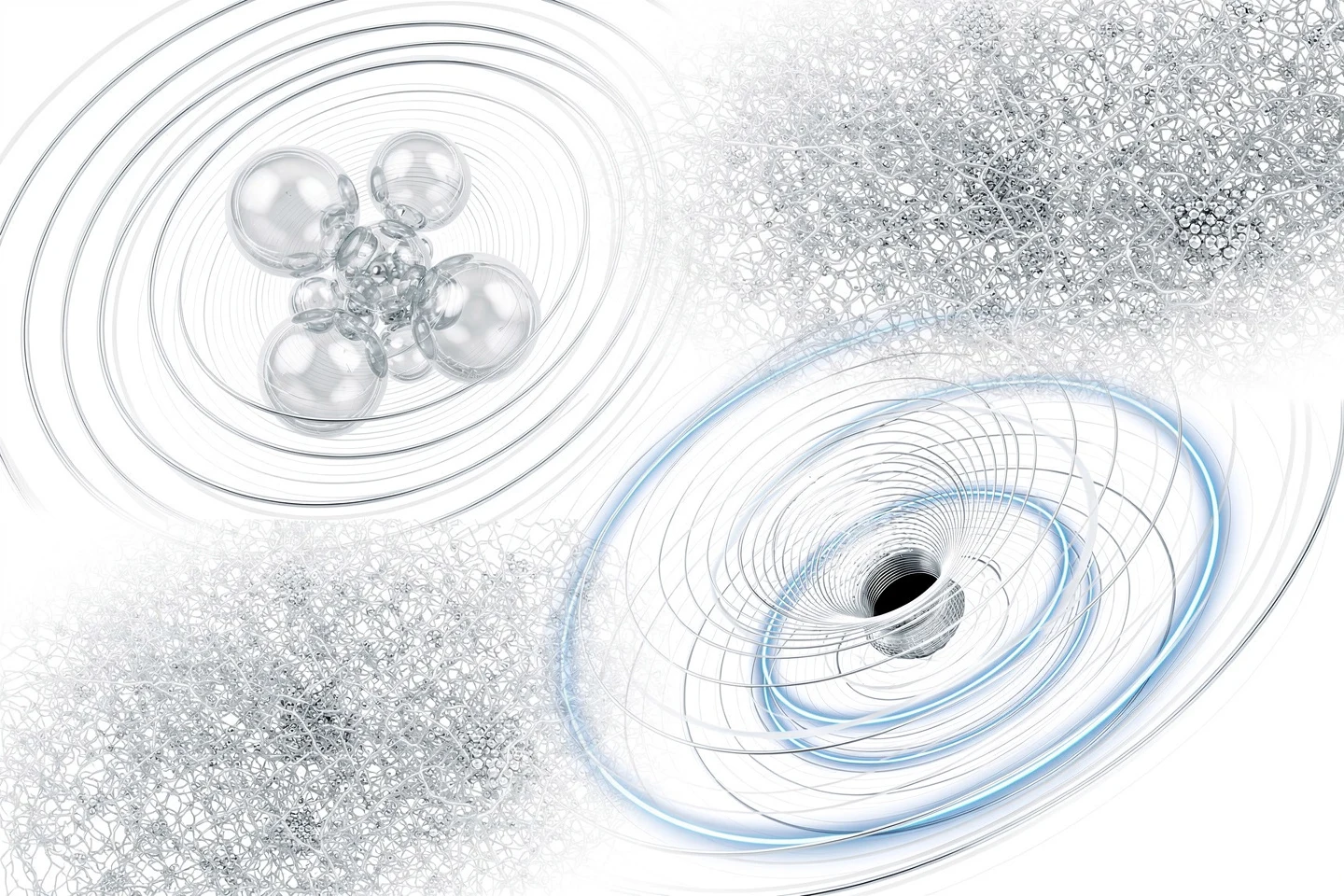
The mystery of dark matter, first glimpsed in the stellar whirlpools by Vera Rubin, has been tormenting physics for nearly a century. One of the boldest hypotheses: primordial black holes, born in the scalding broth of the early universe. Usually their emergence is tied to quantum fluctuations during inflation, which requires fine-tuning of parameters. A new mechanism proposed by physicists rests on a far more spectacular event: cosmic phase transitions, when spacetime itself thundered like timpani, roaring with each shift in phase.
Imagine boiling water: steam bubbles appear, expand, collide. In the early universe, something similar happened with fields: as they cooled below a critical point, bubbles of a new phase were born, bursting against each other and radiating powerful gravitational waves. But the most astonishing part is that this cosmic drumming didn't just race off into the distance. Just as sound waves make sand grains gather into intricate patterns on a membrane, gravitational waves at second order in perturbation theory themselves sculpted compressions and rarefactions out of the vacuum — scalar inhomogeneities. Where the amplitude of these secondary oscillations exceeded a critical threshold, matter collapsed into a black hole. The gravitational wave became the sculptor of its own shadow. The mass of such a hole is tightly tied to the transition temperature: \(M_{\rm PBH} \approx 10^{-6} M_{\rm eq} (T_{\rm eq}/T_\star)^2\), where \(T_\star\) is the phase transition temperature and \(M_{\rm eq}\) is the horizon mass at matter-radiation equality. Simply put, the hotter the transition, the lighter the holes born. And their total fraction in dark matter grows linearly with temperature: \(f_{\rm PBH} \propto T_\star\) — numerical simulations have revealed an almost perfect proportionality. Thus a missing link between particle physics and observational cosmology is forged.
Asteroid-mass primordial black holes with a mass around \(10^{-15}\) solar masses (about the mass of a small mountain compressed to the size of an atomic nucleus) can fully account for dark matter if the phase transition occurred at temperatures between 400 and 10,000 GeV. And this rumble, the inevitable companion of the cataclysm, must fall within the sensitivity range of future detectors LISA and SKA. Frequencies from billionths to hundredths of a hertz, amplitude around \(10^{-8}\) after accounting for cosmological redshift — just what is needed to hear the cosmic timpani. We are on the verge of directly listening to this drum part. It will tell not only about invisible matter but also unveil the laws of physics beyond the Standard Model — the nature of domain walls, the mechanism for generating baryon asymmetry.
Gravitational-wave astronomy, pioneered by the work of Rainer Weiss, is getting ready to hear this echo. Combining data from observations of the cosmic microwave background, the expansion of the universe, and the effects of spacetime curvature through gravitational lensing will allow us to peer into the most intimate moments of the universe's birth. It is quite possible that black holes are not exotic guests but the pervasive fabric of the dark sector, woven from the roar of phase transitions. The next beat of this symphony — accounting for nonlinear effects and the spin of the holes — promises an even richer picture.
Primordial black holes of asteroid mass (about 10⁻¹⁵ M⊙) are comparable in size to an atomic nucleus but weigh as much as a small mountain, and their Hawking evaporation makes them practically invisible to modern instruments.
The idea that a new universe could hide inside a black hole resonates with Lovecraftian horror 'The Shadow Out of Time' and Stephen Baxter's novels, where black holes serve as gateways to other worlds.