Light Leaks into Darkness: How Photons Become Dark Matter ✦
Original: "Redshift Duality with Pantheon+SH0ES in a Planck-anchored Flat $$Λ$$CDM Framework: Implications for Hubble Tension and Observational Inference"
The subtle conversion of light into dark matter resolves the Hubble constant crisis and links the bright and dark sides of the Universe.
Links in the knowledge graph 1
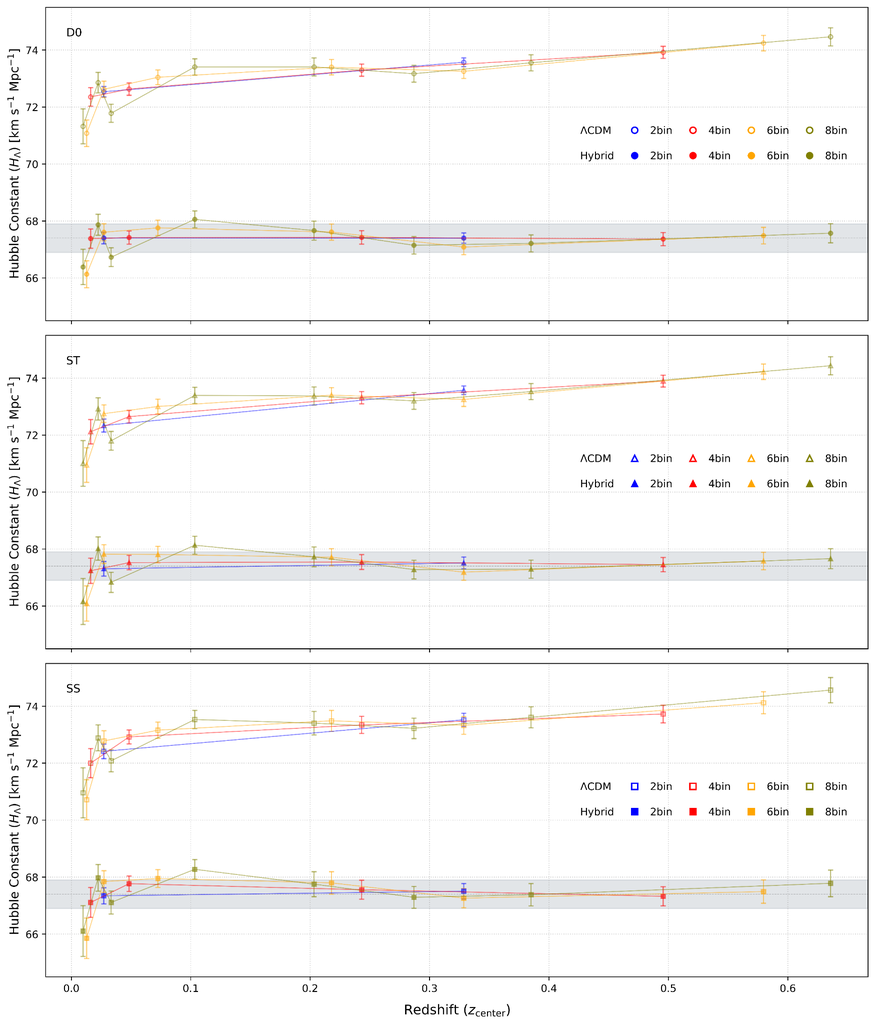
A cosmological riddle: two measurements of the Universe’s age don’t agree. Light ages not only from expansion — some of its energy imperceptibly turns into dark matter, like a river feeding groundwater. Perhaps this is how 5% of photon energy leaks away. Laser experiments in space will test this hypothesis. The quiet whisper of light holds the secret of the invisible world.
🎯 In classical electrodynamics, light absorption is described by the imaginary part of the refractive index. The WMC model assigns the cosmic vacuum an effective “viscosity” — about 1.6×10⁻¹⁹ s⁻¹, making it the most tenuous and nearly perfect fluid imaginable.
(1+z_{\mathrm{obs}}) = (1+z_\Lambda)(1+z_q)
The observed redshift is split into metric and non-metric contributions, just as the total rise of water in a river is the sum of channel stretching and evaporation.
F(X) = F(0)\,e^{-P X}
The flux decreases exponentially with distance, like light dimming in fog.
Scientists
Alan GuthAndrei LindeGeorges LemaîtreJames PeeblesAdam RiessBrian Schmidtsupernova
expansion of the universe
cosmic microwave background
dark energy
dark matter
JWST
photometry
spectroscopy
Time dilation
gravitational lensing
quantum tunnelingLaws
Friedmann equationsHubble's lawDoppler effectgravitational lensingMaxwell's equationsPlanck's law