Dance on the Razor's Edge: How the Star-Black Hole Balance Is Decided by Seven Percent ✦
Original: "Bridging Roche Lobe Overflow and micro-TDEs: The Runaway Evolution of Eccentric Mass Transfer in Star-Black Hole Binaries"
New hydrodynamic simulations show how a convective star either finds stability in the embrace of a black hole or dies from its own pliability—and this fate is decided by just a few percent in distance.
Links in the knowledge graph 1
Just a few percent in distance decide whether it's an eternal waltz or an instant flash. Simulations show: within the first few dozen orbits, it becomes clear if the star will hold. The avalanche of disruption gains strength from each layer shed—paradoxically expanding, the star seals its fate. Such cataclysms are the key to decoding the brightest cosmic explosions.
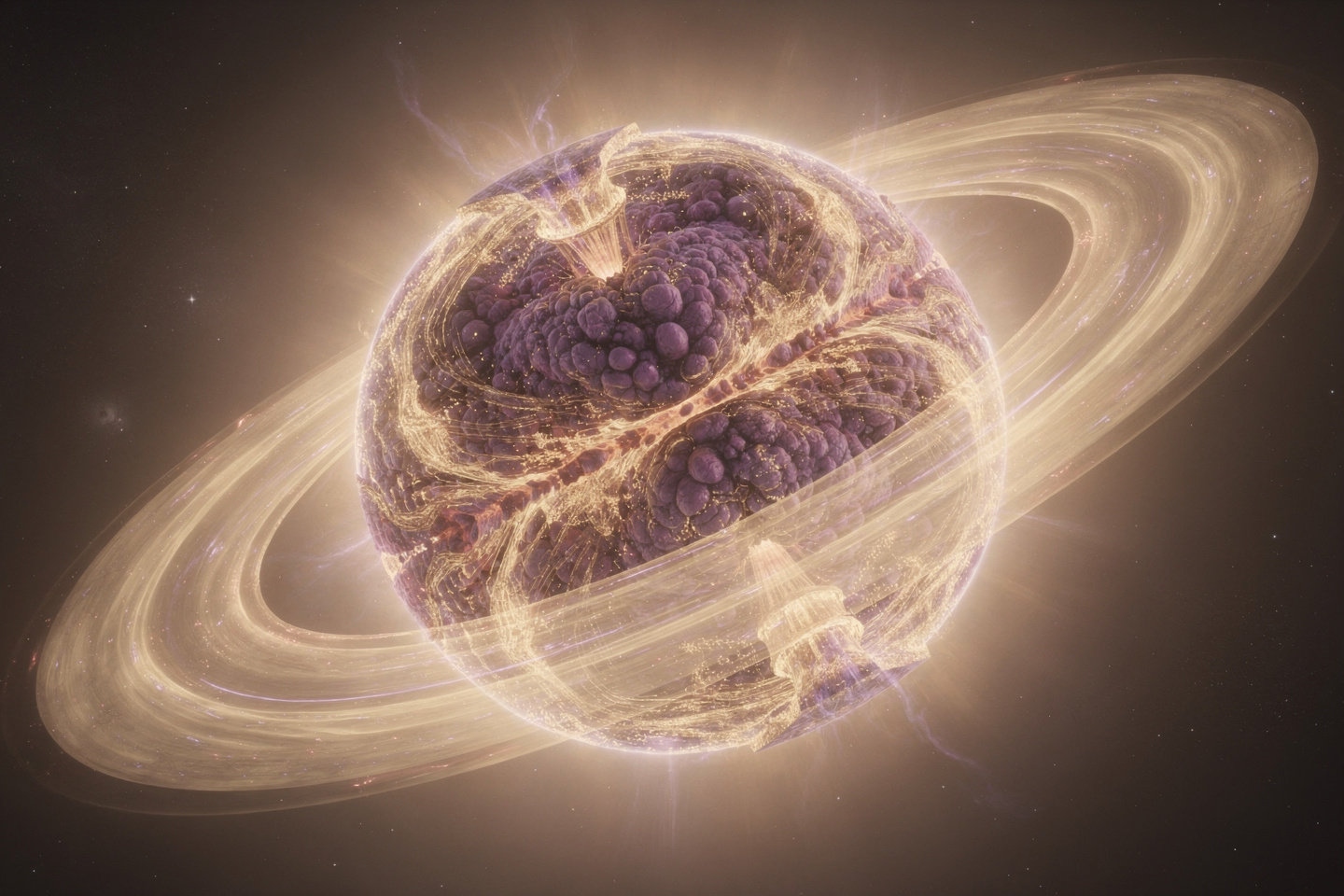
🎯 Tidal disruption of a star is popularly called 'spaghettification' for stretching into a filament. But our simulations add a new culinary image: the star also puffs up from internal heat, like a marshmallow in a microwave—first turning into a bubble, then bursting.
r_{\rm tide} = R_* \left(\frac{M_{\rm BH}}{M_*}\right)^{1/3}
Characteristic distance inside which the star will inevitably be torn apart.
R_L \approx 0.462 \, r_p \left( \frac{M_*}{M_*+M_{\rm BH}} \right)^{1/3}
The region within which matter is gravitationally bound to the star; when the star overflows this region, gas begins to stream onto the black hole.