Scientist

Michel Mayor

1942–present · astrophysics, astronomy
Swiss astrophysicist, Nobel Prize laureate in Physics (2019) for the discovery of the first exoplanet orbiting a sun-like star – 51 Pegasi b. His work opened a new era in astronomy and led to the development of methods for detecting and studying the atmospheres of distant worlds.

Biography

Michel Mayor was born in 1942 in Lausanne, Switzerland. He received his PhD from the University of Geneva, where he worked for most of his career. Before discovering exoplanets, he studied binary stars and Galactic dynamics. Together with Didier Queloz, he developed the ELODIE spectrograph, which made it possible to detect the faint wobbles in the star's radial velocity.

Key discoveries

💡 When Mayor and Queloz first saw the planet's signal, they thought it was an instrument error and spent months checking before believing the discovery.
"He announced that they had discovered a new world, and that this was only the beginning of a great journey."
Concepts
exoplanet atmosphereplanetary migration
Laws
Doppler effect
Scientists
David CharbonneauDidier QuelozR. A. RossiterD. B. McLaughlin

Related articles

Geophysics2008-09-032 minarXiv:0809.0581
The Tropics as a Clean Laboratory: What They Tell Us About CO2
In 1998, the planet's thermometer set a record that still stands. Global temperature spiked and then leveled off, even as CO2 emissions kept rising.
The Second Derivative of CO₂: How the Atmosphere Governs Climate
An interpreter gets distracted by every rustle in the hall, and a one-hour meeting stretches into two. The atmosphere is like such an interpreter: it hears not only the biosphere's words but also its tone. When plants change the pace at which they absorb carbon dioxide, the air responds not to the gas itself but to how quickly and how abruptly its amount changes.
The Carbon Echo of the Pandemic: How Lockdown Reverberated in the Atmosphere
In spring 2020, Earth's atmosphere seemed to hold its breath. Transport ground to a halt, factories fell silent, and carbon dioxide emissions from burning fuel dropped by nearly eight percent. But spotting this "carbon echo" on a global scale proved tricky: the atmosphere is constantly mixing, forests and oceans breathe, and weather adds its own noise.
The Climate Orchestra: Who Really Conducts Global Warming?
The orchestra of world weather is playing a tune we didn't expect. The first violin is not carbon dioxide but chlorofluorocarbons—gases that until recently hid in refrigerators and aerosol cans. They trap heat ten thousand times more effectively than CO₂, and for decades they have been quietly warming the planet.
Why the Planet Hit the Brakes on Warming for a Quarter Century
Picture an orchestra where each instrument plays at its own tempo: violins speed up, woodwinds slow down, and percussion keeps losing the beat. That's roughly what Earth's climate looks like, with the ocean, the Sun, volcanoes, and human activity pulling temperature in different directions.
Ocean Hints at Rain: The Hidden Mechanics of the Monsoon
In the summer of 2022, the sky over western India seemed to have forgotten about drought: rains fell more often than usual, while eastern states languished in dryness. Such an imbalance puzzled forecasters, because ocean currents in the Pacific had promised a steady, abundant monsoon across the country.
Record CO₂: When the Planet's Lungs Held Their Breath
The carbon cycle is like the planet's breathing. Forests and oceans inhale carbon dioxide, while industry and wildfires exhale it back. In 2023, that inhale became gasping and shallow. At the Mauna Loa station, instruments recorded that CO₂ concentrations rose by 3.37 parts per million over the year, 86% faster than the year before.
The Planet's Breath Stumbles: How El Niño Stilled Earth's Lungs
From July 2023 to July 2024, Earth's atmosphere gained carbon dioxide at a rate of 3.66 parts per million per year. That is the fastest pace since 1979. The reason is not that factories and cars suddenly started emitting more CO₂. The planet's lungs—forests and soils—took a shallower breath. The planet breathes through its green cover.
One in Three Sun-Like Stars Is Born with a Tilted Disk
A spinning top tilted over a table, with a dusty pancake swirling around it. That is what a young stellar system looks like when the star's spin axis and the plane of its protoplanetary disk do not align. Until recently, astronomers did not know how common such a configuration is in nature.
Exoplanets2025-10-111 minarXiv:2510.10344express
Can the Moon have its own moon?
The Moon can have its own tiny moon — like a nesting doll, but in space. The outer doll is a planet, the middle one is a moon, the inner one is a small moon-satellite, or submoon. Ньютон showed that all bodies attract each other, and gravity holds them together.
Exoplanets2025-10-281 minarXiv:2510.24575express
The Hunt for Moons of Rogue Planets
In the vast darkness of interstellar space, the rogue planet WISE 0855 flickers with a barely perceptible heat glow, like a cooling ember. Its temperature is only a few dozen degrees above freezing — if life existed there, it would see a sunless sky, in an eternal icy haze.
Exoplanets2025-11-191 minarXiv:2511.15317express
Shadow or Mirage: Hunting a Moon Around a Scorching Jupiter
The hunt for exomoons — the search for satellites around planets of other stars — resembles watching shadows in a theater where the spotlight keeps fading and flaring. The planet Kepler-167e, a gas giant near a scorching star, was discovered by William Borucki and his team.
Exoplanets2025-12-311 minarXiv:2512.24538express
Plant Life Could Last Over a Billion Years
The Sun is slowly brightening, and in hundreds of millions of years its heat would become lethal for Earth. Fortunately, the built-in planetary thermostat — the carbon cycle — when overheating triggers rocks to absorb carbon dioxide faster, cooling the climate.
Chemical Physics2026-01-082 minarXiv:2601.04621express
The Quantum Puzzle of Nitrogen
In every handful of fertile soil, there are bacteria that do something no factory can: they take nitrogen straight from the air and turn it into fertilizer. The secret lies in the enzyme nitrogenase, and its working core, a cluster of iron and molybdenum atoms, looks like a tiny factory floor. Chemists have long tried to understand how this factory works from the inside.
Galaxies2026-01-092 minarXiv:2601.05757express
How Methanol Is Born on Ice
A cosmic dust grain is covered in ice, and on this ice, like in a tiny kitchen, molecules are cooked. One of them is methanol, an alcohol that serves as a building block for more complex compounds in space. Previously, it was thought that methanol only forms when hydrogen atoms stick one by one to a carbon monoxide molecule.
Ice Has a Memory: How Antarctica Responds to Carbon Dioxide
An ice core from Antarctica is a time machine that recorded the climate for 130,000 years straight, year after year, with no gaps. Air bubbles trapped in the ice preserve the carbon dioxide of those ancient eras.
Exoplanets2026-01-131 minarXiv:2601.08923express
The Mystery of Asteroid Kamo'oalewa: Why It's Not from the Moon
Kamo'oalewa is Earth's partner in a peculiar gravitational dance: it orbits the Sun almost in unison with us, edging closer and then pulling away. Its color — the palette of reflected light — matches the lunar surface. Hence the initial thought: it's a chunk of the Moon from the Giordano Bruno crater.
Exoplanets2026-01-131 minarXiv:2601.08938express
How a Hole in a Disk Blocks the Light
Around a young star spins a flat pancake of gas and dust — the future building blocks of planets. The star heats it with ultraviolet radiation, and gas from the disk's surface escapes into space, like water from a puddle under the sun.
Exoplanets2026-01-131 minarXiv:2601.08958express
How Planets Lose Their Volatiles
A young planet grows like a snowball rolling down a slope: countless small pebbles from the surrounding gas disk stick to it. The larger it gets, the stronger it pulls in gas — hydrogen and helium. A dense, hot envelope forms around it. Pebbles falling through it heat up from friction and their own weight, like grains of sand falling into thick honey.
Exoplanets2026-01-142 minarXiv:2601.09438express
Three Teenage Planets Around Star TOI-451
The young star TOI-451 wobbles slightly as three planets circle it. Each wobble is like the tremor of a spiderweb when a tiny spider crawls across it. Astronomers caught this tremor to learn how heavy the planets are. They watched the star for several months using telescopes on Earth. The planets kept passing in front of the star, briefly dimming its light.
Chemical Physics2026-01-172 minarXiv:2601.11936express
How the Tiniest 'Invisible Molecule' Shatters Apart
In the air we breathe, invisible chemical events are constantly unfolding. One of them is the birth and instant death of a particle with the formula H₂COO. Known as an 'intermediate,' it appears for a split second when ozone molecules collide with organic compounds, then immediately shatters into simpler fragments.
Exoplanets2026-01-191 minarXiv:2601.13391express
How Planets Are Born: Turbulence in the Gas Disk
Around young stars, flat clouds of gas and dust swirl: these are the birthplaces of planets. For matter in such a disk to clump together, it must be constantly stirred. But what makes the gas move chaotically when it would otherwise be calm? Part of the answer lies in the fact that the gas in the disk barely conducts electricity: it is weakly ionized.
Earth Can Heat Itself Up
Glaciers don't just darken from soot. Their surfaces host tiny algae that, as temperatures rise, bloom and turn the ice dark. Dark ice absorbs more sunlight, melts faster, and further warms the planet. It's like how a black t-shirt in the sun gets hotter than a white one. The second player in overheating is forests.
Fluid Dynamics2026-01-262 minarXiv:2601.18465express
The Hidden Force on Leaves
A water droplet races across a taro leaf like a bead on a freshly waxed floor. But it doesn't just glide: it picks up electricity. Thirty years ago, scientists explained why lotus leaves stay dry: their surface is covered with microscopic bumps that trap air. Now it turns out that water on leaves has another, hidden power.
Exoplanets2026-01-261 minarXiv:2601.18877express
Why Giant Planets Often Have Slightly Stretched Orbits
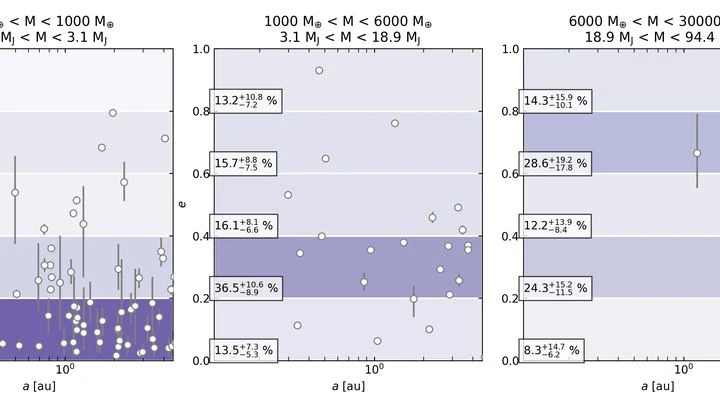
A planet's orbit is its path around its star. If the path is perfectly circular, the planet always stays at the same distance from the star. But many planets have slightly stretched paths, like a running track in a stadium. Astronomers studied hundreds of giant planets around other stars and found a curious pattern.
Exoplanets2026-01-292 minarXiv:2601.21774express
Two Rocky Planets Hidden Around Red Stars
The TESS telescope's data are like a huge archive of old photographs: it already contains images of thousands of stars, but not every detail has been examined. Standard pipelines only look for the most obvious dips in a star's light when a planet passes in front of it. Fainter signals go unnoticed, like a quiet whisper in a noisy room.
Exoplanets2026-01-302 minarXiv:2601.23069express
The Carbon Diet of Young Stars
Young stars are surrounded by disks of gas and dust, like construction sites for future planets. From this material, rocky worlds and gas giants will eventually assemble. So the chemical composition of the disk directly determines what the planets will be like.
Materials2026-01-311 minarXiv:2602.00433express
How Gold-Ruthenium Alloys Restructure in Ammonia
In a jeweler's workshop, gold is never mixed with ruthenium: one is soft and shiny, the other refractory and brittle. But at the nanometer scale, these metals merge into a single alloy that, when heated, begins to separate like oil and water in a cooling broth.
Exoplanets2026-02-031 minarXiv:2602.03393express
A Dancing Disk Around a Young Star
Around young stars, disks of gas and dust swirl: these are the construction sites for future planets. In the binary system HD 142527, such a disk is especially intriguing. Astronomers aimed three instruments working in the infrared range (thermal emission from dust) at it and saw a surprising picture.
Exoplanets2026-02-032 minarXiv:2602.03723express
Hot Jupiters Devoured by Their Stars
A giant planet circles too close to its star. With each orbit, it tugs on the star with its gravity, and waves are born deep inside the star, like ripples from a stone dropped into water. These waves damp the planet's orbit, and it spirals into the star. The star swallows the planet and starts spinning faster. Stellar rotation is the key clue.
Exoplanets2026-02-051 minarXiv:2602.05378express
Rogue Moons: Warmth Without a Star
Rogue planets, ejected from star systems, may harbor life on their moons. A moon of such a planet can preserve heat and liquid water for billions of years. The whole secret lies in a reliable "blanket" and an internal "stove." The stove is tidal forces: they squeeze and stretch the moon's interior, heating it up like kneading clay.
Exoplanets2026-02-131 minarXiv:2602.12522express
A Warm Pocket in a Cold Disk
The young star PDS 66 is surrounded by a flat disk of gas and dust — the cradle of future planets. In the cold outer regions of such a disk, silicon and sulfur are usually hidden inside dust grains, but astronomers spotted a bright patch of gas at about 60 astronomical units from the star.
Exoplanets2026-02-171 minarXiv:2602.15978express
Disk Vortices Keep Planets from Falling In
A young planet in a gas disk is like a swimmer trying to swim against the current: friction with the gas slows it down, and it spirals toward the star. For small rocky planets, this fall can take less time than they need to grow. But the disk also has countercurrents — vortices that can push the planet outward. Scientists built a computer model of a disk around a young star.
Exoplanets2026-02-171 minarXiv:2602.16030express
Cosmic Kitchen: How Carbon and Oxygen Shape the Look of Disks
When a chef prepares a dish, not only the proportions of ingredients matter but also their total amount. Two pies with the same sugar-to-flour ratio but made from different batch sizes will turn out differently. So it is with disks around young stars: carbon and oxygen are the key 'spices,' and their absolute amounts change the look of the cosmic 'kitchen' no less than their ratio.
Materials2026-02-201 minarXiv:2602.17953express
How a 'metallic spiderweb' turns carbon dioxide into fuel
A factory smokestack releases carbon dioxide into the air, and nearby stands a unit that captures this gas and, under sunlight, assembles ethylene molecules from it — the feedstock for plastic bags and pipes. Materials scientists have brought this scenario closer by modifying a crystal of the semimetal PdSn4 with a small amount of platinum.
Fluid Dynamics2026-02-201 minarXiv:2602.18349express
Bubbles Line Up on Their Own
In a narrow vertical tube, alcohol flows upward, surrounded by water, and carbon dioxide bubbles are born inside it. As soon as they appear, they rush toward the axis of the flow, as if an invisible hand gathers them into a neat chain.
Exoplanets2026-02-232 minarXiv:2602.19941express
A Dust Ring Where Giants Are Born
Around the young star MWC 480, a flat disk of gas and dust whirls, like a giant carousel where, instead of horses, you have building blocks for planets. Radio telescopes peered into this disk at different wavelengths, from millimeter to centimeter, and saw exactly where the dust accumulates and how large the grains are.
Exoplanets2026-02-231 minarXiv:2602.20346express
Cosmic Disks Flicker Like Candles
Around young stars, flat clouds of gas and dust swirl — the building material for future planets. Starlight reflects off these clouds, and astronomers see them as faint disks. But sometimes bright spots or dark bands appear in such disks. Fresh observations with the Subaru Telescope show these patterns can change within a matter of months.
Exoplanets2026-02-281 minarXiv:2603.00402express
Why a Tent on Mars Beats a Full-Blown Planetary Makeover
Today's Martian surface is a cold, nearly airless home. Many dream of a full renovation: warming the planet, filling it with air from carbon dioxide and nitrogen.