Popular

High Energy astro-ph.HE

208 articles

Cosmic ray production, acceleration, propagation, detection. Gamma ray astronomy and bursts, X-rays, charged particles, supernovae and other explosive phenomena, stellar remnants and accretion systems.
articles

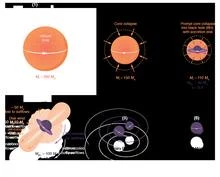
Birth Echo: How Astronomers Found Evidence of a Black Hole

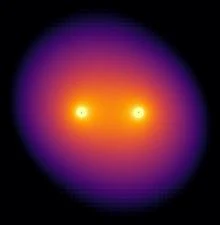
Astronomers have finally found compelling evidence that black holes are indeed born in supernovae. Around the black hole SS 433, a shell of hot gas is visible — like cooling steam from a massive star explosion that thundered 20,000–30,000 years ago.
arXiv:2410.06510 · 2024-10-09

Who's Lurking in the Radio Glow of Galaxies?

In three galaxies, like a city at night, radio astronomers counted 115 bright dots. Most are local streetlights: a supernova remnant, stellar nurseries, unknown warm spots. But nine turned out not to be residents at all – these are distant supermassive black holes whose radiation happens to pierce t
arXiv:2507.23332 · 2025-07-31

Radio Message from When the Universe Was Young

A brief radio flash came from a galaxy that existed soon after the Big Bang. The James Webb Space Telescope helped pinpoint its source—a small, clumpy cluster of stars bustling with star birth. This is the first flash traced to an object at such a distance, and it now allows us to study invisible ga
arXiv:2508.01648 · 2025-08-03

Caught by a Stellar Kick: Webb Finds a Neutron Star

Astronomers have searched for decades for the object left behind by supernova 1987A. Webb finally saw it: a neutron star that is accelerating gas and flying sideways. By measuring its displacement, scientists determined its speed — 500 km/s, as if someone gave it a stellar 'kick'.
arXiv:2508.03395 · 2025-08-05

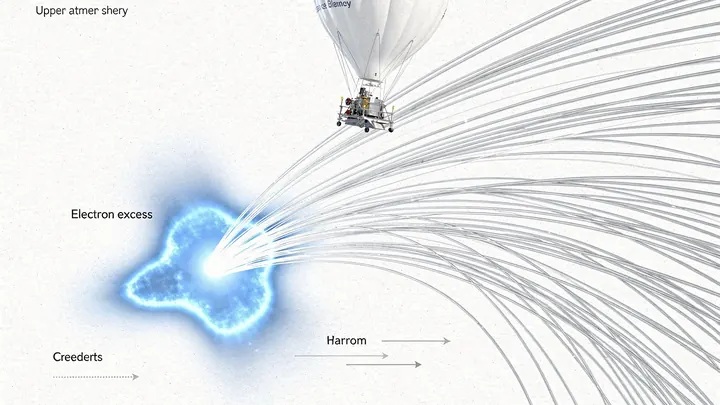
The Cosmic Capacitor: Unraveling Fast Radio Bursts

Astrophysicists have proposed a simple mechanism for mysterious fast radio bursts: an electrical charge builds up in the disk around a black hole, then a spark discharge occurs, producing a bright radio flash. The model is backed by observations and explains how some of the most powerful signals in
arXiv:2508.03620 · 2025-08-05

Gold Isn't Just from Neutron Stars: Where's the Hidden Source?

Astronomers compared data from ripples in space, cosmic flashes, and the chemical makeup of stars. It turned out: neutron star mergers can't saturate the galaxy with gold and platinum. Even counting exotic collisions between black holes and neutron stars, there's still a shortfall. There must be a h
arXiv:2508.06020 · 2025-08-08

The Mystery of the Gamma-Ray Burst: When the Speed of Light Is Not Constant

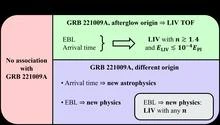
The brightest gamma-ray burst GRB 221009A produced a photon with the energy of a flying mosquito. It arrived an hour and a half late and didn't scatter on background light, although physics laws demand otherwise. Perhaps the speed of light changes with energy.
arXiv:2508.07153 · 2025-08-10

Tiny Giants: Black Holes Grow from Primordial Seeds

The merger of two unusually heavy black holes — GW231123 — suggests they might have originated from primordial seeds. Over billions of years, they sucked in matter, gaining mass and spinning up. Future observations will test this hypothesis and perhaps reveal the nature of dark matter.
arXiv:2508.09965 · 2025-08-13

Quantum Glue for the Universe

Physicists have found that in the extreme gravity of neutron stars and black holes, a Bose–Einstein condensate emerges — a quantum state where particles merge into a single whole, like droplets of mercury. If dark matter consists of ultra-light axions, it naturally turns into a cosmic glue that keep
arXiv:2508.15864 · 2025-08-20

Magnetic Brakes for Cosmic Spinning Tops

Scientists simulated the birth of black holes from massive stars and saw that magnetic fields act as a cosmic brake. A strong field slows the hole's spin, a weak one spins it up to near-light speed. This explained why detectors occasionally see pairs of heavyweight black holes, like the record-break
arXiv:2508.15887 · 2025-08-21

How Twisted Light Reveals a Black Hole's Charge

Light bending around a black hole gets twisted — by the spiraling of the beams you can measure its electric charge. Astrophysicists applied this approach to images of the M87 galaxy and obtained an upper limit for the first time: the hole is almost neutral. The method is universal and suitable for h
arXiv:2508.17300 · 2025-08-24

Starquakes: The Birth of Cosmic Radio Signals

Magnetars are dead stars with colossal magnetic fields. Their crust can crack, sending a pulse into space that can outshine an entire galaxy. New calculations combine seismology and electrodynamics, tracing the full chain from the jolt to a fast radio burst.
arXiv:2508.18033 · 2025-08-25

Black Hole Yields: Weak Spot Found

Black holes are not always perfectly rigid. Under the influence of a field of matter particles (such as electrons), they bend, although it was previously thought that weak influences couldn't deform them. Ordinary fields, like light or gravity, leave them unperturbed, but matter does not.
arXiv:2508.20155 · 2025-08-27

Carbon Giant by a Dead Star

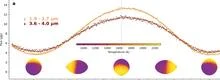
A gas giant the size of Jupiter orbits the pulsar PSR J2322-2650b, heated to 1900°C. Its atmosphere is thick soot of carbon chains, not the usual water vapor. Carbon is a hundred times more abundant than oxygen compared to normal, and ten thousand times more than nitrogen. This doesn't fit the 'blac
arXiv:2509.04558 · 2025-09-04

Black hole merger confirms Hawking's area law

A clear signal from the merger of two black holes, each about 33 solar masses, confirmed Hawking's theorem: the final horizon area turned out larger than the sum of the initial ones. This strengthens the link between black hole area and entropy.
arXiv:2509.08054 · 2025-09-09

Binary Stars Build Dark Matter Molecules

Simulations show that a cloud of dark matter around two stars takes the shape of a molecule. The elongated orbits of the stars knock particles out of the cloud, causing their trajectories to round out. This process could leave a noticeable imprint in the gravitational-wave background, helping to rev
arXiv:2509.09643 · 2025-09-11

Dense Fog Instead of a Cosmic Hurricane

The XRISM telescope discovered that the wind from neutron star GX 13+1 is not fast but exceptionally dense and slow. This changes our understanding of how such outflows are born and their impact on galaxies.
arXiv:2509.14555 · 2025-09-18

A Cosmic Blast Showed How Its Light Is Born

For the first time in a gamma-ray burst GRB 221009A, astronomers noticed how the light fingerprints of elements were born and reddened. It turned out that particles of light emerged when matter met antimatter, and then, colliding with electrons, lost energy — like a billiard ball after a series of h
arXiv:2509.14715 · 2025-09-18

Silent Explosion: The Faintest Supernova in the Galaxy

In 1181, Chinese astronomers spotted a flash — likely the merger of two white dwarfs. Modern observations of the Pa 30 nebula barely pick up a radio signal. This means the explosion’s energy was extremely low, or particle acceleration works differently. The discovery forces us to rethink the nature
arXiv:2509.15792 · 2025-09-19

Invisible Lighthouse: Magnetar Pulse in a Gamma-Ray Burst

The collision of a pair of ultra-dense stars produced the explosion GRB 230307A, which lasted unusually long. In its glow, for a split second, a rhythmic signal at 909 Hz emerged—like the beam of a celestial lighthouse. This pointed not to a black hole but to the birth of a rapidly spinning neutron
arXiv:2509.15824 · 2025-09-19

The Cosmic Lighthouse Has Switched

The Ansky black hole in a distant galaxy has changed the rhythm of its X-ray flares: they are now half as frequent, but four times as powerful and longer lasting. Scientists link this to an object that might be making its final loops before falling into the hole, disturbing the disk of superheated g
arXiv:2509.16304 · 2025-09-19

Hunting for Light from Black Hole Crumbs

Black hole mergers can create tiny mini black holes that quickly evaporate, flashing with gamma-ray light. A search for such signals in the Fermi telescope archive came up empty, but it allowed to rule out certain masses for these crumbs.
arXiv:2509.17599 · 2025-09-22

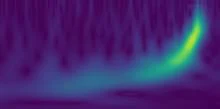
Gravitational Ringing Unveils Neutron Star Mysteries

After neutron stars merge, a ringing clump of ultra-dense matter remains. Analyzing how fast this gravitational chiming fades relative to the spin-down rate allows, for the first time, measurement of matter’s elasticity in the interior, where densities are 5–6 times nuclear. Paradoxically, it can be
arXiv:2509.18665 · 2025-09-23

Magnetar Confirms: The Vacuum Isn't Empty

The polarization of X-rays from a dead star with a monstrous magnetic field has been measured. It changes with energy as if the vacuum behaves like a crystal, bending light. This is the first direct evidence of a quantum effect predicted over 80 years ago.
arXiv:2509.19446 · 2025-09-23

How to Make a Black Hole Perfectly Black

Black holes usually reflect some waves. By shaping these waves to hit a precise resonance, physicists forced a black hole to absorb all energy, turning perfectly black. The absorbed energy is then released as a distinct ring, like a bell's tone revealing its shape. This technique could unveil the se
arXiv:2509.19451 · 2025-09-23

Record Gamma-Ray Burst: 7 Hours of Invisible Light

GRB 250702B broke all the rules: its 7-hour duration didn't fit old models. The solution? A merger of a black hole with a helium star. This event links ultra-long gamma-ray bursts with supernovae and gravitational waves.
arXiv:2509.22792 · 2025-09-26

Space Beacons: LST-1 Telescope Begins Tracking

For two years, the LST-1 prototype tracked the flickering of distant space beacons — blazars. At their centers, supermassive black holes act like giant spotlights, shooting out narrow beams of gamma rays. The telescope didn't catch the rays themselves, but their atmospheric footprints — faint blue f
arXiv:2510.03702 · 2025-10-04

Sky Hotspots: The Senders of Ultra-Particles Identified

Record-breaking energy particles point to nearby galaxies where rare neutron star collisions occur. This explains the mysterious hotspots and differences in observations by various telescopes.
arXiv:2510.06193 · 2025-10-07

Artificial Intelligence Unravels the Mysteries of Cosmic Radio Bursts

Astronomers trained a neural network to search for fast radio bursts without complex data preprocessing. On the repeating source FRB 20121102A, it found 5,927 signals—three times more than before. Analysis showed that the burst energies always split clearly into two classes, and this property is unc
arXiv:2510.07002 · 2025-10-08

Rhythms of Black Holes: 34 Pulsations in Gamma-Ray Bursts

In data from the Swift telescope, 34 gamma-ray bursts with a clear rhythm were discovered. These bursts are born when a dying star collapses into a black hole, and its superheated gas swirls into a rapidly rotating disk. The rhythmic pulsations reveal the dance of matter around the hole: perhaps thi
arXiv:2510.11136 · 2025-10-13

Tiny black holes from cosmic collisions

When particle rays collide in space, they can create microscopic black holes that instantly evaporate into a stream of neutrinos. Already, by studying neutrinos from a distant galaxy, scientists have tested energy limits where gravity changes the rules. Upcoming observatories will search even deeper
arXiv:2510.11879 · 2025-10-13

Stellar explosions puff up giant gamma-ray bubbles

A computer model revealed that the gamma-ray bubbles at the Galaxy’s center are not the result of a black hole, but of vigorous stellar life. Like a boiling pot, massive star explosions hurl out particles that shine in gamma rays. The finding explained the Fermi telescope’s riddle and showed where t
arXiv:2510.14908 · 2025-10-16

Gravitational Waves Gain Overtones

Event GW250114 helped physicists capture not only the main wave from the black hole merger, but also the quiet overtones. These nonlinear oscillations, born from the self-interaction of spacetime, refined the black hole’s parameters and opened a new way to test relativity in strong fields.
arXiv:2510.16903 · 2025-10-19

Black Holes Where You'd Least Expect Them: Solving the Mass Gap Mystery

It was thought that the most massive stars explode completely, leaving no black holes, so none exist in the 50 to 130 solar mass range. New observations found several such anomalies with low spin. The reason lies in the nuclear reaction rate inside stars, which shifts the boundaries of what's possib
arXiv:2510.22698 · 2025-10-26

Star explosions accelerate particles to record energies

The LHAASO observatory studied gamma-ray emission from supernova remnant IC 443 and found that particles there are accelerated to record energies with no signs of slowing down. This is direct confirmation: it's star explosions that produce the most energetic cosmic rays bombarding Earth.
arXiv:2510.26112 · 2025-10-30

When the Speed of Light Stops Being the Limit

An excess of particles with energies at which they should have disappeared was detected in gamma-ray burst GRB 221009A. Probably, at such energies, the speed of light is slightly higher, which suppresses their absorption. This violation of Lorentz symmetry may open the way to a quantum theory of gra
arXiv:2511.15542 · 2025-11-19

Why neutrinos in a supernova reach consensus faster

In the cramped quarters of a dying star, neutrinos stop acting like loners. A new calculation shows: by talking to each other, they switch flavors faster than previously thought. This finding refines the physics of stellar explosions and the birth of heavy elements.
arXiv:2511.16506 · 2025-11-20

Black Holes: Absolute Rigidity

The most precise measurements of gravitational waves from a black hole collision have set a record limit on their deformability. It turns out that black holes keep their shape even under unimaginable tidal loads — just as Einstein predicted. This closes a loophole for 'soft' quantum models.
arXiv:2512.01918 · 2025-12-01

Dark Stars: First Light from Invisible Matter

Invisible dark matter could have fueled the first stars. As its particles collided, they released heat and ignited giant luminaries that later collapsed into black holes. Calculations show their collective gamma-ray glow should be noticeable, opening a new way to hunt for dark matter.
arXiv:2512.04061 · 2025-12-03

Runaway Black Hole Leaves an Interstellar Trail

A runaway supermassive black hole leaves a superheated gas tail visible from Earth. The James Webb Space Telescope clocked its escape velocity at 954 km/s, revealing that such giants can be flung from their galaxies.
arXiv:2512.04166 · 2025-12-03

Cosmic Heavyweight: Neutron Star Sets Mass Record

Astronomers measured the mass of a neutron star in a binary system—it turned out to be 2.35 times heavier than the Sun. This pushes the theoretical mass limit for such objects up to 2.27 solar masses. The result narrows down the possibilities for how matter behaves under unimaginable pressure.
arXiv:2512.05099 · 2025-12-04

The Twinkling of Quasars and the Variable Dark Energy

Astronomers noticed that the light of quasars flickers like a candle flame. By analyzing the flickering pattern, they can determine the quasar's true brightness and calculate its distance. This allowed them to peer into the Universe's past and see that dark energy may not have been constant over tim
arXiv:2512.07931 · 2025-12-08

A Nearby Supernova: Recipe for Rocky Planets

Astronomers have found an elegant mechanism: the supernova doesn't destroy the planetary cradle but sends rays that create the necessary radioactive atoms right inside the disk. At a distance of one parsec, it works perfectly. This discovery makes rocky planets common.
arXiv:2512.09660 · 2025-12-10

How Neutrinos Switch Flavors While Traveling Through the Sun

Solar neutrinos change their type on the way to Earth — theory predicted this, but directly observing the transition has been elusive due to background noise. A new filtering method in the JUNO detector will make it possible to see this process for the first time, strengthening our current picture o
arXiv:2512.14824 · 2025-12-16

Dark Matter: A Hidden Threat to Neutron Stars

In a five-dimensional space, gravity behaves differently, and a tiny cloud of dark matter inside a neutron star can compress it into a black hole. The hole grows, devouring the star, thereby ruling out many possible compositions of dark matter.
arXiv:2512.14837 · 2025-12-16

A Middleweight Black Hole Exposed by a Torn Star

The flare AT2018cqh in a dwarf galaxy turned out to be the trail of a star torn apart by a middleweight black hole. These objects are the missing link between tiny and giant black holes, and they are extremely hard to find. This discovery offers a new way to hunt for the invisible.
arXiv:2512.16568 · 2025-12-18

Plasma Sphere Explains Magnetars and Radio Bursts

Magnetars — neutron stars with a monstrous magnetic field — sometimes outshine an entire galaxy. Fast radio bursts are enigmatic radio signals from distant galaxies. A new model unites them: it's all about an expanding cloud of magnetized plasma. A dense cloud produces an X-ray flare, a thin one pro
arXiv:2601.00441v2 · 2026-01-01

How to Hear Stellar Collisions More Clearly

Scientists improved a model of neutron star mergers by including heating. This cut the error by a factor of 10 and showed that the main burst frequency shifts by 150 Hz depending on the star's composition. The finding will help next-generation detectors study ultra-dense matter.
arXiv:2601.01402v1 · 2026-01-04

Ghost Neutrinos: Born in the Coronas of Black Holes

Scientists have discovered that quiet galaxies with hot coronas, rather than bright jets, generate almost all the neutrinos that reach Earth. The finding, made with the Antarctic IceCube detector, changes our understanding of the origin of these elusive particles.
arXiv:2601.01533v2 · 2026-01-04

Hiding in Plain Sight: A Nearby Neutron Star

The star J2354, a few hundred light-years away, has a hidden companion that heats one side of the star. Observations of the star's wobble and light spectrum suggest the companion is a neutron star, firing winds that create a permanent hotspot. This proximity makes it one of the closest neutron stars
arXiv:2601.01755v1 · 2026-01-05

Cosmic Explosions: The Secret of the Strange Vortex Star

An ergostar is a theoretical remnant of neutron star mergers that spins so fast it twists spacetime. Long thought to be unstable and quickly collapse into black holes, a new study suggests that if it consists of 'strange' matter (quark soup), it becomes stable, and its rotational energy is enough fo
arXiv:2601.01949v1 · 2026-01-05

Black Holes as Ghost Particle Accelerators

Using computer simulations, scientists uncovered how natural particle accelerators work in the searing coronas around supermassive black holes. Shock waves in the plasma transfer about 10% of their energy to protons—even from mild shocks. This explains why neutrinos arrive from active galaxies while
arXiv:2601.01999v2 · 2026-01-05

First Stars: Fireworks Seen by Webb

In the James Webb Space Telescope's images, bright dots thought to be distant galaxies might actually be explosions of the first stars — pair-instability supernovae. These cosmic fireworks happen when a massive star made of pure hydrogen and helium is torn apart as light transforms into matter and a
arXiv:2601.02469v2 · 2026-01-05

Why Magnetic Fields Make Black Holes Quiet

Researchers found: the thicker the disk around a black hole, the rarer objects collide. Magnetic fields puffing up the disk can cut merger rates by billions of times. Astrophysicists must rethink gravitational wave forecasts.
arXiv:2601.02487v2 · 2026-01-05

Solar Storm Illuminated Magnetic Fields in Space

Usually, cosmic rays arrive evenly from all directions, but when the Sun ejects a magnetic cloud, their paths bend. On November 4, 2021, the LHAASO observatory caught a temporary lopsidedness, offering the first-ever glimpse of invisible magnetic structures in interplanetary space.
arXiv:2601.02801v1 · 2026-01-06

The Ultimate Stiffness Limit of Neutron Stars

In a neutron star, matter is compressed to the limit. But even that limit has a limit: physicists have calculated that the ratio of pressure to energy density never exceeds 0.385. This law holds for any ultra-dense matter in the universe.
arXiv:2601.02980v1 · 2026-01-06

Wind for the swift: how turbulence heats the solar corona

The theory discovered: chaotic electric fields in plasma, like a sieve, sift fast particles from slow ones, forming a universal 'tail' of super-fast particles. The reason lies in the shielding effect: slow particles wrap themselves in charge clouds and become invisible to the field, while fast ones
arXiv:2601.03344v2 · 2026-01-06

Distant Quasar Sets Gamma-Ray Record

Astronomers observed a gamma-ray flare from a quasar — the ultra-bright core of a galaxy with a black hole inside. The light traveled for 7 billion years. Unexpectedly, it turned out to have originated not from the hole itself, but from the dust ring surrounding it. This helps us understand how blac
arXiv:2601.03873v2 · 2026-01-07

Radio signal from space rang like a bell: rhythmic fading detected

A powerful radio pulse from a distant galaxy revealed eight fading bursts—like a cosmic bell that tolled and then went silent. This is the first observation of fading rhythms in such signals, and it reveals the trembling of the magnetic cocoon around the ultra-dense core of a dead star. From the rhy
arXiv:2601.03950v2 · 2026-01-07

How a Crystal’s Hidden Order Sharpens Gamma-Ray Telescopes

Gamma rays are hard to catch. In a telescope’s crystal detector, they create a particle shower that usually fans out, demanding heavy hardware. But if the crystal’s atomic grid aligns with the ray, the shower tightens. A small, oriented crystal then does a better job, even measuring the gamma ray’s
arXiv:2601.04129v2 · 2026-01-07

Сверхновая из детства Вселенной

Самую далёкую сверхновую SN Eos подтвердили, разложив её свет в спектр. Взрыв произошёл в среде, почти лишённой тяжёлых элементов, — прямое доказательство рождения массивных звёзд в ранней Вселенной. Открытие стало возможным только благодаря гравитационному линзированию и поможет уточнить темп рожде
arXiv:2601.04156v2 · 2026-01-07

The Secret of Neutron Stars: Sizing Them Up

Neutron stars are the densest objects in the universe. Their internal makeup has long been a mystery. A new approach uses mass and radius to pinpoint what’s inside, without relying on assumptions.
arXiv:2601.04294v1 · 2026-01-07

Galactic Bubbles: How Black Holes Paint the Cosmos

Simulations reveal that giant bubbles in the Circinus galaxy are sculpted by narrow black hole jets, not stellar winds. This unlocks the secret of how black holes govern galaxy growth.
arXiv:2601.04317v1 · 2026-01-07

Wobbly Magnetars: The Secret Behind Bizarre Radio Flashes

Brief powerful radio signals from space behave oddly: some repeat, others are one-offs. A new explanation: their source is misshapen magnetars. The star spins like a lopsided top, its radio beam flickering toward us, then vanishing for years. This same crookedness blocks the detection of gravitation
arXiv:2601.04953v3 · 2026-01-08

Fireworks Called Off: Star Shrouded in Smoke

Some massive stars die without an explosion, quietly collapsing into a black hole. James Webb Space Telescope observations of the suspicious star M31-2014-DS1 showed it didn't vanish: a dusty cloud glows in its place with no X-rays. Possibly it's not a solo death but the merger of two stars shrouded
arXiv:2601.05317v1 · 2026-01-08

Cosmic Fireflies: How Dark Matter Turns into Visible Light

Dark matter may consist of invisible particles that clump into clouds. Once such a cloud finds itself in a magnetic field, it lights up with ordinary light — like a firefly in the night. This effect offers a new way to detect the mysterious substance that makes up 85% of the Universe.
arXiv:2601.05351v2 · 2026-01-08

How One Supernova United Different Types of Explosions

Supernova PTF12dam changed its appearance right as it was brightening. This prompted astronomers to think: the entire diversity of superluminous supernovae could be explained by the temperature of the ejected material at peak brightness. It turned out that the slower the light rises, the weaker the
arXiv:2601.05363v1 · 2026-01-08

A black hole tore a star apart and sent a ghost particle

A single neutrino, caught by an Antarctic telescope, coincided with a flare from a star being torn apart by a black hole. The discovery showed that such catastrophes give birth to ghost particles. Now we know one of the sources of cosmic neutrinos.
arXiv:2601.05601v1 · 2026-01-09

A black hole rings nonlinearly: new gravitational overtones heard

In the gravitational waves from the black hole merger GW250114, nonlinear overtones—vibrations born from the interaction of the fundamental tones—have been directly detected for the first time. This discovery proves the complex nature of strong gravity and provides a new way to test relativity.
arXiv:2601.05734v1 · 2026-01-09

The Quiet Death of a Star

In the Andromeda galaxy, a star faded away without a flash. James Webb and the Chandra telescope saw a dim object in a dust cocoon. This proves that a black hole can be born in the quiet collapse of a star, not just in the fire of a supernova.
arXiv:2601.05774v2 · 2026-01-09

Tiny Black Holes Rip Atoms Apart

Scientists have shown that atom-sized black holes might be dark matter. With their gravity, they rip apart hydrogen atoms, leaving flashes. These traces can be found in ancient radio waves and chemical anomalies — that's how the invisible mass will be discovered.
arXiv:2601.05935v2 · 2026-01-09

A Cosmic Lighthouse Born from a Star's Explosion

Years after a supernova flash, astronomers noticed a growing radio signal. By combining several telescopes into a giant antenna, they spotted a tiny, almost stationary source. Everything points to a young pulsar — a spinning neutron star that, like a lighthouse, beams narrow jets of radiation. If co
arXiv:2601.06278v2 · 2026-01-09

Ice detectors listen to the radio voices of cosmic particles

The ARA and RNO-G experiments in the ice of Antarctica and Greenland 'listen' for radio signals from neutrinos. But the main background comes from cosmic rays — their signals are almost identical. Using the FAERIE simulation, scientists have recreated the radio portrait of cosmic rays: wave directio
arXiv:2601.06409v1 · 2026-01-10

Supernova Born from the Merger of Two Stars

Supernova SN 2018gj looked strange: it exploded in an old region of the galaxy and quickly faded. Computer modeling showed that such behavior can only be explained by the merger of two stars before the explosion. This is the first confirmation that the most massive type of supernovae does not always
arXiv:2601.06577v2 · 2026-01-10

How Gravitational Waves Twist Light

Scientists have described for the first time a mechanism by which gravitational waves flip the twist of light. The effect resembles the action of sugar syrup on polarization, but here curved spacetime does the work. The exchange of spin between the wave and the photon is rigidly fixed: gravity's spi
arXiv:2601.07179v1 · 2026-01-12

A Spinning Top at the Galaxy’s Core Snuffs Out Stars

Scientists studied the galaxy VV 340a, where the jet from its central black hole wobbles with a period of about 800,000 years. It sweeps away gas—roughly 19 solar masses per year. The superheated gas leaves the galaxy, and star formation shuts down.
arXiv:2601.08791v1 · 2026-01-13

A Black Hole with an Icy Surface

Scientists have proposed a model of a black hole where matter and light freeze at the edge, like a whirlpool gripped by ice. Its shadow betrays itself with unexpected brightness—a path to testing quantum gravity.
arXiv:2601.10806v2 · 2026-01-15

X-ray Thunder After Gamma-ray Lightning

Astronomers have directly proven for the first time that a short gamma-ray burst is followed by a prolonged phase of soft X-ray emission. The discovery by the Einstein Probe telescope links gamma-ray bursts with gravitational waves and will allow more precise localization of neutron star and black h
arXiv:2601.14137 · 2026-01-20

Red Dots in Space Turned Out to Be Growing Black Holes

Data from the James Webb Telescope showed: mysterious red dots in the early universe are growing black holes. They emerged directly from gas clouds, without forming stars, and are now devouring matter at an incredible rate. This explains how supermassive black holes managed to grow so quickly.
arXiv:2601.14368 · 2026-01-20

Magnetar Polarizes X-rays Up to 47%

Using the IXPE telescope, which measures the direction of X-ray waves, astronomers peered into the heart of a magnetar—a neutron star with a colossal magnetic field. The light turned out to be highly polarized: its oscillations are aligned almost in a single plane, like after passing through a filte
arXiv:2601.15452 · 2026-01-21

The Moon as a Gravitational Wave Detector

The first accurate model of the Moon's response to gravitational waves reveals: uneven crust amplifies the signal tenfold. Energy transfers into extra vibration modes — like a bell with irregular walls. This will help pinpoint the ideal location for a lunar detector capable of catching the 'echo' of
arXiv:2601.16567 · 2026-01-23

How Earthly Atomic Nuclei Reveal the Size of Neutron Stars

Neutron stars are among the densest objects, but their exact size long remained a puzzle. Now physicists have found a universal link: the easier it is to deform a lead nucleus in the lab, the softer the matter inside a neutron star and the smaller its radius. Using lab data, scientists calculated th
arXiv:2601.16894 · 2026-01-23

Black Hole with Double Flashes

Five years after ripping a star apart, a black hole in a distant galaxy is emitting regular X-ray emissions: every 12 hours, a powerful flare, and on its crest, micro-bursts. Astronomers explain this by oscillations in the gas disk, churned up by an unseen companion, and in the future, such systems
arXiv:2602.03932 · 2026-02-03

Cosmic Orchestra: Atomic Superflare at the Heart of the Galaxy

Superradiance is when billions of atoms, like musicians, simultaneously emit light, creating a flash brighter than a star. Astrophysicists believe that in interstellar space, especially near the center of our Galaxy, hydrogen and positronium stage these natural 'concerts'. This discovery promises a
arXiv:2602.07489 · 2026-02-07

Invisible Black Hole Shreds Star in a Galactic Suburb

Normally, black holes rip stars apart in the centers of galaxies. A new discovery shows that some black holes lurk in the outskirts. Astronomers spotted a flare tens of thousands of light-years from the center of a large galaxy. A computer algorithm trained on similar events helped identify it. Soon
arXiv:2602.10180 · 2026-02-10

Wormhole Shadow: Sharp Angles When Rotating

New calculations show: if a wormhole rotates and lets light pass through its throat, its shadow unexpectedly gains jagged edges. The sharp transition from a smooth shadow to a 'gear' could help tell wormholes apart from black holes in telescope images.
arXiv:2602.14182 · 2026-02-15

Baby Black Holes and Giants: One Law for All

Black holes of any mass obey a single rule when ejecting matter. This was discovered by observing how supermassive black holes tear apart stars. The ejection mode changes when the brightness drops to 2% of the critical threshold beyond which light would blow away matter. This explains mysterious jet
arXiv:2602.14838 · 2026-02-16

Black Hole Throws Off Its Rhythm

At the supermassive black hole 'Ansky,' X-ray flares follow a steadily slowing rhythm. Each day, the gap between them grows by nearly half an hour. This defies all models: when a star falls into a black hole, flares should speed up, not slow down. The cause remains unknown.
arXiv:2602.16776 · 2026-02-18

How a Neutron Star Cooled Off in Just Four Days

When the neutron star MAXI J1752–457 cooled down in 4 days instead of weeks, scientists suspected a draft. It turned out to be the nuclear 'Urca process': in an ocean of atomic nuclei, neutrinos are born and instantly fly away, carrying heat off.
arXiv:2602.19018 · 2026-02-22

Cosmic Kitchen: Nuclear Pasta in the Depths of Stars

By modeling a neutron star's crust, scientists discovered that deep down, atomic nuclei stretch into strands and sheets resembling pasta. These layers occupy only 14% of the thickness but account for nearly half the crust's mass. The star's trembling, caused by this pasta, was matched to actual puls
arXiv:2602.19125 · 2026-02-22

The Elusive Lightweight Black Hole: Key to Dark Matter?

Gravitational wave detectors caught the merger of two objects with a total mass less than the Sun's. Such black holes aren't born from stars—they could be primordial black holes, formed in the era described by the Standard Model of physics. Perhaps they actually make up dark matter. Calculations sug
arXiv:2602.21295 · 2026-02-24

Radio Burst Reveals the Secret of a Newborn Supernova

Astronomers observed the radio burst for three years and noticed that the cloud of scattering particles around it was thinning — a sign of an expanding supernova. A temporary intensification of the magnetic field pointed to a neutron star with an extraordinarily powerful field.
arXiv:2602.22309 · 2026-02-25

A Flashlight Wrapped in Red Tape: Why Active Cores Change Color

Scientists have explained the mystery of "red dots" in the early Universe: it's all about the viewing angle. If an active core is seen edge-on, dust makes it dim and red; face-on — bright and blue. Like a flashlight wrapped in red tape: straight on, the light is white; from the side, it's red.
arXiv:2602.22386 · 2026-02-25

Mysterious radio pulsar beats every 36 minutes

Astronomers discovered an unusual radio signal with a 36-minute period. It sent pulses for only eight days, then vanished. Its radio waves oscillated strictly in one plane, and that plane gracefully rotated. Such 'beacons' likely flare up frequently in the Galaxy, but are hard to catch. Unraveling t
arXiv:2603.07857 · 2026-03-09

Black Holes Sing Gravitational Songs

Scientists have discovered how rapidly spinning black holes produce the lightest particles—axions. These particles accumulate and vibrate, emitting gravitational waves at a single constant frequency. The hum from millions of such holes in our Galaxy can already be 'heard' by existing detectors, open
arXiv:2603.15734 · 2026-03-16

Measuring Black Holes with Spacecraft Stopwatches

When a tiny black hole evaporates, it releases a gamma-ray flash. Nearby black holes produce curved waves; distant ones, flat. Timing differences between spacecraft can gauge that curve to measure distance. No nearby events yet, but future missions could spot primordial black holes — tiny heavy remn
arXiv:2603.16508 · 2026-03-17

Quasi-stars: Cocoons with a Black Hole Inside

Astronomers have modeled quasi-stars—objects where a black hole hides inside a gas cocoon. When accreting matter rapidly, such a cocoon shines tens of thousands of times brighter than the Sun and lives for millions of years. Comparisons with telescopes show that these cosmic giants may be lurking in
arXiv:2603.21714 · 2026-03-23

Mystery of Cassiopeia star solved after 50 years

X-rays from Gamma Cassiopeiae moved in sync with an unseen white dwarf. This showed that the energy flares when the dwarf pulls matter from the larger star. One in ten such systems hides such a companion, shaping stellar fates.
arXiv:2603.22938 · 2026-03-24

Mysterious Blue Flashes: What Their Host Galaxies Hide

Astronomers have found that mysterious blue flashes prefer dwarf galaxies but avoid regions of new star formation. This indicates their nature: a merger of a dead neutron star with a massive dying star — not an explosion, but a collision.
arXiv:2603.23597 · 2026-03-24

Supernova Exhaled Carbon Monoxide

62 days after supernova SN 2024rbc exploded, its debris revealed an infrared signal from carbon monoxide—a first. It helps explain how cosmic dust is born in the Universe.
arXiv:2603.23877 · 2026-03-25

Tuning Into the Hum of Spinning Stars

If neutron stars had tiny bumps, they would constantly hum with gravitational waves. Using LIGO, scientists searched for that hum from 34 pulsars, the largest search of its kind. No signals were found, which pushes the theoretical limits even lower. The Crab pulsar, for instance, turns less than 0.0
arXiv:2603.25938 · 2026-03-26

Secrets of the Lunar Garden: How Meteorites Mix Cosmic Dust

The Moon looks dead, but its surface is constantly refreshed by meteorite impacts. A new mathematical model recreated this process as a fascinating form of cosmic gardening. It accurately predicted the distribution of rare atom varieties from supernovae. In the future, by studying lunar samples, we’
arXiv:2604.09524 · 2026-04-10

Neutron Star Glitches: Solved in the Lab

Neutron stars sometimes abruptly speed up on their own. Experiments with superfluid helium in aerogel replicated the mechanism: in the star's crust and core, quantum whirlpools either break loose or are born in avalanches, nudging the star forward.
arXiv:2604.18016 · 2026-04-20

Neutrino from the Cradle: The Secret of the Early Universe

A recently caught ultra-high-energy particle may have been born not in distant space, but right after the Universe became transparent. This hypothesis resolves discrepancies with other experiments and predicts a barely perceptible trace in the afterglow of the Big Bang. The discovery forces a fresh
arXiv:2604.18677 · 2026-04-20

How Neutrinos Test the Constancy of the Laws of Physics

New neutrino detectors promise to be tens of times more sensitive than existing instruments. They will catch the slightest glitch in the constancy of the speed of light—a violation that would rewrite our understanding of space and time.
arXiv:2604.19880 · 2026-04-21

18 Years Later: A Supernova Lights Up the Radio

Scientists recorded radio emission from supernova SN 2007it, which flared in 2007. The signal arrived 18 years later: all that time, the shock wave was pushing through rarefied space until it hit a dense gas cloud. The discovery clarifies how massive stars lose mass before exploding.
arXiv:2604.20076 · 2026-04-22

Density Staircases Birth Neutrinos Inside Neutron Stars

Just as a strong electric field rips electron-positron pairs out of the vacuum, steep density "steps" deep inside neutron stars create neutrinos and antineutrinos. By catching these messenger particles, scientists can probe superdense matter beyond the reach of any telescope.
arXiv:2604.21968 · 2026-04-23

The Final Symphony of Neutron Stars

New simulations show: before merging, neutron stars twist magnetic fields like strings, generating gamma-ray bursts and radio signals. These precursors will help astronomers prepare for the event and perhaps unravel the mystery of fast radio bursts.
arXiv:2604.22059 · 2026-04-23

Gravitational Waves Reveal the Cosmic Missing Link

Merging black holes and neutron stars send out gravitational waves. A neural network trained on these signals can instantly tell if a gap object—the missing link between neutron stars and black holes—is involved. Quick classification directs telescopes to the fleeting light of kilonovae, where heavy
arXiv:2605.00391 · 2026-05-01

Self-propelled Pair of Black Holes

When two black holes orbit each other, they act like a boat with oars: they fling away passing stars and push themselves. This not only brings them closer but also causes the pair to shift, spin, and tilt. This explains why supermassive black holes are sometimes found far from the centers of galaxie
arXiv:2605.00976v1 · 2026-05-01

Even Ordinary Stars Give Birth to Black Holes When They Explode

Computer simulations show that most massive stars don't go supernova but instead collapse directly into a black hole. The resulting flash is distorted by gravity, turning into a ghostly ring.
arXiv:2605.01405 · 2026-05-02

Cosmic voids are not quite empty

The Universe resembles a sponge with huge pores—voids. Almost devoid of stars, these voids, as astronomers discovered, still harbor a thin gas. Using fast radio bursts, scientists managed to 'weigh' this invisible substance. It turned out to be about one and a half times less than the cosmic average
arXiv:2605.01994 · 2026-05-03

The Black Hole's Spin Signature: Polarization Ripples on Its Shadow

New research reveals a subtle mechanism: polarization doesn't just illuminate a black hole's shadow — it deforms it. The effect, predicted for rotating holes, is vanishingly small but fundamental: polarimetry transforms from a passive spectator into an active probe of extreme gravity. In a static sc
arXiv:2605.02136v2 · 2026-05-04

Pulsars Hunt Dark Matter: What the Search Revealed

Astronomers used pulsars — ultra-precise cosmic lighthouses — to search for elusive dark matter. If it were made of ultralight wave-particles, they would distort the flawless rhythm of these stars. Years of observations showed no disturbances, but for the first time set bounds for two hypothetical f
arXiv:2605.02172 · 2026-05-04

How Particle Clouds Bend Light Rays

Light curves around massive bodies — that's gravity's rule. The new method also factors in hadron clouds: specks of matter that slow light down and deepen the bend. A simple formula tied to cloud density will give astronomers sharper shots of black holes.
arXiv:2605.02807v2 · 2026-05-04

Primordial [tag:black_hole]black holes[/tag]: cracking the [tag:gravitational_waves]gravitational hum[/tag]

Primordial black holes are the key to two puzzles. They may make up dark matter (an idea by Vera Rubin and Fritz Zwicky), help black holes grow by generating a gravitational hum, and explain the giant black holes in early galaxies spotted by the Webb telescope.
arXiv:2605.03156v1 · 2026-05-04

Breath of the Abyss: How a Black Hole's Horizon Pulsates to the Rhythm of Accretion

Analog gravity doesn’t freeze in weak perturbations. When gas roars onto a black hole, it gives birth to a living acoustic spacetime—a horizon that oscillates and shifts. Using an equation of state for ultrahot plasma with a variable adiabatic index, the authors showed that the horizon radius dances
arXiv:2605.04158v2 · 2026-05-05

Cosmic Hourglass: The Flickering Shadow of a Wormhole

Numerical simulations revealed how plasma gets stuck in the throat of a rotating wormhole, painting a thin luminous rim on its shadow and making it flicker with a period set by mass and spin. These signatures, observable by the Event Horizon Telescope at 230 GHz, turn active galactic nuclei into nat
arXiv:2605.04631v1 · 2026-05-06

The Invisible Artist: How Dark Matter Distorts Portraits of Black Holes

Simulating black hole images against different dark matter profiles revealed a frightening flexibility: a cored-NFW-type flattened halo noticeably inflates the bright ring, shifts its center, and amplifies asymmetry — almost exactly replicating real Event Horizon Telescope data. The Einasto profile,
arXiv:2605.05635v3 · 2026-05-07

Cosmic Magnifying Glasses Catch Gravitational Waves

When ripples in space from colliding black holes pass by a galaxy, it bends their path and makes the signal brighter — like a cosmic magnifying glass. This helps us hear the most distant cataclysms and weigh invisible dark matter.
arXiv:2605.06321v2 · 2026-05-07

Nuclear Reaction Defines the Abyss for Black Holes

Stellar-mass black holes are almost absent between 60 and 120 solar masses—there yawns an abyss from pair-instability explosions. These blasts completely destroy the star. Where the edge lies is determined by the reaction of carbon with helium. New data: the abyss begins at 61–75 solar masses.
arXiv:2605.07027v1 · 2026-05-07

Кварковая симфония нейтронной звезды

Байесовский ансамбль уравнений состояния, построенный на гауссовских процессах, восстанавливает термодинамику холодной сверхплотной материи без предвзятых параметризаций. Ограничения от рентгеновских наблюдений NICER и гравитационно-волнового сигнала GW170817 заставляют скорость звука сначала взлете
arXiv:2605.08584v2 · 2026-05-09

The Formula Governing the Magnetic Fields of Stars

The Grad–Shafranov equation is the key to understanding magnetic fields in hot gas. Previously, it had to be derived anew for each object. New work provides a general form that works both in tokamaks and near black holes. Modeling cosmic magnets has become simpler.
arXiv:2605.08597 · 2026-05-09

Stellar Mimicry: Boson Stars Pretend to Be Black Holes

The heart of the Milky Way, the object Sagittarius A*, might turn out not to be a black hole, but its perfect cosmic counterfeit — a boson star. Data from the infrared interferometer GRAVITY were compared with models of twelve such stars — giant scalar clumps — and the Bayesian verdict could not tel
arXiv:2605.09521v1 · 2026-05-10

Astrons: Electric Leviathans That Defy Cosmology

Astrons — hypothetical relics of the early Universe with a mass on the order of 10¹² solar masses and a gigantic electric charge — could explain dark energy. However, rigorous analysis crushes the simple hopes: ordinary accretion does not yield the required charge, and phenomenologically interesting
arXiv:2605.10587v1 · 2026-05-11

AI Learns to Listen to Black Holes: A Simple Recipe for Gravitational Waves

Collisions between black holes shake spacetime itself, sending out gravitational waves. Decoding these signals used to require hours of computer simulations—until scientists built an AI agent. Like a chef reconstructing a recipe from taste, it finds a simple formula that nearly matches exact calcula
arXiv:2605.11280 · 2026-05-11

Lunar detector to hear ancient black holes

A supersensitive laser device will be built on the Moon—it will catch the trembling of space from the merger of intermediate-mass black holes. This will help peer into the early Universe and understand how galaxies grew. The detector will warn of a collision months in advance, so telescopes across E
arXiv:2605.11283v1 · 2026-05-11

Polarization Echo: Light Catches the Gravitational Ringing of a Black Hole

A covariant approach has been developed, showing that light in the gravitational "storm" of merging black holes alters its polarization, tracing the damped melody of the ringdown. Numerical simulations based on Kerr perturbation theory confirm: an achromatic rotation of ~10 degrees is a direct impri
arXiv:2605.11499v1 · 2026-05-12

How the elongated merger orbit points to where the pair was born

When two dead bodies draw near in a dense stellar city, their orbit before impact becomes elongated, like a skid mark. This elongation tells about speed, and speed about place: in old globular clusters, stars move slowly, like on a quiet lane, while in nuclear clusters they race as if on a freeway.
arXiv:2605.11947 · 2026-05-12

Ancient Black Hole Jet Left a Gamma Trail in the Center of the Galaxy

Mysterious gamma-ray glow in the center of the Milky Way has been attributed for 15 years to either dark matter or pulsars. New work links it to the echo of an ancient jet: the same black hole Sagittarius A* ejected particles millions of years ago and inflated giant bubbles. Collisions of these part
arXiv:2605.12448v2 · 2026-05-12

The Dance of Light Around a Black Hole: How to Keep the Main Frame Sharp

Light from gas around a black hole takes different times to reach us. If not accounted for, rapid changes in an image get blurred. The study proposes an intermediate method, 'brisk light', which preserves important temporal details and is easy to compute. This is critical for future observations of
arXiv:2605.12659 · 2026-05-12

Black Holes: The Perfect Mask of the Abyss

All the headline discoveries — from mergers detected by LIGO to the image of M87*’s shadow — are interpreted as direct proof of black holes’ existence. But a careful analysis shows that the same signatures arise from any ultracompact horizonless object, if its radius differs from the gravitational r
arXiv:2605.13901v1 · 2026-05-12

The Bicycle Dynamo in Space: How Collapsar Jets Are Born

Three-dimensional modeling of a collapsing star has shown for the first time: from chaotic magnetic fields, a dynamo effect spontaneously arises, creating giant magnetic loops that feed oscillating jets. This mechanism explains the launch of long gamma-ray bursts and predicts their unusual 'striped'
arXiv:2605.12931 · 2026-05-13

How to Hear a Planet Near a Dead Star

Simulations show that a planet buffeted by a pulsar's wind generates radio waves. This means exoplanets around neutron stars can be detected by their radio glow. The method has been tested on the system PSR J0636+5129 b.
arXiv:2605.14077 · 2026-05-13

Stellar Echoes: What Neutron Stars Conceal

When ripples in spacetime strike a neutron star, it doesn't respond right away. First comes a sharp reflected pulse, then a series of fading echoes: the wave bounces around inside the ultra-dense sphere and emerges with a delay. A new method breaks this smeared signal into clear steps. From them, li
arXiv:2605.15429 · 2026-05-14

Ghost Black Holes: The Hunt That Comes Up Empty

An analysis of black hole mergers over the past year of observations reveals: almost all signals come from ordinary black holes of stellar origin. Primordial black holes, if they exist at all, make up only a tiny fraction of dark matter.
arXiv:2605.15749 · 2026-05-15

Magnetars: How Magnetic Fields Fool Light

Magnetars are neutron stars with a magnetic field a quadrillion times stronger than Earth's. Turns out, their field isn't just powerful—it adds its own bend to light, independent of gravity. Ignoring this effect can skew radius measurements by up to 10%—critical for telescopes probing ultra-dense ma
arXiv:2605.17048 · 2026-05-16

Dark Matter Around Black Holes: How to Hear the Invisible

The future LISA detector will be able to catch distortions in gravitational waves from black hole mergers, caused by clouds of dark matter. If dark matter consists of ultra-light particles, their clusters act like a sound-absorbing fog. By changes in the 'ringing' of space, scientists will determine
arXiv:2605.17589 · 2026-05-17

Celestial Waves: Found in Just 16 Seconds

Collisions of neutron stars or black holes create ripples in spacetime—gravitational waves. Scientists need to know about such an event instantly to see its light. This is the story of GstLAL, a program that finds the signal in just 16 seconds and almost never shuts down. Thanks to it, out of 250 al
arXiv:2605.19153 · 2026-05-18

How to Reconcile Two Neutron Stars

Observations of two cosmic cataclysms gave conflicting hints about neutron star density. New analysis shows that sound inside them can accelerate to nearly the speed of light, and the structure can be two-layered. This resolves the paradox while staying within relativity.
arXiv:2605.30369 · 2026-05-18

Invisible Middleweight Black Holes Discovered

The universe is full of black holes, but middleweights long eluded detection. Now distortions in radio signals have given them away, as if invisible masses altered the voice of distant bursts. These could be Big Bang relics hiding in dark matter.
arXiv:2605.19653 · 2026-05-19

Neutron stars could be more compact than black holes

Black holes are the record holders for compressing matter. But physicists have found a way for neutron stars to beat them in density: just add tiny corrections to the theory of gravity that kick in under extreme conditions. Calculations show that such ultra-dense stars are stable and can produce gra
arXiv:2605.19731 · 2026-05-19

Where Do Intermediate-Mass Black Holes Hide?

Researchers trained a neural network on computer twins of star clusters to guess the main black hole. Comparison with real objects showed: giants are rare in globular clusters, while central clusters of galaxies might harbor middleweights. Unexpected twist: many black holes get a kick from the merge
arXiv:2605.21593 · 2026-05-20

Black Hole Pinball: How Spin Creates Dark Matter

Light caught in the gravitational trap of a spinning black hole bounces around like a pinball and, under the influence of magnetic fields, turns into axions—prime dark matter candidates. This process betrays itself by a dimming of high-energy emission. Future telescopes could spot this 'dimming' and
arXiv:2605.22696 · 2026-05-21

The Black Hole's Record: Flare Rhythm Reveals Its Spin

Astronomers cracked the flare pattern of a distant galaxy. A tiny orbiting object repeatedly punches through a gas cloud — the remains of a torn-apart star. The cloud is bent, so some bursts shine brighter, others dimmer. This on-off rhythm unveils the central black hole's spin. In a few decades, th
arXiv:2605.24905 · 2026-05-24

Why Black Holes Dance Differently

Gravitational wave detectors have revealed three distinct black hole merger styles: a slow waltz, a chaotic disco, and a mixed dance. The difference points to their origin — either from binary stars or star clusters — and helps reconstruct the history of galaxies.
arXiv:2605.25980 · 2026-05-25

Record Haul: 161 Black Hole Mergers in Gravitational Waves

The updated GWTC-5.0 catalog includes 161 recent gravitational-wave bursts from black hole collisions. Thanks to improved detector sensitivity, some signals are now record-breakingly clear, allowing for more precise measurements of black hole masses and stricter tests of relativity. The total number
arXiv:2605.27225 · 2026-05-26

Light Delay Near Black Holes Will Uncover the Mystery of Dark Matter

Astrophysicists have shown: dark matter around a black hole barely distorts images of distant galaxies, but it alters the delay between the distorted images. For giant holes like M87*, the difference in light arrival time can be measured—a path to solving the dark matter puzzle.
arXiv:2605.27242 · 2026-05-26

The Swirling Dance of Neutron Stars

New simulations show how neutron star spin changes the merger outcome. Aligned spins birth a narrow jet, opposite spins — chaos. Ghostly neutrinos turn the ejecta into proton-rich matter, where nickel-56 ignites. Its glow reveals a long-lived remnant.
arXiv:2605.30548 · 2026-05-28

Phantom Glow: A Wormhole's Shadow Shines Brighter Than a Black Hole's

Scientists compared images of an Ellis-Bronnikov wormhole and a Schwarzschild black hole with accreting plasma. It turns out the central shadow and photon ring of the wormhole are noticeably brighter—light passes through the throat, adding from the far side of the disk. The result matches Event Hori
arXiv:2606.01699v1 · 2026-06-01

A Polygraph for Flashes: How the Pincus–Lyapunov Diagram Uncovers FRBs

To unravel the nature of fast radio bursts (FRBs), astrophysicists applied methods from nonlinear dynamics and constructed the Pincus–Lyapunov diagram, comparing them with pulsar glitches, solar flares, and earthquakes. It turned out: repeating FRBs form a compact cluster on the border between stoch
arXiv:2606.01855v1 · 2026-06-01

Fading Black Hole Flares: The Key Is the Star's Rapid Spin

Some repeating partial tidal disruption events show flares that fade from one to the next—a phenomenon that contradicted old models. Hydrodynamic simulations reveal that the culprit is the rapid initial prograde spin of a star captured via the Hills mechanism: the tidal torque is inefficient, and ma
arXiv:2606.02692v1 · 2026-06-01

Smoldering Ember in a Star’s Heart: Two Apocalypse Scenarios

These objects are one of the biggest mysteries and a possible key to dark matter. New modeling has revealed a rare but spectacular scenario with two outcomes for capture by a binary system. Without an accretion disk, the star fades unnoticed; with a disk, it is torn apart by relativistic jets in min
arXiv:2606.02700v1 · 2026-06-01

Milky Way passes the baton: seamless transition of cosmic rays

Precision data from DAMPE, LHAASO, and IceTop for protons, helium, and iron (40 GeV – 500 PeV) are well described by the sum of three components: a low-energy galactic one with a curved spectrum, a high-energy galactic one that creates the PeV knee, and an extragalactic one that dominates above ~100
arXiv:2606.02748v1 · 2026-06-01

Quiet Quark Waltz: New Data Tighten Bounds on Color Superconductivity

Weaving together NICER, LIGO, and heavy pulsar observations with neural networks and quantum chromodynamics equations, scientists have for the first time imposed a tight constraint on the color-flavor locking parameter (ΔCFL < 66 MeV) — half as wide as previous model estimates. It turns out that col
arXiv:2606.03707v2 · 2026-06-02

Dance of Vortices in the Magnetic Heart of a Pulsar

Why do pulsars—rapidly spinning neutron stars—fall silent for tens of periods, then emit modulated pulses one after another? New three-dimensional modeling unveils the dance of non-axisymmetric plasma vortices: the diocotron instability makes charges break into a dance across magnetic field lines, r
arXiv:2606.03984v1 · 2026-06-02

Echoes of Black Holes: How Gravitational Sirens Reveal the Curvature of the Universe

Gravitational waves from mergers of black holes and neutron stars are not just ripples of curved spacetime but precise 'standard sirens' for measuring distances. A new study demonstrates that the Cosmic Explorer and Einstein Telescope detectors will be able to determine curvature Ω_k with an error o
arXiv:2606.04216v1 · 2026-06-02

Cosmic Waltz: How a White Dwarf Became a Radio Beacon

The system ASKAP J1745−5051 is a close binary where a magnetic white dwarf strips material from a red dwarf every 1.37 hours. The resulting radio bursts are so powerful that their brightness temperature exceeds 10^12 K, requiring a coherent emission mechanism — a cosmic analog of a laser. Spectrosco
arXiv:2606.04232v1 · 2026-06-02

Scarlet Invisible Cores: How Hydrogen Fog Conceals Black Holes

Scientists spectroscopically studied 14 'little red dots' (LRD) — compact objects at high redshifts. They decomposed the hydrogen Balmer series lines and found that the anomalously high Balmer decrement values are not due to dust absorption, but to extreme gas density (above 10⁹ cm⁻³). This led to a
arXiv:2606.04711v1 · 2026-06-03

Dance on the Razor's Edge: How the Star-Black Hole Balance Is Decided by Seven Percent

In tight binary systems, a star on an elongated orbit sheds mass—and this shedding either brakes the catastrophe or triggers a chain reaction of disruption. The key is the duel between two radii: the tidal radius and the Roche lobe. If the pericenter is below 3.45 tidal radii, adiabatic expansion in
arXiv:2606.04966v1 · 2026-06-03

Magnetic Forge: Plasma Pulsations Give Birth to Record Energies

In astrophysical plasma with high beta parameter — from planetary magnetospheres to accretion disks around black holes — particles with non-thermal energies are often detected. New kinetic simulations have shown for the first time: they are produced by magnetic pumping — rhythmic cycles of compressi
arXiv:2606.05286v1 · 2026-06-03

Winds of Cosmic Noon: How Quasar WISSH13 Halts Star Formation

At the peak of star formation, 12 billion years ago, quasar WISSH13 was ejecting two streams of matter at near-light speeds. Analysis of XMM-Newton and NuSTAR data revealed a cold corona and powerful reflection—a sure sign of accretion at the Eddington limit. These ultrafast winds, with kinetic powe
arXiv:2606.05312v1 · 2026-06-03

Plateau and Dip: The Music of Cosmic Strings

Two unrelated puzzles of the Standard Model — the flavor hierarchy and the strong CP problem — find a common solution in a model with flavor gauge symmetry and an axion. Born in the early Universe, two types of cosmic strings after the QCD phase transition become efficient sources of gravitational w
arXiv:2606.05320v1 · 2026-06-03

Magnetic Thermos of Stars: Birth of a Micronova

In the tight binary system IGR J17014-4306, astronomers recorded an optical flare of a micronova — a localized thermonuclear explosion on a white dwarf. Over 1.56 days, it released 3.25×10³⁸ erg of energy, equivalent to burning a hydrogen column the mass of a small asteroid. This brought the rare cl
arXiv:2606.06305v1 · 2026-06-04

The Cosmic Tuning Fork: Einstein Telescope Will Catch Neutron Star Resonances

New large-scale modeling shows that the Einstein Telescope will be able to detect tidal resonances in neutron stars with an efficiency of about 32% for the loudest signals. The smallest detectable phase shift in gravitational waves will be around 0.03 radians—a tiny delay of a fraction of a millisec
arXiv:2606.06376v1 · 2026-06-04

Neutrino Lighthouse: The Hidden Heart of Supernova SN 2021foa

For the first time, a collapsing supernova is reliably linked to high-energy neutrinos. IceCube detected four neutrino events clustered in time and space near the peak brightness of SN 2021foa, a rare Type IIn supernova. The energy of the neutrino burst exceeded the optical by two orders of magnitud
arXiv:2606.06409v1 · 2026-06-04

Gravitational Phantoms: Domain Walls Instead of Black Holes

The recent short gravitational-wave transients GW190521 and GW231123 have caused puzzlement: their parameters — extreme masses and spins — challenge the standard black hole merger scenarios. Scientists tested an exotic hypothesis: perhaps these bursts are not generated by cosmic catastrophes, but by
arXiv:2606.06478v1 · 2026-06-04

The Neutrino Chord: How a Supernova Will Unveil the Hidden Mass Order

The next galactic supernova is a rare gift to astrophysics, capable of answering a key particle physics question in a fraction of a second. Analysis of two independent signals—the sharp peak of electron neutrinos in the first milliseconds and the rise rate of the electron antineutrino flux—points to
arXiv:2606.06580v1 · 2026-06-04

The First Cry of a Merging Black Hole Confirms Hawking's Unbreakable Law

Scientists used a new method: measuring the horizon area from short-lived direct gravitational waves emerging right after the merger, before the quasi-normal ringing. Analysis of GW250114 showed agreement with the Kerr remnant area — a direct test of the area law. This opens an independent pathway t
arXiv:2606.06592v1 · 2026-06-04

Roots of the Cosmic Banyan: How Black Holes Feed

New data from the JWST telescope on galaxy NGC 4696 in the Centaurus cluster have for the first time traced the kinematic connection between large-scale filaments and a compact circumnuclear disk with a radius of about 120 parsecs. The S-shaped structure, familiar from Hubble images, turned out to b
arXiv:2606.06620v1 · 2026-06-04

The Rapids of a Black Hole: The Birth and Death of Blanets

In the turbulent disks of active galactic nuclei, blanets form—giant planets of incredible density. Drifting toward the central black hole, they are torn apart by tidal forces, generating brief but dazzling flares in optical and ultraviolet light. Their density allows them to approach the horizon of
arXiv:2606.06884v1 · 2026-06-05

PeVatron's Hybrid Orchestra: A Particle Symphony at the Edge

Astrophysicists have built a self-consistent model of the source LHAASO J1849-0002, associated with the pulsar PSR J1849-0001. In the hybrid scenario, relativistic electrons from the pulsar wind nebula scatter the cosmic microwave background, while protons collide with a nearby molecular cloud, prod
arXiv:2606.06974v1 · 2026-06-05

Broken Prism: How a Pulsar Became a Cosmic Ghost

In December 2019, the CHIME telescope picked up a signal with a crisp periodicity of 217 ms, hailed as the first periodic FRB. It later turned out to be a series of giant pulses from the long-known pulsar PSR J0248+6021, misprojected 20 degrees to the south. The culprit was a crack in the mathematic
arXiv:2606.07087v1 · 2026-06-05

Dark Matter's Invisible Sparks: Tiny Black Holes as Stellar Detonators

What if dark matter isn’t just passive, but can actually ignite stars? New research simulates white dwarf explosions triggered by the passage of a primordial black hole—a candidate for dark matter. Hydrodynamic simulations and nucleosynthesis calculations of 495 isotopes show that such Type Ia super
arXiv:2606.07505v2 · 2026-06-05

A Lens in the Depths: Why the Axion Limit Isn't Afraid of Exotics

Neutron stars are ultra-dense laboratories where matter is compressed to its limit, and hypothetical axions can reveal themselves through accelerated cooling. Even the addition of exotic baryons in the core hardly shifts the tight constraint on the axion mass; in some models, the limit brushes again
arXiv:2606.07742v1 · 2026-06-05

Message from the Invisible World: FAST Listens to Axions

Axions are ghostly particles, candidates for dark matter, capable of explaining both the hidden mass of the Universe and the violation of strong interaction symmetry. In the monstrous magnetic fields of neutron stars, they can momentarily become light — a radio pulse at a precisely defined frequency
arXiv:2606.17067v1 · 2026-06-05

Radio Telescopes Hear Gravitational Ripples

Radio telescopes CHIME and FAST can detect high-frequency gravitational waves that, passing through magnetic fields, turn into radio signals. This method enables the detection of mergers of microscopic black holes and even clouds of invisible particles around black holes, paving the way to solving t
arXiv:2606.09968 · 2026-06-08

Hunting Ghost Particles from a Supernova

A new method will allow catching particles with a microscopic charge, born in supernova explosions. They arrive after neutrinos, like a delayed wave. Perhaps dark matter is made of exactly such particles.
arXiv:2606.11310 · 2026-06-09

Twisted Solar Loop Reveals the Secret of Magnetic Explosions

A solar magnetic loop, twisted by 540 degrees, snapped at one end alone, spewing hot gas and hard X-rays. This proves that magnetic reconnection accelerates particles and heats the corona. Scientists found a pattern: the frequency of plasma pulsations directly indicates the strength of the magnetic
arXiv:2606.13953 · 2026-06-11

The Law of Unified Cooling: What Links Blazars and Gamma-Ray Bursts

Blazars are long-lasting beams from black holes in galactic cores; gamma-ray bursts are short flashes from stellar explosions. Scientists have discovered that, despite their different timescales, their radiation is shaped by the rapid cooling of electrons in a weakening magnetic field. This explains
arXiv:2606.15759 · 2026-06-14

Young Stars: Gamma Rays from Jets

It turns out young stars don't just warm their cradles but also emit gamma rays. This happens when their jets, like from a hose, slam into clouds of gas and dust. Now we can peer through the dust into the hidden processes of planet birth.
arXiv:2606.19445 · 2026-06-17

Red Dots in the Early Universe Are Black Holes Viewed Edge-On

In the young universe, telescopes found many reddish dots. A new explanation: these are huge black holes that we see from the side. The gas disk around them blocks the most energetic radiation, allowing only dim red light and hydrogen glow. A similar object exists right in the Milky Way. If viewed f
arXiv:2606.21105 · 2026-06-19

Ghostly Neutrinos Illuminate the Milky Way's Bubbles

A powerful explosion once erupted at the center of our Galaxy, creating two searing-hot bubbles. Neutrinos — ghostly particles — arrived from their edges, proving that shock waves there accelerate matter to incredible energies. The discovery offers a glimpse into the black hole's turbulent past.
arXiv:2606.22387 · 2026-06-21

A Black Hole's Corona Blazes Like the Sun's

X-ray telescopes caught a double flare from the black hole in galaxy NGC 3783: first hard radiation, then soft. On the Sun, that pattern signals magnetic reconnection. The black hole also blasted out a stream of gas, akin to solar eruptions but billions of times stronger. For the first time, it's be
arXiv:2606.25636 · 2026-06-24

Neutrino Secret: The Invisible Express in a Black Hole's Jet

Nearly invisible neutrino particles come from black holes, but their source remained a mystery: the jets seemed too slow. New analysis revealed that inside the jet hides a super-fast core, racing at near-light speed. This core is the neutrino generator, and the radio signal arrives years later, like
arXiv:2606.27430 · 2026-06-25

Fog Passes Off Tiny Black Holes as Giants

The Webb telescope spotted red dots that look like galactic cores with enormous black holes. But a fresh analysis suggests they might be modest-sized objects wrapped in a dense gas cocoon. Just as fog makes a lantern seem like a huge red ball, the gas distorts our estimates. Inside, there may not be
arXiv:2606.30711 · 2026-06-29

The Universe's Foundry: Kilonova Dust and the Birth of Gold

Astrophysicists have discovered that dust grains of refractory elements—tungsten and osmium—form in the ejecta of a kilonova. Their near-blackbody infrared emission perfectly matches JWST data for kilonova AT2023vfi. Simulations of cluster growth and radiative transfer confirmed the rapid formation
arXiv:2607.00433v1 · 2026-07-01

Dancing Dispersion: The Millisecond Life of a Neutron Star

FRB 20250613A, caught in a dwarf galaxy at z=0.0987, surprised us: its dispersion varied 50 times within minutes. The bursts repeat with a rhythm of 6.8 ms, as if a neutron star is spinning. And most strikingly, the brighter the pulse, the cleaner the ether: the radio wave accelerates oncoming elect
arXiv:2607.00505v1 · 2026-07-01

15 Solar Masses: The Spin Frontier of Black Holes

Analysis of 259 gravitational-wave events revealed a sharp change in the effective spin χeff of binary black holes at around 15 M⊙. Below this threshold, spins tend to be positive and cluster in a narrow peak, while above it, the distribution broadens and becomes symmetric. It’s as if nature drew a
arXiv:2607.00565v1 · 2026-07-01

Dark Blizzard on the Edge of the Abyss: How Invisible Particles Ignite Stars

Star S4714 orbits the supermassive black hole at the center of the Milky Way on an extremely tight path, dipping into a hypothetical dark matter density spike. Scientists have shown that elastic scattering of dark matter particles off hydrogen nuclei and electrons can transfer energy to the star com
arXiv:2607.00840v2 · 2026-07-01

The Smoking Gun of Hierarchy: Black Holes Betray Their Ancestors

Using a flexible mixed population model, scientists discovered a striking coincidence: the mass distribution of high-spin black holes exactly matches the distribution of remnant masses from the low-spin subpopulation. This ‘smoking gun’ proves that rapidly spinning black holes arose from hierarchica
arXiv:2607.01121v1 · 2026-07-01

Cosmic Radio: How a Neural Network Catches the Whisper of Neutron Stars

The Aframe algorithm, previously honed on black hole mergers, now teases out signals from binary neutron star mergers from the noise of gravitational wave detectors in fractions of a second. Thanks to a trick from the radio engineer's toolbox—heterodyning—minute-long 'chirps' are compressed to just
arXiv:2607.01372v1 · 2026-07-01

The Cosmic Club with Face Control: The Mystery of Quasar Broad Lines Solved

Broad emission lines are the hallmark of active galactic nuclei, but they mysteriously weaken both at low and critically high accretion rates. A new study proposes a unified mechanism: the filtering of ionizing radiation by dense inner disk structures plays the decisive role. The effective flux reac
arXiv:2607.01479v1 · 2026-07-01

Gravitational Atoms: When Boson Stars Break the Laws of Energy

Physicists investigated boson stars in teleparallel gravity, where a scalar field is non-minimally coupled to spacetime torsion. It turned out that excited states of these objects can have negative energy density, violating all four classical energy conditions. The compactness of these stars exceeds
arXiv:2607.02017v1 · 2026-07-02

Black Hole Cardiogram: NICER Records X-ray Heartbeat

In 2025, the NICER X-ray telescope aboard the ISS monitored the outburst of black hole 4U 1630−47, a binary system where matter from a companion star falls onto the compact object. Analysis revealed quasi-periodic oscillations (QPOs)—rhythmic flux variations with frequencies from 0.24 to 3.43 Hz—and
arXiv:2607.02228v1 · 2026-07-02

Neutrino Tomography of Earth: A New Look at the Planet's Interior

Earth's internal structure is traditionally studied using seismic methods and gravimetry. But neutrinos—particles that barely interact with matter—offer a fundamentally different, gentle probe. The IceCube collaboration analyzed 10.7 years of muon neutrino observations with energies from 500 GeV to
arXiv:2607.02644v2 · 2026-07-02

Corkscrew Galaxy: How a Twisted Jet Reveals the Magnetic Signature of Clusters

The spiral radio jet of the 'Corkscrew Galaxy' served as a natural magnetometer: astronomers compared its bends with Faraday rotation measure and proved that RM oscillations are synchronous with its morphology. In the eastern part of the jet, rotation is generated by its own magnetic field, while in
arXiv:2607.02665v1 · 2026-07-02

Dark Core or Pearlescent Layer: Metamorphoses of Neutron Stars

Scientists used an agnostic approach to study how dark matter affects neutron star structure. Light dark matter forms extended halos that boost tidal deformability, while heavy dark matter creates a dense core, making the star more compact. Constraints from NICER and GW170817 show that the fraction
arXiv:2607.03840v1 · 2026-07-04

Pendulum without heating: X-ray mystery of PSR J0901-4046

Observations by the Chandra space observatory set a record-low upper limit on X-ray luminosity for the periodic radio pulse source PSR J0901-4046. Its period—75.9 seconds—is too long for a classical pulsar: there isn't enough electric potential to pull particles out of the vacuum. It was thought tha
arXiv:2607.03848v1 · 2026-07-04

Cosmic Lightning: How Fast Radio Bursts Illuminate Hidden Baryons

Analysis of 3455 fast radio bursts from the CHIME telescope has mapped electron density fluctuations in the cosmic web. The statistically significant signal at >3σ confirms that residual dispersion measures are not random, but reflect real baryon clumping. The method, which does not require precise
arXiv:2607.04106v1 · 2026-07-05

Cosmic Palimpsest: Gravitational Waves Reveal the Story of Ancestor Black Holes

Analysis of two recent events from the GWTC-5.0 catalog showed that, with a probability 6–8 times higher than alternative explanations, the primary black holes in these systems were born in previous collisions. A Bayesian comparison of hypotheses favored the “2G+1G” scenario—a merger of a descendant
arXiv:2607.04663v1 · 2026-07-06

The Pulse of a Black Hole: Birth of a Jet in X-ray Echo

Years of observations with XMM-Newton, Swift, and VLA showed how the changing-look active galaxy 1ES 1927+654 underwent a dramatic transition from a wind regime to a jet. X-ray spectra revealed oxygen emission lines and a broad iron line, while ionized absorption faded. Synchronously, radio emission
arXiv:2607.05246v1 · 2026-07-06

Magnetic Echolocation: Measuring the Cosmic Cocoons of Fast Radio Bursts

Fast radio bursts (FRBs) — millisecond signals of colossal energy — remain one of the great mysteries of astrophysics. Their environment is often saturated with magnetized plasma that distorts polarization and scatters the pulses. A new technique combines the analysis of these distortions, akin to d
arXiv:2607.05289v1 · 2026-07-06

Symphony of Shadows: Neutrino Telescopes Catch the Whisper of Dark Matter

Using 13 years of data from the ANTARES telescope, scientists have set stringent limits on the interaction of dark matter with ordinary matter across mass scales from keV to GeV. Collisions of cosmic rays with dark matter particles in the Galactic Ridge produce neutrinos that are detected by deep-se
arXiv:2607.05335v1 · 2026-07-06

The Forge of Black Holes: Stellar Mergers as a Source of Spin

In dense globular clusters, frequent collisions of massive stars lead to the formation of rapidly rotating blue supergiants. Simulations show that when the mass ratio of the components exceeds 0.3, the merger product does not expand into a red supergiant and retains its angular momentum. The collaps
arXiv:2607.05495v1 · 2026-07-06

The Arrow Piercing the Disk: Recipe for an X-ray Flare

When a wandering star slams into the accretion disk of a supermassive black hole at immense speed, a quasi-periodic X-ray flare is born — a cosmic firework capable of outshining a galaxy. For the first time, 3D radiation hydrodynamics simulations systematically linked the collision parameters — star
arXiv:2607.05508v1 · 2026-07-06

Cosmic Forge: Cygnus X-3 and the Birth of a Gamma-Ray Bubble

The LHAASO observatory detected an extended gamma-ray source — the Cygnus Bubble — and new calculations show that it was spawned by the microquasar Cygnus X-3. Particles accelerated in the jets to tens of PeV diffuse into the surrounding medium and, upon colliding with gas, produce gamma-ray photons
arXiv:2607.07100 · 2026-07-08

Cosmic Calligraphy: A General-Purpose Neural Network Catches Fast Radio Bursts

Fast radio bursts—ultra-short but colossally powerful radio flashes from distant galaxies—leave an elegant curved trace on spectrograms, resembling a calligraphic flourish. For decades they were hunted with heavy algorithms and narrow neural networks, until the most unexpected tool was tried: a mult
arXiv:2607.07382 · 2026-07-08