Scientist

Didier Queloz

1966–present · astrophysics, astronomy
Swiss astronomer, co-discoverer of the first exoplanet orbiting a sun-like star. His instrumental developments and observational campaigns laid the foundation for modern exoplanet science. Nobel Prize laureate in Physics 2019.

Biography

Didier Queloz was born in 1966 in Switzerland. As a graduate student at the University of Geneva under the supervision of Michel Mayor, he participated in the creation of the ELODIE spectrograph and data analysis. After the discovery, he continued exoplanet research at Cambridge, where he became a professor. He is also a co-founder of several projects searching for extraterrestrial life.
Key discoveries

💡 Queloz was still a student when working on the project, and often joked that his main task was 'cleaning contacts on the spectrograph' — so much depended on eliminating noise.
"He emphasized that we must never forget that each new planet is an opportunity to understand our place in the Universe."
Concepts
exoplanetexoplanet atmospherespectroscopy
Laws
Doppler effect
Scientists
Robert HookeJohann Jakob BalmerJocelyn Bell BurnellArno PenziasCharles TownesJames Clerk MaxwellErwin SchrödingerCecilia Payne-Gaposchkin

Related articles

Geophysics2008-09-032 minarXiv:0809.0581
The Tropics as a Clean Laboratory: What They Tell Us About CO2
In 1998, the planet's thermometer set a record that still stands. Global temperature spiked and then leveled off, even as CO2 emissions kept rising.
The Second Derivative of CO₂: How the Atmosphere Governs Climate
An interpreter gets distracted by every rustle in the hall, and a one-hour meeting stretches into two. The atmosphere is like such an interpreter: it hears not only the biosphere's words but also its tone. When plants change the pace at which they absorb carbon dioxide, the air responds not to the gas itself but to how quickly and how abruptly its amount changes.
The Andean Geostationary Sentinel: How a Satellite Finds Windows in the Clouds
Every night, an invisible sentinel hangs over the Andes. The GOES-12 satellite, and later its successor GOES-13, watches Earth from an altitude of 36,000 kilometers, recording how the mountains breathe clouds. For five straight years, it tracked where the sky stayed clear and where it got wrapped in cotton.
Quiet Dryness over Armazones: Six Years of Celestial Chronicle
Every clear night, a telescope in the Chilean desert records light from distant stars, and in those recordings, like old ship logs, traces of weather remain. The thin dark bands in the spectrum are imprints of water vapor that hung over the observatory at the moment of observation.
stat.ME2016-12-193 minarXiv:1612.06303
The Ocean's Long Reach: Accounting for Teleconnections in Spatial Models
In the mountains of Colorado, snowfall varies from winter to winter, and the reason is not always local weather. Thousands of kilometers away, in the tropical Pacific Ocean, water warms and cools, and this pulsation extends an invisible hand that alters precipitation in the Rockies.
The Carbon Echo of the Pandemic: How Lockdown Reverberated in the Atmosphere
In spring 2020, Earth's atmosphere seemed to hold its breath. Transport ground to a halt, factories fell silent, and carbon dioxide emissions from burning fuel dropped by nearly eight percent. But spotting this "carbon echo" on a global scale proved tricky: the atmosphere is constantly mixing, forests and oceans breathe, and weather adds its own noise.
The Climate Orchestra: Who Really Conducts Global Warming?
The orchestra of world weather is playing a tune we didn't expect. The first violin is not carbon dioxide but chlorofluorocarbons—gases that until recently hid in refrigerators and aerosol cans. They trap heat ten thousand times more effectively than CO₂, and for decades they have been quietly warming the planet.
Stellar2023-03-031 minarXiv:2303.01791express
Silence of the Red Dwarfs
The RATAN-600 radio telescope is a ring of hundreds of aluminum panels on a mountainside in Karachay-Cherkessia. In the spring of 2018, its mirror caught radio waves from sixteen red dwarfs — small, dim, but very long-lived stars.
Why the Planet Hit the Brakes on Warming for a Quarter Century
Picture an orchestra where each instrument plays at its own tempo: violins speed up, woodwinds slow down, and percussion keeps losing the beat. That's roughly what Earth's climate looks like, with the ocean, the Sun, volcanoes, and human activity pulling temperature in different directions.
Atacama Climate: How El Niño Runs the Telescopes
The Atacama Desert in northern Chile is the driest non-polar place on Earth. The sky is almost always clear, and the air is so devoid of moisture that even distant galaxies are visible without interference.
Ocean Hints at Rain: The Hidden Mechanics of the Monsoon
In the summer of 2022, the sky over western India seemed to have forgotten about drought: rains fell more often than usual, while eastern states languished in dryness. Such an imbalance puzzled forecasters, because ocean currents in the Pacific had promised a steady, abundant monsoon across the country.
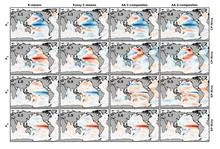
El Niño Flavors: An Ocean Palette Instead of Two Colors
An artist painting the ocean does not limit themselves to two colors: warm and cold. Likewise, climatologists studying El Niño increasingly speak of a whole palette of shades. El Niño is a warm current off the coast of Peru that, every few years, alters weather across the planet. Its counterpart, La Niña, brings cold.
Record CO₂: When the Planet's Lungs Held Their Breath
The carbon cycle is like the planet's breathing. Forests and oceans inhale carbon dioxide, while industry and wildfires exhale it back. In 2023, that inhale became gasping and shallow. At the Mauna Loa station, instruments recorded that CO₂ concentrations rose by 3.37 parts per million over the year, 86% faster than the year before.
The Planet's Breath Stumbles: How El Niño Stilled Earth's Lungs
From July 2023 to July 2024, Earth's atmosphere gained carbon dioxide at a rate of 3.66 parts per million per year. That is the fastest pace since 1979. The reason is not that factories and cars suddenly started emitting more CO₂. The planet's lungs—forests and soils—took a shallower breath. The planet breathes through its green cover.
Galaxies2025-07-283 minarXiv:2507.20684
One in Three Sun-Like Stars Is Born with a Tilted Disk
A spinning top tilted over a table, with a dusty pancake swirling around it. That is what a young stellar system looks like when the star's spin axis and the plane of its protoplanetary disk do not align. Until recently, astronomers did not know how common such a configuration is in nature.
Ice in the Shadows: SPHEREx Spots Vanishing Ice in Prestellar Cores
Deep inside a molecular cloud, where temperatures drop to 10–20 kelvin and gas densities reach a million particles per cubic centimeter, a frozen shadow prevails. There, far from starlight, water, carbon dioxide, and other molecules freeze onto dust grains.
Stellar2025-08-253 minarXiv:2508.18348
The Signature of Infalling Gas in the Light of a Newborn Planet
In 2022, the Subaru telescope photographed a point of light 100 astronomical units from the star AB Aurigae. The point was named planet AB Aur b, but debates did not subside: what exactly is glowing, the planet itself or dust around it?
Titanate Clouds Above a Scorching Giant
The dayside of WASP-121b is scorching at 2358 kelvins, hotter than the surface of many stars. Here, in perpetual light, the atmosphere does not just boil: it melts rock and turns it into gas. But not all gas stays gaseous. Some condenses into clouds, and those clouds hide titanium the way a trap hides its prey.
Galaxies2025-09-082 minarXiv:2509.06787
Seven Embryos in One Disk: The Birth of an Extreme Stellar Family
In the dark cloud NGC 6334I-North, 5500 light-years from Earth, the ALMA radio interferometer spotted something unexpected: around a young massive star, a disk of gas and dust is swirling, and inside it are seven dense clumps. Each one could become a star. This is what the birth of a stellar family looks like, and an unusually large one at that.
Galaxies2025-09-122 minarXiv:2509.10615
The Invisible Janitor at the Heart of the Milky Way
At the center of the Milky Way, 27,000 light-years from Earth, lives the supermassive black hole Sagittarius A*. It weighs in at four million Suns. It does not flare brightly like quasars; instead, it smolders almost imperceptibly. For a long time, astronomers debated whether it blows a wind. Now we have the answer: it does.
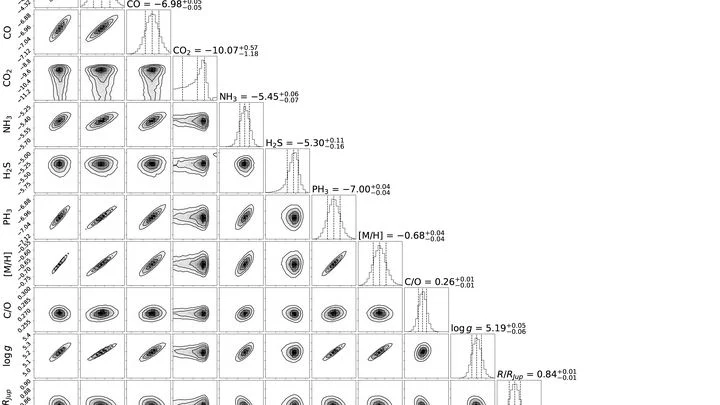
Sulfur in the Sky of a Warm Neptune: Sulfur Dioxide in the Atmosphere of HAT-P-26 b
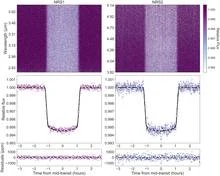
In 2023, the James Webb Space Telescope turned its gaze toward a distant star in the constellation Virgo. Orbiting it is HAT-P-26 b, a warm Neptune, a world with a mass of 18.6 Earths and a radius of 6.33 Earths. The planet transited across the star's disk, and at that moment its atmosphere became briefly visible.
Red Dots as Gravastars: A Birth Mechanism
The James Webb Space Telescope has spotted a scattering of compact objects in the early universe, nicknamed 'little red dots.' They are too red and too dim to be ordinary quasars, and astrophysicists are scratching their heads over what powers them.
Stellar2025-10-041 minarXiv:2510.03916express
Exoplanets2025-10-061 minarXiv:2510.04863express
The Invisible Planet in a Carbon Cocoon: How a Hot Neptune Cheated Death
Astronomers couldn't understand why the 'hot Neptune desert' — a region right next to stars — has almost no Neptune-sized planets. It was thought that there they are doomed: the star's proximity boils off the atmosphere, leaving a bare rocky core. But the exoplanet LTT-9779 b, 29 times heavier than Earth and with a 19-hour orbit, survived.
Exoplanets2025-10-071 minarXiv:2510.06366express
Exoplanets2025-10-081 minarXiv:2510.07378express
Hydrogen Atmospheres on Scorching Planets: The Volcano Secret
Many planets around other stars — exoplanets — have elongated orbits. With each close approach, the star’s gravity squeezes and stretches them, like kneading dough. Friction heats up the interior to the point where rock melts, creating underground oceans of magma.
Exoplanets2025-10-101 minarXiv:2510.09809express
Exoplanets2025-10-101 minarXiv:2510.09920express
Comets around an alien star reveal their sizes
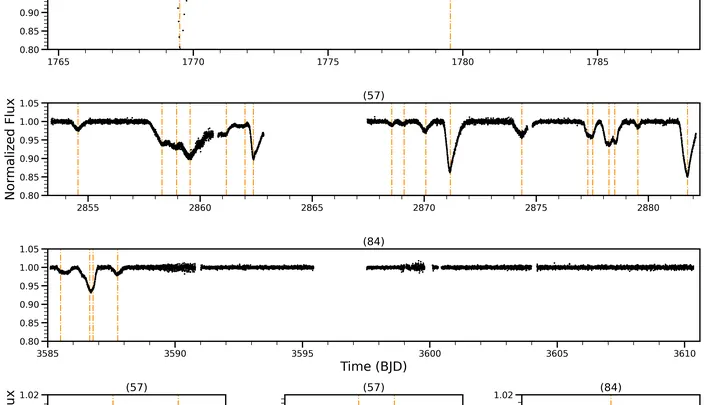
The TESS telescope, usually hunting for planets around other stars, spotted 24 dimmings around RZ Psc. These were comets — chunks ranging from 1 to 7 km in size, transiting the star's disk. Like a distant searchlight momentarily blocked by a tiny pebble: the deeper the shadow, the larger the object.
Exoplanets2025-10-111 minarXiv:2510.10344express
Can the Moon have its own moon?
The Moon can have its own tiny moon — like a nesting doll, but in space. The outer doll is a planet, the middle one is a moon, the inner one is a small moon-satellite, or submoon. Ньютон showed that all bodies attract each other, and gravity holds them together.
Exoplanets2025-10-161 minarXiv:2510.14229express
Exoplanets2025-10-281 minarXiv:2510.24575express
The Hunt for Moons of Rogue Planets
In the vast darkness of interstellar space, the rogue planet WISE 0855 flickers with a barely perceptible heat glow, like a cooling ember. Its temperature is only a few dozen degrees above freezing — if life existed there, it would see a sunless sky, in an eternal icy haze.
Exoplanets2025-11-021 minarXiv:2511.00952express
Lunar Heating: How Tides Prolonged Earth's Magma Ocean
After the Moon's birth, Earth resembled a sizzling lump of dough: a continuous liquid magma and a dense shroud of gases. The Moon acted like a giant spoon, constantly kneading this lump with its gravity. Friction generated heat, delaying cooling.
Exoplanets2025-11-031 minarXiv:2511.01351express
Planetary pressure cooker: how gas and rock give birth to oceans
The most common type of planet in our Galaxy — rocky worlds around other stars, or exoplanets, shrouded in the simplest gas hydrogen. Their innards remained a mystery until scientists recreated the conditions of the interior in the lab.
Exoplanets2025-11-091 minarXiv:2511.06507express
How Hydrogen and Magma Create Water Deep Inside Planets
Sub-Neptunes — worlds slightly smaller than Neptune — are common among exoplanets. They are detected using the transit method (by the dimming of a star), pioneered by William Borucki.
Biological Physics2025-11-091 minarXiv:2511.08624express
Which Stars Can Give Birth to Life? The Answer's in the Color
Life began with molecules akin to natural sunscreen — based on carbon, they soaked up the mild ultraviolet of the young Sun and turned it into heat. This way of dissipating energy wasn’t just heating: it made molecules self-organize, like chefs kneading structured dough out of a chaos of ingredients. But ultraviolet is a finicky tool.
Exoplanets2025-11-181 minarXiv:2511.14407express
New Schedule for Faraway Worlds
A bus schedule drifts: if you don't check it, you'll miss your ride. Planets around other stars have the same problem – their crossings of the star's disk gradually shift. The ExoClock project pooled 30,000 observations from Earth and space to refine the schedule for 620 distant worlds. For 45% of the planets, transits were found to be off by hours.
Exoplanets2025-11-191 minarXiv:2511.15317express
Shadow or Mirage: Hunting a Moon Around a Scorching Jupiter
The hunt for exomoons — the search for satellites around planets of other stars — resembles watching shadows in a theater where the spotlight keeps fading and flaring. The planet Kepler-167e, a gas giant near a scorching star, was discovered by William Borucki and his team.