Scientist

R. A. Rossiter

1886–1977 · astronomy, astrophysics
American astronomer, jointly with D. B. McLaughlin discovered the Rossiter–McLaughlin effect, which allows measuring the projection of a star's rotation onto the line of sight by the distortion of radial velocity curves during eclipses. The effect is widely applied in studies of transiting exoplanets to determine the orientation of planetary orbits relative to the rotation of the parent stars.

Biography

Richard Alfred Rossiter was born in 1886. He was educated at the University of Michigan, where he worked for most of his career at the observatory. He studied binary stars, variable stars, and galactic rotation. His first scientific publication on the effect of radial velocity distortion due to stellar rotation was published in 1924 based on observations of the Beta Lyrae system.

Key discoveries

💡 Rossiter published his work on the influence of rotation on radial velocities in the same year as McLaughlin (1924), but they worked independently. The effect was recognized only many years after the first works.
"He noted that observing the rotation of stars through their spectra opened a new era in astrophysics."
Concepts
exoplanetexoplanet atmospherespectroscopytransit method
Laws
Doppler effect
Scientists
Robert HookeJohann Jakob BalmerJocelyn Bell BurnellArno PenziasCharles TownesJames Clerk MaxwellErwin SchrödingerCecilia Payne-Gaposchkin

Related articles

High Energy2026-03-042 minarXiv:2603.04679express
X-ray Doppler Tomography: A Velocity Map of a Binary System
A stone thrown into water creates expanding ripples; if the stone moves, the ripples bunch up in front of it. This effect, discovered by Christian Doppler, applies not only to sound or water waves but also to light: when the source moves, its color shifts — toward the blue end of the spectrum when approaching, toward the red when receding.
Optics2026-03-072 minarXiv:2603.07124express
Light Changes Color as It Passes Through a Vibrating Grating
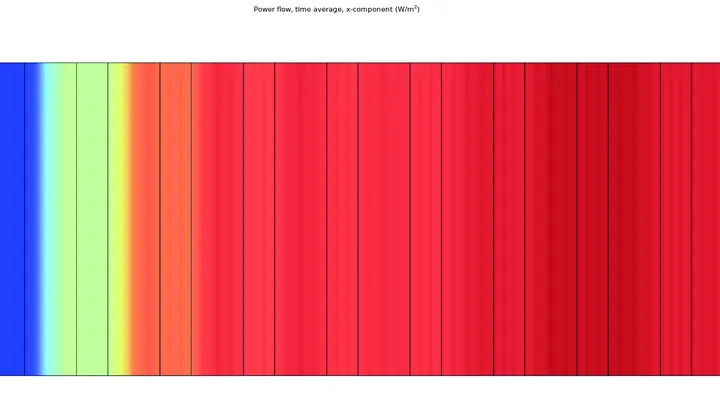
A beam of light passing through a transparent plate usually keeps its color. But if you stack the plate from thin alternating layers, it becomes a grating that reflects and transmits waves selectively. This has long been used in lasers and optical filters. Now such gratings have been made to vibrate, and light started changing color.
Stellar2026-03-181 minarXiv:2603.17241express
Waves on a Solar Streamer: Slow Eruptions Can Do It Too
Above the Sun's surface hang long ribbons of glowing gas — streamers. They look like giant harps stretched across the corona. When a wave runs along such a ribbon, it trembles and bends like a string after being plucked. For a long time, it was thought that only a very fast ejection of material, one traveling at more than 500 kilometers per second, could launch such a wave.
Optics2026-03-282 minarXiv:2603.27275express
Waves Frozen Beside a Moving Source
A swimmer cutting through water at the speed of the waves running on it finds themselves in a strange position: the waves they themselves generate can neither overtake them nor fall behind. They pile up at the swimmer's bow and freeze. A similar phenomenon occurs when a light source moves inside a medium at a speed matching the speed of energy transfer of the waves.
Cosmology2026-05-043 minarXiv:2605.03004
Ocean of Currents: Why the Universe's Acceleration Varies with Direction
Cosmology holds that on large scales, the Universe is a calm ocean without storms or currents. This is the cosmological principle, the foundation of the standard ΛCDM cosmological model.
Long-Throat Wormholes: How Doppler Notes Give Them Away
When a black hole steps into the lens, it leaves a perfect darkness in the image — a gravitational well where light falls forever.
General Relativity2026-05-191 minarXiv:2605.20354express
A Vortex's Silent Patch Reveals Its Speed
In a water vortex swirling toward the drain, the flow speed near the center can exceed the speed of sound. Sound gets trapped: waves cannot escape back, forming a silent region — a sound shadow. Half a century ago, William Unruh realized that this is an exact copy of a black hole, but for sound instead of light.
Quantum Physics2026-05-201 minarXiv:2605.21206express
How Motion Teaches a Detector to Distinguish Directions
An ordinary photometry detector can't tell a left photon from a right one. But let it start moving, and everything changes. Imagine a rower moving between two flutists playing the same note. His ear is perfectly tuned to that note and ignores all others. As he moves, the pitch from the flutist ahead sounds higher, and from the one behind sounds lower.
Quantum Physics2026-05-241 minarXiv:2605.27447express
Light under Control: One-Way Photons Without Magnets
Light loves symmetry: in an open channel, it flows equally both ways. To steer it one way, physicists often use magnets. A new approach does without, using rotation — just the speed of a vinyl record — and interference from two atoms. Rotation changes the “pitch” of light for different directions, just as a siren’s tone shifts when a car approaches or recedes.
Signal Processing2026-07-161 minarXiv:2607.15127express
Lightweight AI for Space Communications: More Accurate and Efficient
Communicating with a satellite is like trying to hear a whisper in a storm: the signal drowns in noise. Engineers have created an AI algorithm that runs directly on the satellite and, with minimal power consumption, detects distortions more accurately than previous methods.
General Relativity2026-07-292 minarXiv:2607.27343express
Gravity Overflows Its Banks
A cloud of waves collapses under its own gravity. While it's loose, everything goes by the book: the field oscillates gently in nearly flat space, and approximate formulas work perfectly. But add just a bit more energy, and the picture changes. Physicists used a numerical model to catch the moment when simple calculations stop describing reality.
Koopman Operator Hears a Change in Tone of an X-Ray Binary Days Before Its Outburst
The interpreter in the meeting room hears the shift in tone before it is spoken aloud. They catch subtle changes in breathing, pauses, and intonations, and already know that in a few minutes the conversation will turn heated.