Gravitational Atoms: When Boson Stars Break the Laws of Energy
Original: "Boson Stars in Teleparallel Gravity with a Nonminimally Coupled Field: The Violation of Energy Conditions and Gravitational Waveforms from EMRIs"
Excited states of boson stars in teleparallel gravity exhibit negative energy density and generate unique gravitational waves, paving the way for testing modified theories.
Links in the knowledge graph 1
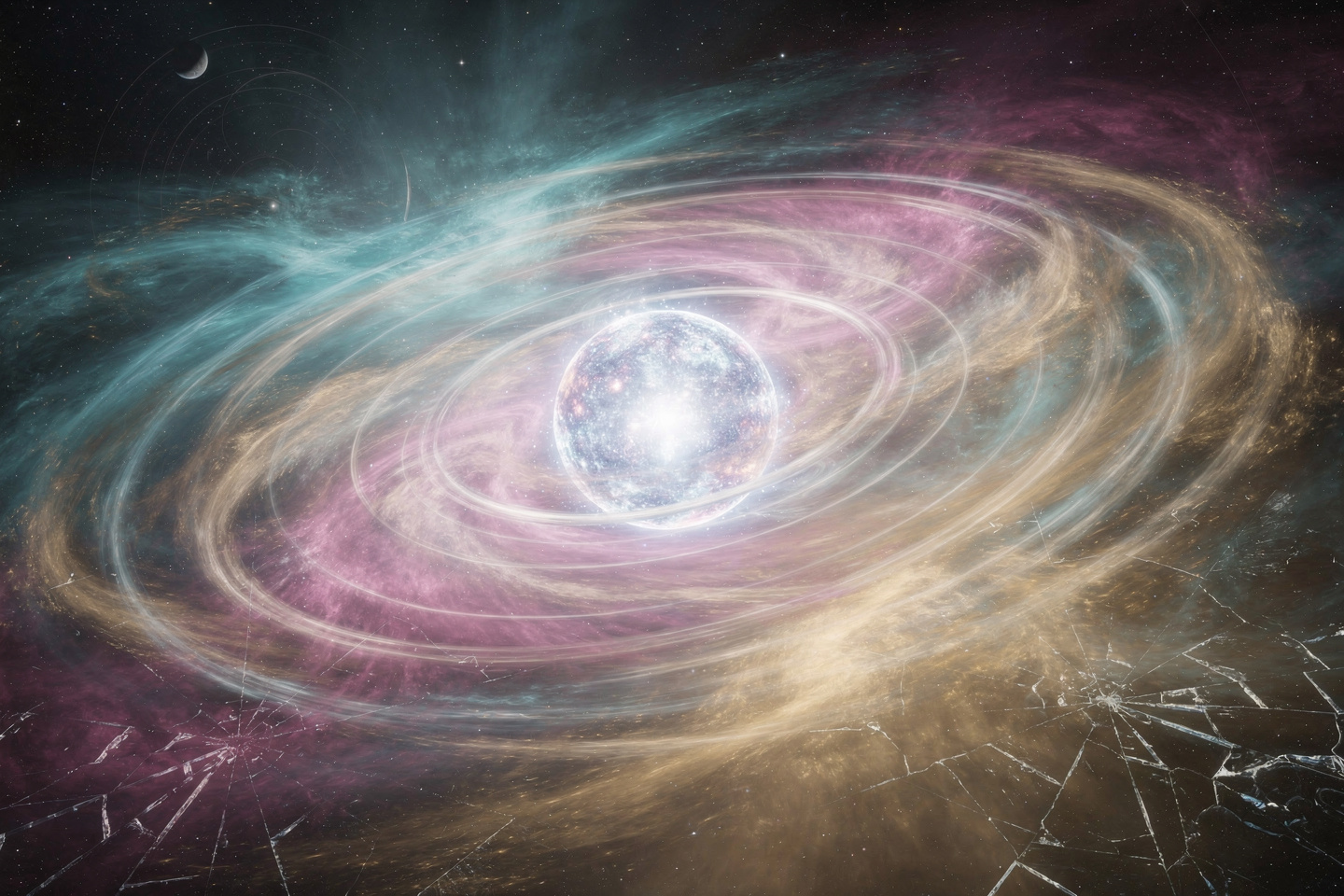
Boson stars are gravitational atoms: clouds of scalar field in quantum orbits around their own gravity. In excited states, their energy becomes negative—laws that forbid this are violated. Their gravitational waves can be caught by LISA. We are on the verge of detecting objects without an event horizon, and this will change our understanding of spacetime.
🎯 Boson stars are sometimes called 'gravitational atoms': just as electrons surround a nucleus, a quantum scalar field is held together by its own gravity, forming discrete levels with different numbers of nodes.
S = \int d^4x\, h\left[ -\frac{T}{2\kappa} - \xi \Phi^*\Phi T + \mathcal{L}_M \right]
The action of teleparallel gravity: S is the total action, h is the determinant of the tetrad, T is the torsion scalar, κ=8πG, ξ is the coupling constant of the scalar field Φ to torsion, ℒ_M is matter. This is a generalization of Einstein's theory, where geometry is described not by curvature but by torsion.
Scientists
Alan GuthAndrei LindeGeorges LemaîtreJames PeeblesStephen HawkingJacob Bekensteingravitational waves
black hole
neutron star
dark energy
dark matter
Time dilation
Standard ModelLaws
Friedmann equationsHawking radiationgravitational lensingNoether's theoremBekenstein-Hawking entropyEinstein field equations