Gravitational Atoms: When Boson Stars Break the Laws of Energy ✛ ✎
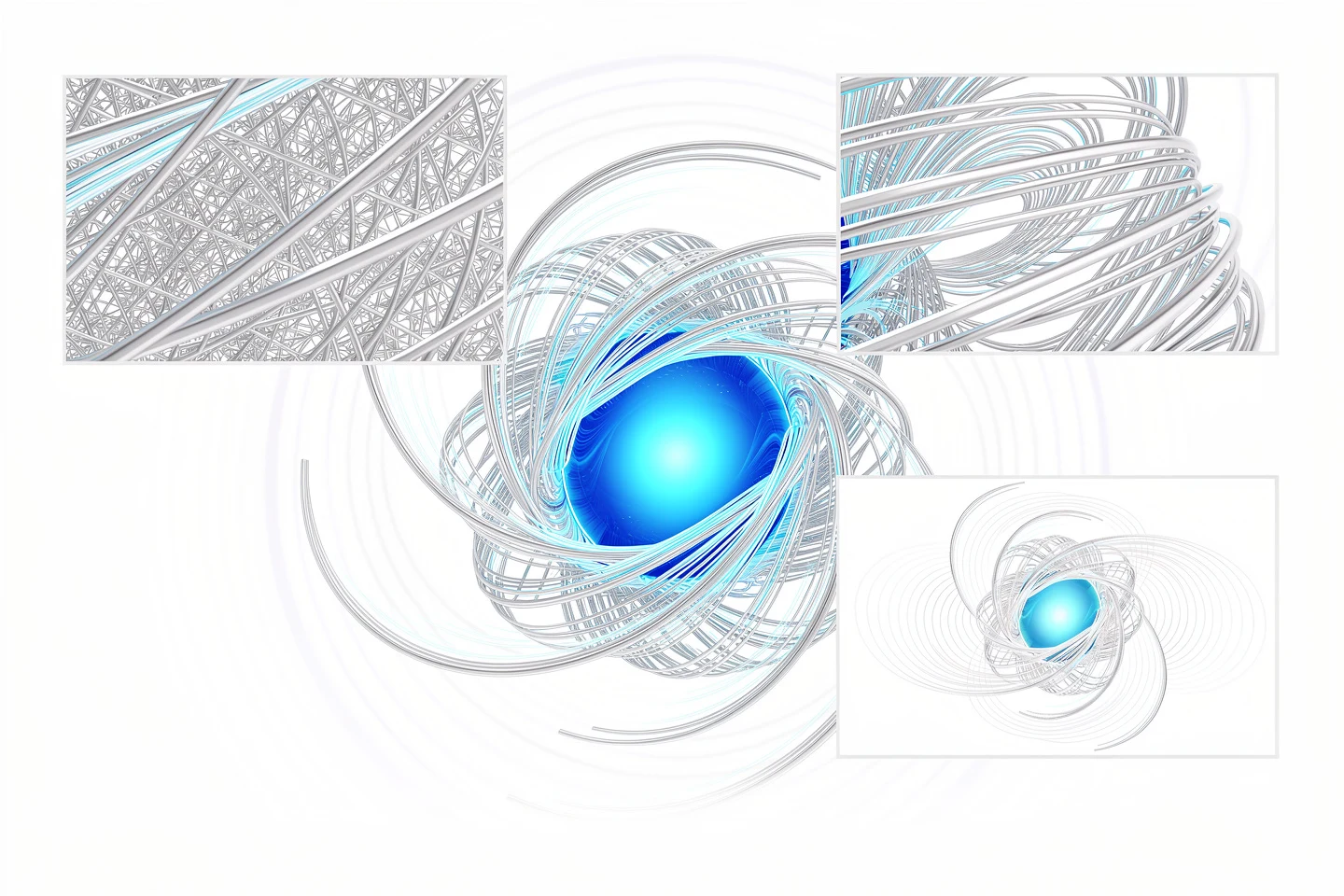
Boson stars are gravitational atoms. Only instead of electric charge, gravity itself serves as the nucleus, holding a cloud of scalar field in quantized clumps. Back in the 1930s, Fritz Zwicky suspected a lack of visible mass in galaxy clusters, and Vera Rubin later confirmed it from the rotation of spiral galaxies. Thus the mystery of dark matter was born. Today, candidates range from elementary particles to primordial black holes, but boson stars hold a special place: they are quantum, macroscopic, and lack an event horizon. In an expanding Universe, where dark energy pushes galaxies apart, testing new theories of gravity becomes urgent. One of them — teleparallel gravity — replaces curvature with torsion and allows an unusual coupling of scalar fields with geometry.
In a new study, Chinese physicists constructed static spherically symmetric solutions for a complex scalar field non-minimally coupled to the torsion scalar T. Like an electron in higher orbits, the field can exist in excited states with nodes — regions of zero density. And here the most surprising part begins. For sufficiently strong coupling (ξ>30), the energy at some points becomes negative, violating all classical constraints: the null, weak, dominant, and strong energy conditions. It is as if quantum prohibitions gave way under the pressure of monstrous gravity. Meanwhile, the compactness of such objects reaches C~0.3—higher than that of neutron stars (C~0.2) and almost matching the Buchdahl limit. The effect of gravitational time dilation additionally imprints signals, delaying the wave phase like thick oil slows music.
The predictions for gravitational waves lend special value to the work. Scientists simulated systems with extreme mass ratios (EMRIs): a boson star of a million solar masses and a body of ten solar masses falling along different orbits. Trajectories that penetrate inside the star give rise to a continuous modulated chorus, while grazing ones produce rare bursts, resembling black hole mergers. And most importantly: these signals lie in the 0.003–0.1 Hz range, exactly where the LISA space antenna will operate. The development of such detectors is owed to the pioneering ideas of Rainer Weiss and his colleagues, who gave us the gravitational-wave sky.
The violation of energy conditions challenges Penrose's singularity theorems and could become a window into physics beyond the Standard Model. After all, if boson stars are stable (and the next step is to study their stability), they could constitute part of the dark mass and provide a key to the theory of quantum gravity. Already it is clear: we hold a tool capable of distinguishing a black hole from a horizonless object not by radiation, but by the very rhythm of spacetime. The work paves the way for constructing precise templates for gravitational wave data and, perhaps, for revisiting the law of energy conservation in strong fields.
Boson stars are sometimes called 'gravitational atoms': just as electrons surround a nucleus, a quantum scalar field is held together by its own gravity, forming discrete levels with different numbers of nodes.