Stars like reverse springs: gravity with a surprise ✛ ✎
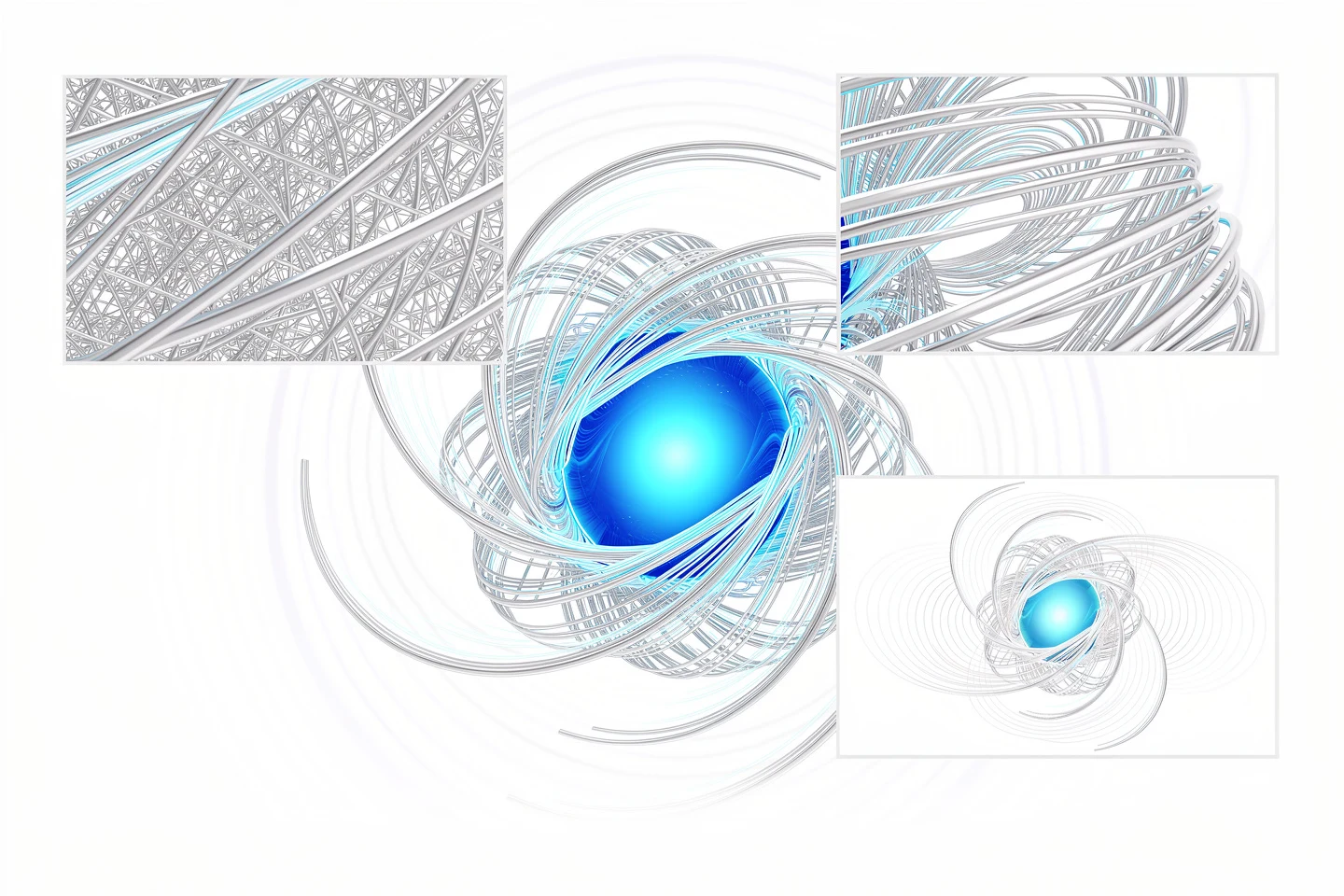
Imagine a spring: if you compress it, it resists and pushes back. That's similar to how ordinary matter interacts with gravity — it attracts. But what if there was a spring that, when compressed, does not resist but instead pushes outward? That's exactly the kind of 'reverse spring' that appears in unusual states of boson stars.
These star-like objects consist not of atoms but of a quantum field — like invisible clumps of energy. Back in the last century, astronomer Fritz Zwicky suspected hidden mass in galaxies, and Vera Rubin confirmed it by observing the rotation of stars. Perhaps part of this dark matter is made of boson stars. New research shows that if such a star 'vibrates' in a specific way, regions with negative energy appear within it. This strange behavior challenges conventional rules and arises naturally in modified theories of gravity that attempt to explain dark energy — the mysterious force accelerating the Universe. In the strong field of such a star, noticeable time dilation occurs, altering signal frequencies. These effects leave a distinctive imprint on gravitational waves — ripples in space, discovered thanks to the ideas of Rainer Weiss. All this goes far beyond the Standard Model of particle physics and may be tested by the future space-based detector LISA.
Boson stars are sometimes called 'gravitational atoms': just as electrons are held around a nucleus, the quantum field holds itself together by its own weight, forming levels.