Triple Black Hole Waltz: How Chaos Spawns Mergers
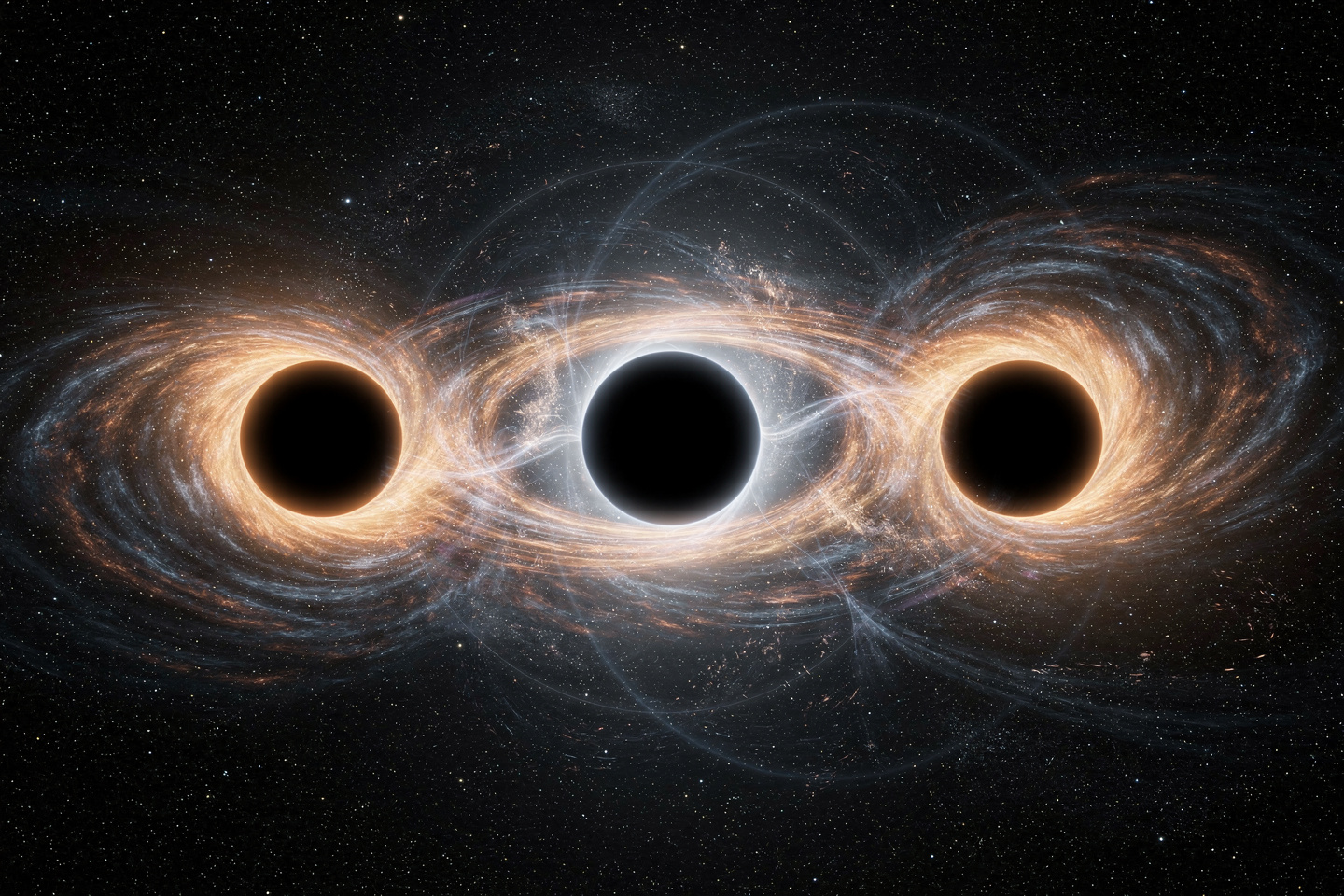
At the centers of galaxies, an invisible game unfolds: black holes whirl in a triple waltz, and sometimes the third partner abruptly hastens the finale. A tilt of just a few degrees—and billions of years of waiting collapse into hundreds of millions. Chaos proves to be the architect of mergers. By 2035, the LISA detector will be able to hear this gravitational music—all that remains is to decipher the score.
🎯 In triple black hole systems, orbital eccentricity can soar so high that mergers occur in thousands of years rather than billions—as if nature itself hits the fast-forward button.
🎬 The theme of triple systems and chaotic interactions echoes the plot of Liu Cixin's novel 'The Three-Body Problem,' where the instability of three suns' orbits determines a civilization's fate. In reality, our models predict no less dramatic outcomes: from swift mergers to the ejection of a black hole into intergalactic space.