Triple Black Hole Waltz: How Chaos Spawns Mergers ✛
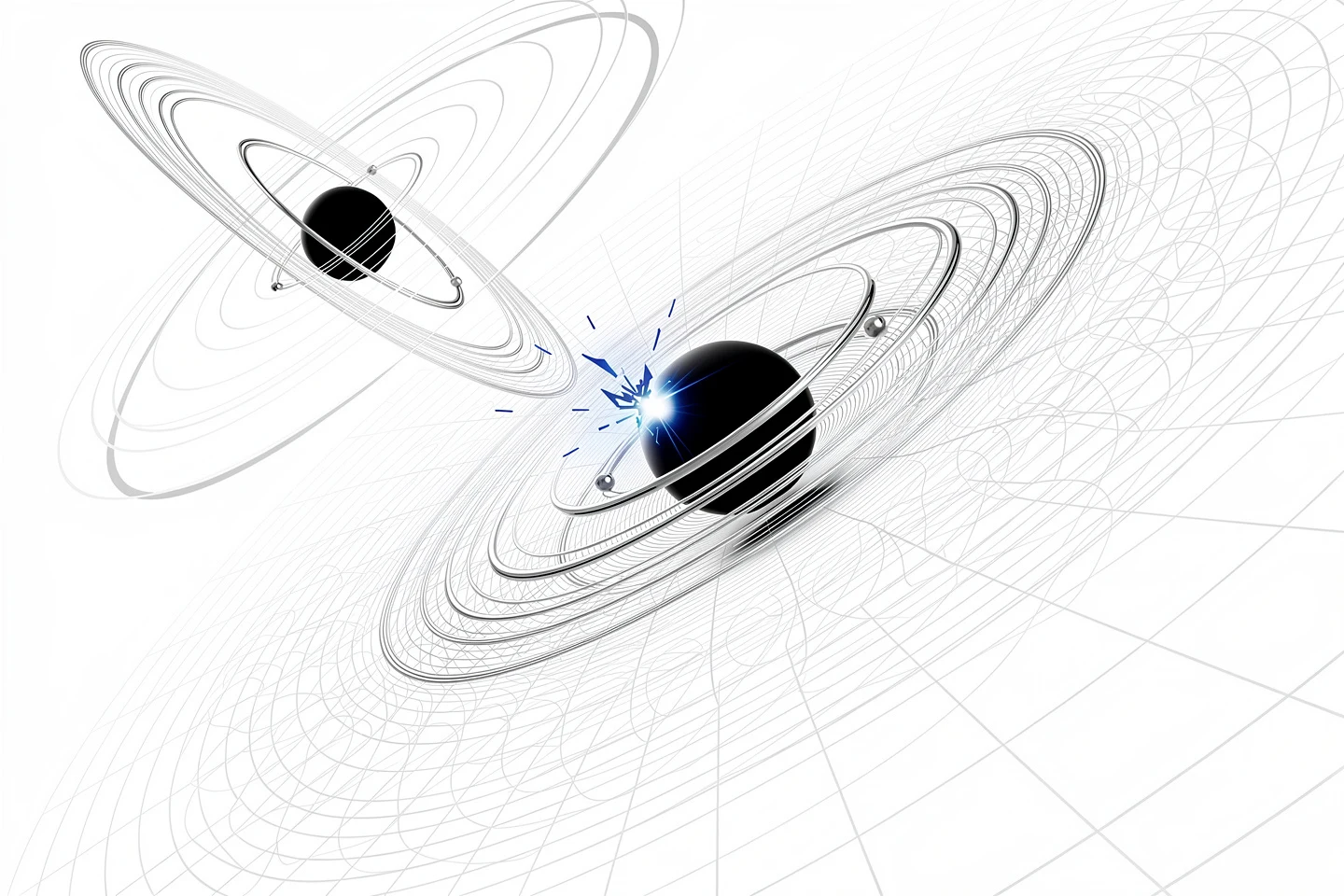
At the heart of almost every galaxy slumbers a supermassive black hole — the invisible conductor of a stellar orchestra. When galaxies collide, their central monsters draw closer, entwining in a gravitational dance. Sometimes a third partner joins the duo, and then a triple waltz begins, its outcome unpredictable. A new work for the first time enacted this piece inside a living simulation, breathing gas and dark matter, and discovered: the third is far from extraneous.
The key problem that tortured theorists is the 'final parsec': a pair of black holes just a few light-years apart seemingly get stuck, unable to draw close enough to emit gravitational waves. Dynamical friction, first described by Subrahmanyan Chandrasekhar, loses its effectiveness, and an extra push is needed. That push could come from a third hole or a gaseous disk. The authors extended the RAMCOAL code, stitching in semi-analytical recipes for all stages — from inspiral to the final scream of gravitational waves racing away at the speed of light. For the triple mode, they introduced a seven-state classifier that recognizes the moment when an orderly minuet gives way to chaotic Brownian motion.
The results force us to rethink growth scenarios for supermassive black holes from the era of the early universe to the present day. James Webb is already finding compact galaxies with dual active nuclei, and now we understand: the third hole could have played a decisive role. Each final chord (merger, ejection, or stalling) leaves its imprint on the gravitational wave signal, which is caught by networks of pulsars (PTA), inheriting methods pioneered by Jocelyn Bell Burnell. The Karl Schwarzschild metric describes the void around a lone hole, but in a triple dance, spacetime twists in far more complex ways.
Ahead lies the launch of the LISA mission, which will directly hear these mergers. The model will become the foundation for synthetic catalogs, linking signal parameters to the makeup of the host galaxy, including its dark halo. In this way, we will learn to read the history of cosmic cataclysms from the gravitational echo. The triple black hole waltz is not just an exotic curiosity but a natural mechanism that packs billions of years of evolution into one powerful burst.
In triple black hole systems, orbital eccentricity can soar so high that mergers occur in thousands of years rather than billions, as if nature itself hits the fast-forward button.
The theme of triple systems and chaotic interactions echoes the plot of Liu Cixin's novel 'The Three-Body Problem,' where the instability of three suns' orbits determines a civilization's fate. In reality, our models predict no less dramatic outcomes: from swift mergers to the ejection of a black hole into intergalactic space.