Cosmic Billiards: The Triple Play of Black Holes ✛
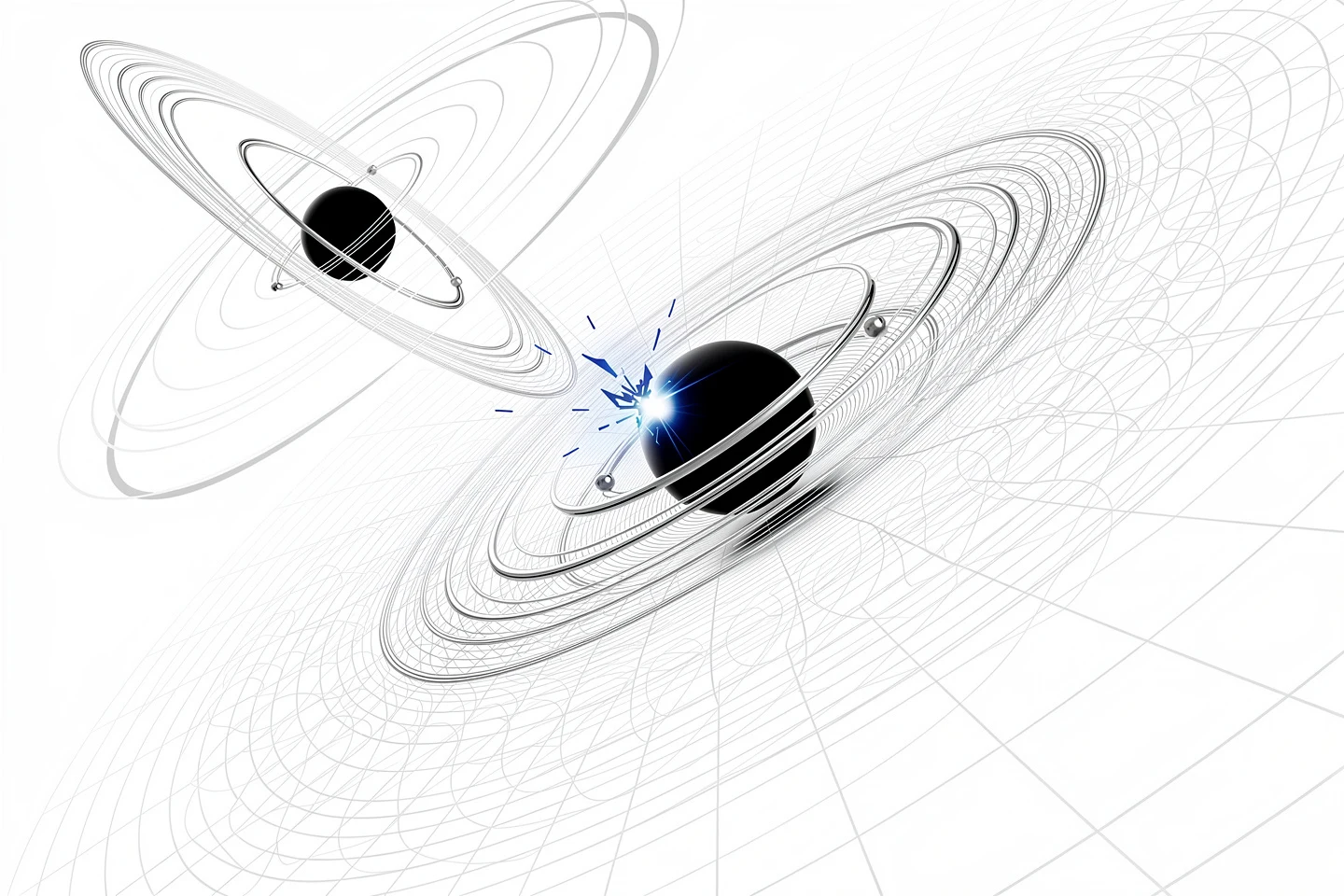
Imagine a billiard table with three balls zipping around. They collide, change direction, and you never know where the next shot will go. Roughly the same thing happens in the centers of galaxies when three supermassive black holes meet.
Scientists have created a computer model that for the first time traces the entire history of such a triple — from slow approach to final collision. Previously, such calculations were too simplified or didn't account for the surrounding gas and stars. Now we can see how the tilt of the third hole's orbit or an extra gulp of gas changes the outcome: sometimes pairs merge in hundreds of millions of years, and sometimes get stuck for many billions. When they merge, gravitational waves are born — ripples in space itself, traveling at the speed of light. Scientists detect them using pulsars — cosmic lighthouses discovered by Jocelyn Bell Burnell.
All this complex mechanics rests on laws established by pioneers: Subrahmanyan Chandrasekhar explained how stars move in galaxies, and Karl Schwarzschild was the first to describe black holes mathematically. Now we know that the holes' dance is hugely influenced by invisible dark matter enveloping the galaxy — without it, many mergers simply wouldn't happen.
In a triple system, a black hole can sharply accelerate the merger of the other two, like a billiard ball that with a precise shot pockets both of its neighbors at once.
This work vividly recalls the novel "The Three-Body Problem" by Liu Cixin: there, the chaos of three suns determined the fate of a civilization, while here the chaotic dance of three black holes decides whether they merge or fling one out into intergalactic void.