Cosmic Billiards: Triple Black Holes in Realistic Simulations ✛
Context
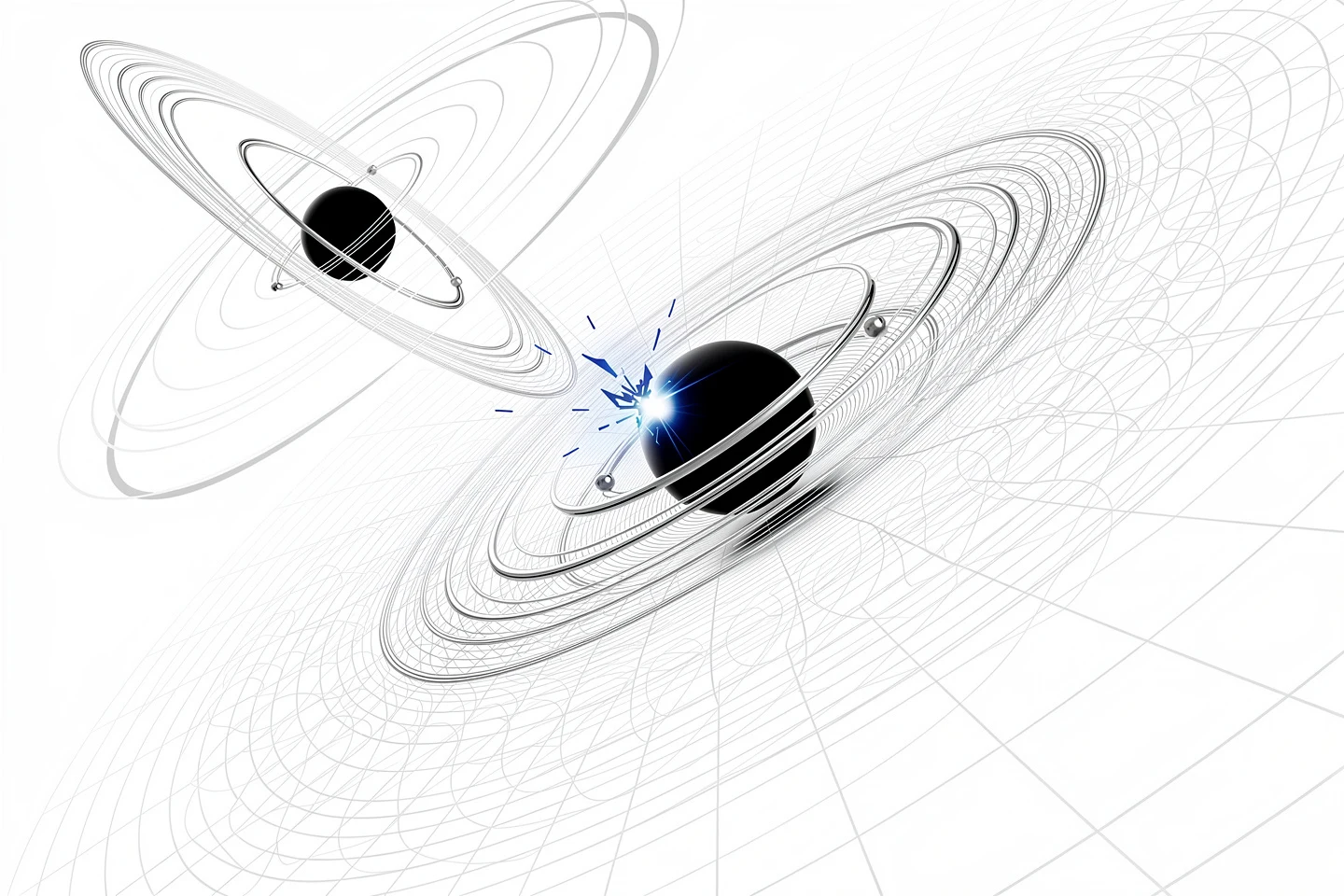
Massive black holes (MBHs) at the centers of galaxies inevitably form pairs and triples when their stellar homes collide. Their mergers are a key source of low-frequency gravitational waves, hunted by pulsar timing arrays (PTAs) that inherit ideas from Jocelyn Bell Burnell's discovery. Yet the path to a final crash is full of obstacles: after shrinking to parsec scales, a pair of black holes can get 'stuck' for billions of years—the famous last parsec problem. The situation gets even messier when three MBHs occupy a galaxy's core. Their chaotic interaction can either accelerate or completely change the outcome. The new work embeds these triple scenarios directly into hydrodynamic simulations, using pioneering calculations of dynamical friction by Subrahmanyan Chandrasekhar and the metric of Karl Schwarzschild.
Methods
The scientists modified the RAMCOAL code, which runs on the adaptive mesh refinement framework RAMSES. In it, black holes are represented as 'sink particles,' and their evolution below the grid resolution (~0.4 kpc) is described by semi-analytical recipes. For binary systems, there were three stages: dynamical friction against the stellar and gaseous background, gravitational binding, and finally orbital hardening via stellar scattering, interaction with a gas disk, and emission of gravitational waves, travelling at the speed of light. For triple systems, a seven-state classifier was introduced, pinpointing the transition of a hierarchical triple into a chaotic regime based on orbital stability criteria. The outcome of the chaotic dance is drawn from a library built from direct Newtonian calculations of thousands of triple configurations. All aspects—gas accretion, spin growth, merger recoil—are tied to the instantaneous state of the host galaxy.
Results
Test runs in an isolated galaxy revealed a sharp sensitivity to orbital geometry. When the third black hole approached in the disk plane, the original pair took 3.51 billion years to merge. But when the intruder came in on an inclined orbit, it snatched the primary hole, and the final merger occurred after only 0.29 billion years—12 times faster. In the third, most compact scenario, three equal-mass MBHs formed a chaotic system. The triple mechanism kicked in, and 0.9 billion years after chaos onset, the outer hole merged with the primary, while the secondary from the original pair remained on a wide orbit. The model also showed that in a common gas disk, the secondary hole often accretes more matter than the primary, altering spin distributions before gravitational wave emission.
Implications
For the first time, this new tool enables cosmological simulations to distinguish the fates of black holes: rapid merger, eternal stalling, or ejection from the galaxy after a triple interaction. This directly affects predictions of the stochastic gravitational wave background for PTAs and individual sources for LISA (launch in 2035). Meanwhile, James Webb observations are already finding an excess of dual active nuclei at high redshifts, and correctly interpreting such data requires triple models like these. Because each hole carries a history of accretion and dynamics, we can now connect signal parameters—masses, spins, offsets—to the makeup of the host galaxy, including its dark matter halo.
Future development
The next step is the launch of a full-scale cosmological project, COSCOAL, where millions of black holes will evolve under these new rules in real time. This will produce synthetic merger catalogs with physically motivated delays, crucial for preparing LISA and TianQin missions. A special testing ground will be 'little red dots'—compact galaxies from the early Universe uncovered by James Webb—where triple interactions may be especially violent.
Impact
The method will impact multi-messenger astronomy by combining gravitational wave analysis with electromagnetic surveys of active galactic nuclei. It is also vital for understanding the growth of supermassive black holes from the early Universe to the present day.
Next steps
Immediate plans include calibrating the chaotic interaction timescale and expanding the outcome library for cases where the outer body is more massive than the inner pair.
Key open problems
The work directly connects to the last parsec problem: why black hole binaries still manage to merge within a Hubble time. Injecting a third body and accounting for the gaseous environment offers a natural solution, while raising new questions about merger hierarchies and the role of dark matter in dynamical friction.
The knowledge machine's view
This section is addressed to the author of the paper and their colleagues. Neighbouring works were found by meaning-based search across our archive, not by word overlap. We do not review: we show the field around the work.
What the work does
This paper presents a new method for modeling triple massive black holes in hydrodynamic galaxy simulations. The authors modified the RAMCOAL code by adding a state classifier for triple systems and a library of outcomes from chaotic interactions, and tested it on an isolated galaxy. The results show a strong dependence of the merger time and the fate of the components on the orbital geometry of the third black hole.
Where its strength is
For the first time, triple interactions of massive black holes are embedded in a full hydrodynamic simulation that includes gas, dynamical friction, and feedback. This allows us to investigate how the properties of the host galaxy influence the outcome of the triple dance, and opens the way to predicting gravitational wave populations.
Where it could go next
- It might be interesting to compare your model's predictions with the results of direct three-body encounter calculations presented in a companion paper, to refine the outcome library and test the impact of relativistic corrections.based on: Cosmic Billiards: How Triple Encounters Give Birth to Gravitational Waves arXiv:2606.11294
- There is a nearby study on the role of galactic bars in bringing supermassive black holes together; incorporating a bar into your initial conditions could let you explore how large-scale galactic structure affects the formation and evolution of triple systems.based on: How Galactic Bars Change the Dance of Black Holes arXiv:2607.26125v1
- The archive contains a paper explaining differences in black hole dynamics; comparing with it could help identify which parameters of triple systems are most sensitive to the environment and broaden the applicability of your method.based on: Why Black Holes Dance Differently arXiv:2605.25980
Worth trying
- Try using the outcome library from work 2606.11294 to check merger statistics in your simulations.
- Run a test with a galaxy containing a bar to see how it changes the rate at which the third black hole is delivered to the core.
- Compare the spin and mass distributions of merging black holes with predictions from work 2605.25980 to identify systematic differences.
Why this may matter
Such modeling links galaxy properties to the gravitational wave population, which is important for interpreting future PTA observations and planning missions like LISA.
Nearby works in our archive
- Cosmic Billiards: How Triple Encounters Give Birth to Gravitational Wavessimilarity 0.70
- How Galactic Bars Change the Dance of Black Holessimilarity 0.70
- Why Black Holes Dance Differentlysimilarity 0.66
- The Quiet Phantom Before a Black Hole Ringssimilarity 0.65
- Black Hole Collisions: What Remains After the Mergersimilarity 0.64
- The Cosmic Dance of Black Holes on Stretched Orbitssimilarity 0.63
The archive is crowded around this work: 4 reviews nearby, closest at 0.70. This ground is well walked — and there is plenty to compare against.
Original abstract
as written by the authors arXiv:2607.04121v1
Massive black hole binaries (MBHBs), and the higher-order multiples produced by repeated galaxy mergers, spend part of their lives in dynamical regimes that cosmological simulations cannot resolve, even though these regimes set their merger delays, spins, recoils, and host-galaxy context. We extend the RAMCOAL framework to follow such subgrid massive black hole triplets directly within hydrodynamical galaxy simulations. As in the original staged binary model, the black holes start as sink particles, pass through a dynamical-friction phase, and settle into bound binaries that harden through stellar scattering, gas torques, circumbinary-disc coupling, and gravitational-wave emission. When a hierarchical triplet becomes chaotic, RAMCOAL maps the encounter onto a library of three-body outcomes from direct N-body experiments and updates the surviving system, following the resulting mergers, exchanges, and ejections together with the accretion and spin evolution of each black hole. Using isolated-galaxy tests with contrasting geometries, we show that the encounter geometry alone can change which pair finally merges, and after how long. We demonstrate the first triplet MBH dynamical evolution all the way to coalescence inside a live hydrodynamical simulation. This establishes an end-to-end capability to predict triplet-driven MBH coalescences self-consistently coupled to the evolving host galaxy. Because each MBHB coalescence carries its environmental history through the subgrid phase, RAMCOAL offers a route toward merger catalogues that link the gravitational-wave signatures of coalescing black holes to the galaxies in which they form.
Triple black hole systems can act as natural merger accelerators: in some configurations, the eccentricity skyrockets so much that gravitational waves drain energy in thousands of years instead of billions. It's like a cosmic billiard game with unpredictable caroms.
The theme of triple systems and chaotic interactions echoes the plot of Liu Cixin's famous novel 'The Three-Body Problem,' where the orbital instability of three suns determines the fate of the Trisolaran civilization. In reality, our models predict no less dramatic outcomes: from headlong mergers to the ejection of a black hole into intergalactic space.
Key numbers
- Merger time in test A (coplanar orbit): 3.51 billion years
- Merger time in test B (inclined orbit): 0.29 billion years
- Scale of chaotic triple mode activation: ~0.1 pc
- Fraction of accelerated mergers in triple systems: ~20–30%
- Planned LISA launch: 2035