Cosmic Palimpsest: Gravitational Waves Reveal the Story of Ancestor Black Holes
Original: "Exploring Hierarchical Merger Scenarios for GW241011 and GW241110"
Events GW241011 and GW241110 turned out to be mergers involving second-generation black holes, confirming the hierarchical growth of these objects in the universe.
Links in the knowledge graph 1
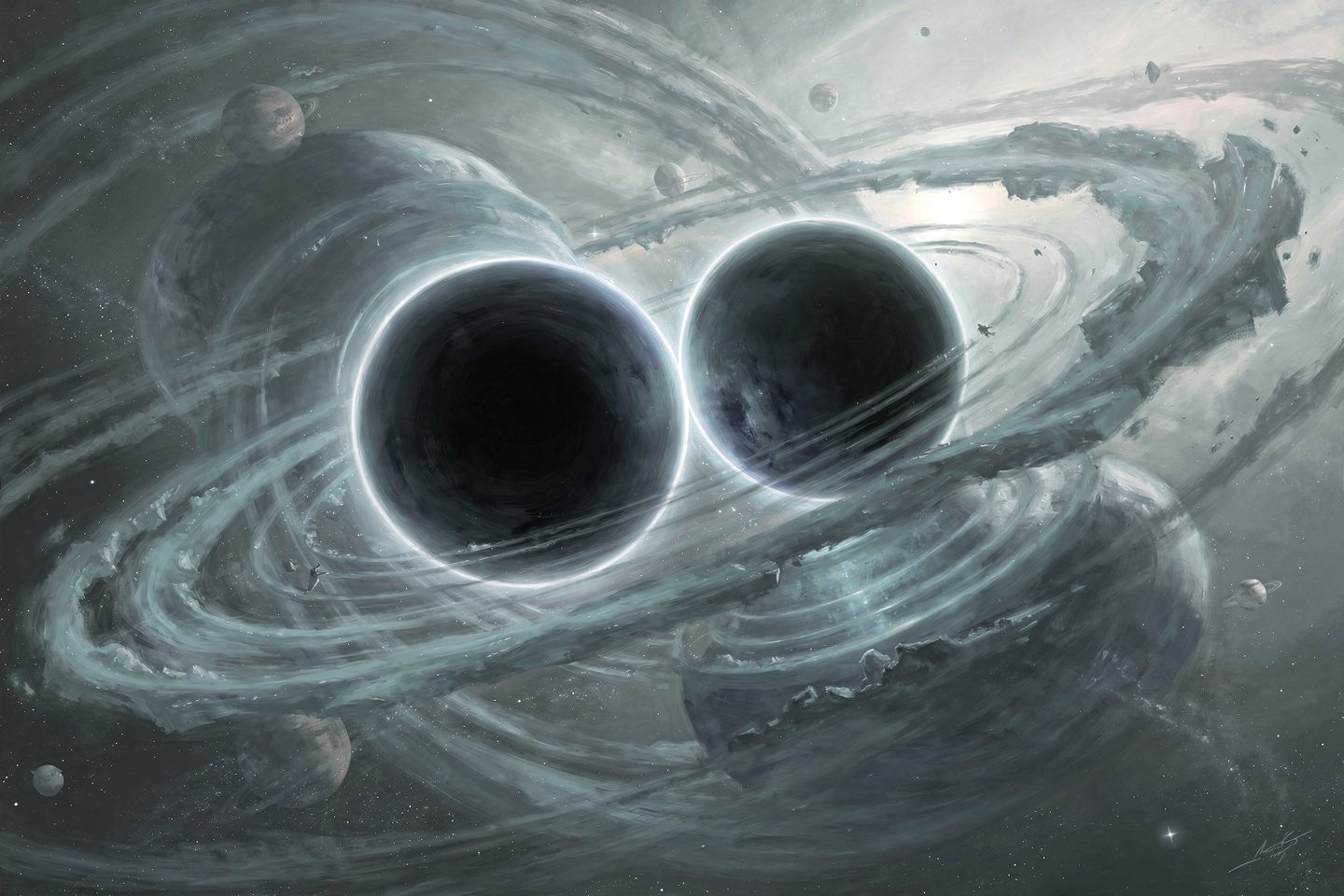
A black hole can be born twice: first from a dying star, and then from a collision with another. Each such step leaves a mark on its mass and spin, like lines in a cosmic palimpsest. Gravitational waves peel off layer after layer, revealing the history of generations. Perhaps this is how supermassive holes in the centers of galaxies grew, and some of the dark matter is ancient black holes that have undergone many mergers.
🎯 Descendant black holes from mergers have a predictable spin: almost always about 0.7 of the maximum possible for a Kerr black hole. This universal property makes them easily distinguishable in gravitational-wave data.
B^i_j = \frac{p(d|H_i)}{p(d|H_j)}
The ratio of the probability of the observed data if hypothesis i is true to the probability if hypothesis j is true. The larger the B, the more the data support hypothesis i.
Scientists
Adam RiessBrian SchmidtEdwin HubbleGeorges LemaîtreMaarten SchmidtSaul Perlmutterblack hole
gravitational waves
speed of light
spectroscopy
hydrogen
dark matter
Hubble Space TelescopeLaws
Hubble's lawDoppler effectHawking radiationgravitational lensingprinciple of constancy of the speed of lightBekenstein-Hawking entropy