Popular

Edwin Hubble

1889–1953 · Astronomy, Cosmology, Astrophysics
American astronomer who changed the view of the Universe by proving that it is expanding and that many nebulae are actually separate galaxies beyond the Milky Way. His discovery of redshift and Hubble's law became the foundation of modern cosmology.

Biography

Initially studied law, worked as a teacher and basketball coach, but then returned to astronomy. Received his doctorate from the University of Chicago. Worked at the Mount Wilson Observatory. Awarded the Catherine Bruce Medal and other honors; the famous space telescope bears his name.
Key discoveries

💡 In his youth, Hubble was a promising athlete: he won boxing championships and even turned down a career as a professional heavyweight to pursue science.
Quote: "We forever move between the unknown and the unknowable."
Links in the knowledge graph 1
Related tags
Hubble Space Telescopebig bang
Related laws
Hubble's law
Related scientists
Arno PenziasRalph AlpherStephen HawkingFred HoyleGeorges LemaîtreGeorge GamowBrian SchmidtRashid Alievich Sunyaev

Related articles

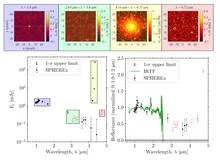
Radio Message from When the Universe Was Young

A brief radio flash came from a galaxy that existed soon after the Big Bang. The James Webb Space Telescope helped pinpoint its source—a small, clumpy cluster of stars bustling with star birth. This is the first flash traced to an object at such a distance, and it now allows us to study invisible ga
arXiv:2508.01648 · 2025-08-03

The Universe's Secret Phase: How the Dark Sector Reconciled the Astronomers

The universe is expanding, but measurements of its speed give conflicting numbers. This puzzle is called the Hubble tension. A new model suggests that in the early universe, a phase transition occurred in a hidden dark sector. It’s like the sudden freezing of supercooled water: a burst of energy was
arXiv:2508.03795 · 2025-08-05

Cosmic Clocks Diverge: A New Mystery of the Universe's Expansion

A new study used only pulsating Cepheid stars to calculate the expansion rate of the Universe. The resulting value of 71.1 (km/s)/Mpc turned out to be lower than the previous 'gold standard' and even further from the Planck satellite data. This sharpens the 'Hubble tension' and suggests our knowledg
arXiv:2509.09665 · 2025-09-11

How Dark Energy Makes Black Holes Less Destructive

Calculations show: dark energy weakens tidal forces at the black hole’s horizon. So a large object has a chance to survive if the universe’s expansion is accelerating. Without dark energy, any body would be torn apart.
arXiv:2509.18903 · 2025-09-23

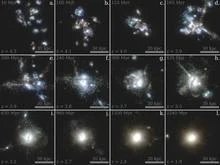
Why 'impossible' galaxies don't break cosmology

JWST data on massive galaxies at the dawn of time threatened to overturn dark matter theory. But new work shows the reason: systematic errors when converting brightness to mass. With those accounted for, 'impossible' galaxies vanish.
arXiv:2511.13708 · 2025-11-17

Black Holes Instead of Dark Energy

Researchers simulated how primordial black holes with a repulsive core accelerate the expansion of the universe. Ultra-light ones triggered inflation, while black holes with the mass of an asteroid and the size of a proton mimic early dark energy, resolving the famous discrepancy in the measurement
arXiv:2511.18080 · 2025-11-22

Universe's expansion rate refined using supernova 'twins'

By comparing supernova 'twins', astronomers eliminated the effect of cosmic dust and arrived at a more precise expansion rate. It turned out higher than what observations of the early universe suggest. The 'Hubble tension'—as this discrepancy is called—has been confirmed, meaning our picture of the
arXiv:2512.02391 · 2025-12-02

How a galaxy's shape reveals its history

Adding shape information to brightness, astronomers can forgo expensive spectrometers and solve the mysteries of cosmic dust. This method will speed up the study of millions of distant objects.
arXiv:2512.05078 · 2025-12-04

Gravitational waves and galaxy maps measure the expansion of the Universe

The expansion rate of the Universe — the Hubble constant — is key to the age and fate of the cosmos. The 'peak siren' method compared distances from galaxy light and gravitational waves. A match was found with 5.9 sigma confidence: H₀ = 67 km/s/Mpc. This is a new way to measure without relying on tr
arXiv:2512.15380 · 2025-12-17

How Galaxies 'Simmered' Metals in the Cosmic Noon Era

Astronomers studied 34 ancient galaxies with the James Webb Telescope. They precisely measured oxygen content and found that more massive galaxies are richer in heavy elements. This relationship turned out to be similar to the modern one, but computer models couldn't reproduce it. It seems the basic
arXiv:2512.16989 · 2025-12-18

Why Has Cosmology Cracked?

Different ways to measure the expansion rate, the properties of dark matter and energy, yield contradictions. Before changing physics, scientists are checking if their instruments are off. But increasingly it seems: the yeast is alive, and the recipe of the cosmos is not eternal.
arXiv:2601.01525v1 · 2026-01-04

Black Holes 'Weigh' the Expansion Rate of the Universe

Analysis of 137 black hole mergers revealed three favorite masses: around 10, 18, and 33 solar masses. A flexible analysis, like a tuner, picked out these 'notes' more precisely than previous methods. As a result, the expansion rate of the universe was refined by 21%. This shows that the better we h
arXiv:2601.03347v2 · 2026-01-06

Gravitational waves refine cosmic expansion rate

By combining gravitational waves from merging neutron stars with galaxy surveys, scientists refined the universe’s expansion rate to 67.9 km/s per megaparsec (6.4% uncertainty), bridging a long-standing debate.
arXiv:2601.04774v1 · 2026-01-08

Dark Matter and Dark Energy: A Slow Reaction

A new model shows that dark matter and dark energy can transform into each other like a reversible chemical reaction. Observational tests confirmed that this process is almost impossible — only a few thousand transformations have occurred in the entire history of the Universe.
arXiv:2601.05646v2 · 2026-01-09

Red Dots in Space Turned Out to Be Growing Black Holes

Data from the James Webb Telescope showed: mysterious red dots in the early universe are growing black holes. They emerged directly from gas clouds, without forming stars, and are now devouring matter at an incredible rate. This explains how supermassive black holes managed to grow so quickly.
arXiv:2601.14368 · 2026-01-20

Lack of Information Accelerates the Universe

Scientists have found a new explanation for why measurements of the universe's expansion rate don't match: a tiny fraction of information may be 'erased' from its visible edge. This shortage creates extra energy that slightly accelerates expansion in the last few billion years, without affecting the
arXiv:2601.17938 · 2026-01-25

Dark Dancers: When Dark Matter and Dark Energy Dance Together

The universe is expanding, but two measurement methods give different speeds—this puzzle was called the Hubble tension. Scientists have proposed a model in which dark matter and dark energy are not strangers but interact, like dance partners. This simple assumption smooths out the contradiction. Tes
arXiv:2601.19662 · 2026-01-27

Warm Emptiness Instead of Dark Energy

Many explain the galaxies' recession with dark energy — a mysterious force that does not change over time. But there's an idea to replace it with the heat of emptiness itself. The cosmic horizon — the boundary of what we see — is slightly heated. This heat pushes the Universe apart. This approach re
arXiv:2602.08522 · 2026-02-09

Cosmic Neon Sign: Gas Glows Brighter Than Stars

In a distant galaxy, almost all light comes not from stars, but from clouds of hot gas. This discovery helps understand what the Universe looked like shortly after the Big Bang. Perhaps the gas is heated by remnants of the first stars, which consisted only of hydrogen and helium. This explains why t
arXiv:2603.13471 · 2026-03-13

The Universe Sings: Resonance of Dark and Ordinary Matter

Scientists have shown that different speeds of dark and ordinary matter create a gravitational resonance. Like a bow on a string, it amplifies sound waves in ordinary matter, explaining the longevity of spiral arms and gas heating. This makes it possible to 'hear' dark matter by its seismic imprint.
arXiv:2604.22665 · 2026-04-24

Curved Cosmos: The Secret Life of the Local Universe

Using Cosmicflows-4++, scientists directly estimated relativistic corrections and found that curvature contributes about 10% to the expansion dynamics on scales up to 300 Mpc/h, while kinematic backreaction is negligible. This challenges the globality of ΛCDM and threatens systematic errors in cosmo
arXiv:2605.05454v1 · 2026-05-06

AI assistant tackles cosmology's trickiest math

Scientists test new theories of gravity to explain the accelerating expansion of the Universe without dark energy. They need to solve equations describing how tiny clumps after the Big Bang became galaxies. This used to take a lot of time. Now researchers connected a language model to a computer alg
arXiv:2605.08212 · 2026-05-06

Gravitational Radio Forest: How a Hydrogen Quantum Detector Reveals Dark Matter

Astrophysicists have proposed a new method for hunting dark matter — not searching for the black holes themselves, but listening to the quantum echo of gravity. In regions of ionized hydrogen, tidal forces from primordial black holes split the atomic level 2P₃/₂, turning a single 9.9 GHz absorption
arXiv:2605.13042v1 · 2026-05-13

Orbital Web: Why the Big Rip Will Wait at Least 30 Years

Cosmology allows for a terrifying scenario of phantom dark energy, where the universe's expansion accelerates so violently that it tears apart galaxies, stars, and atoms. Deep-space detectors can't spot a sudden shift to this state: light from distant supernovae has traveled billions of years. So Ro
arXiv:2605.13705v1 · 2026-05-13

Cosmic Booster Solves the Hubble Riddle

The Universe is expanding, but measurements of the rate from early times and today disagree — this puzzle is called the Hubble tension. A new model introduces an invisible chameleon field that recently began nudging expansion further and adds invisible mass that holds galaxies together. Near Earth,
arXiv:2605.14977 · 2026-05-14

The Devourer Universe: Dark Energy from World Mergers

In a new cosmological model, the source of accelerated expansion is not a mysterious cosmological constant but the process of absorbing other universes. The merger intensity is set by a single constant g, calibrated by the local value of the Hubble constant. The computed evolution of the dark energy
arXiv:2605.15045v1 · 2026-05-14

Virtual Universes Reveal the Cosmos with Greater Precision

Thanks to the discoveries of Edwin Hubble and Vera Rubin, we know that the Universe is expanding and contains invisible mass—dark matter. Astronomers have developed a new method: they create computer simulations to guess the Universe's properties without complex formulas. Combining maps of galaxies
arXiv:2605.26210 · 2026-05-25

A Universe Without Dark Energy? A Simple Model Bypasses the Standard One

Comparing two models: the standard one requires invisible dark energy, the alternative plays fair. Data with 92% probability support the simpler option.
arXiv:2605.28903 · 2026-05-27

The Universe Doesn't Remember Its Youth: The Echo of Quantum Gravity Can't Be Caught

Cosmologists searched for the imprint of the tumultuous birth of the universe in galaxy distance data and the afterglow of the Big Bang. But all measurements fit perfectly into the standard model, with no 'memory'. If a trace exists, it's too faint for current instruments.
arXiv:2606.00227 · 2026-05-29

Light Leaks into Darkness: How Photons Become Dark Matter

Two key methods for measuring the expansion rate of the Universe — the cosmic microwave background and supernovae — yield values differing by 5 sigma. A hybrid model adds to the cosmological redshift a contribution from quantum conversion of photons into hidden mass. Analysis of the Pantheon+SH0ES c
arXiv:2606.02097v1 · 2026-06-01

Quantum Tide from the Future: Accelerating the Universe Without Dark Energy

A new study offers a bold explanation: the accelerating expansion of the Universe isn't the result of mysterious dark energy, but a consequence of quantum boundary conditions imposed from the distant future. In a radiation-dominated model with zero cosmological constant, a final state in the form of
arXiv:2606.02514v1 · 2026-06-01

The Mystery of 'Impossible' Galaxies: How Outer Color Maps Are Rescuing Cosmology

Using NIRCam on JWST, astronomers studied four supermassive quiescent galaxies whose light has been traveling to us for over 11 billion years. It turns out that in three of them, the color shifts smoothly from center to outskirts: red old cores surrounded by bluer, younger regions. This color map re
arXiv:2606.02698v1 · 2026-06-01

Smoldering Ember in a Star’s Heart: Two Apocalypse Scenarios

These objects are one of the biggest mysteries and a possible key to dark matter. New modeling has revealed a rare but spectacular scenario with two outcomes for capture by a binary system. Without an accretion disk, the star fades unnoticed; with a disk, it is torn apart by relativistic jets in min
arXiv:2606.02700v1 · 2026-06-01

Ruby Pupae: How Dark Matter Transforms the Face of Galaxies

The James Webb Space Telescope discovered a population of 'little red dots' (LRDs) — compact objects with disproportionately massive black holes that almost disappear at z<3. A study of 98 such sources showed that at z>4 they reside in sparse regions, but by z~3.5 their environment and dark halo mas
arXiv:2606.02773v1 · 2026-06-01

Roots from the Abyss: The Secret Growth of Supermassive Black Holes

Astronomers are increasingly finding giant black holes in the early universe, with masses reaching a billion suns. Ordinary gas accretion can't 'fatten' them up fast enough. A new hypothesis introduces an extra dimension: our brane-universe and an invisible donor brane intersect at a shared horizon.
arXiv:2606.03414v1 · 2026-06-02

Red Lanterns of the Cosmos: What Compact Objects from the Early Universe Conceal

Analysis of a hundred 'little red dots' (LRDs) with JWST has shown that their ultraviolet light is redder and more compact than that of ordinary galaxies. Spectral lines of carbon, helium, and hydrogen point to extreme conditions around a black hole, whose radiation seeps through a clumpy envelope.
arXiv:2606.03522v1 · 2026-06-02

Bees of Dark Clouds: How Ions Weave Carbon Rings in Space

In the PIRENEA ion trap, a cosmic dance was recreated: benzyl-type ions intertwine with alkylnaphthalenes, birthing a photostable acenaphthylene cation. This solves the mystery of cyanoacenaphthylene in the TMC-1 cloud and rewrites the rules for assembling aromatic compounds in the cold depths of sp
arXiv:2606.03575v1 · 2026-06-02

Cosmic Detective: Two Independent Clues Against the Main Cosmological Debate

The Hubble constant — the expansion rate of the universe — has become a bone of contention: data from the cosmic microwave background and the distance ladder diverge by 6 sigma. Astrophysicists have proposed a new arbitration by cross-breeding 142 gravitational-wave events from the GWTC-4 catalog wi
arXiv:2606.03634v1 · 2026-06-02

Echoes of Black Holes: How Gravitational Sirens Reveal the Curvature of the Universe

Gravitational waves from mergers of black holes and neutron stars are not just ripples of curved spacetime but precise 'standard sirens' for measuring distances. A new study demonstrates that the Cosmic Explorer and Einstein Telescope detectors will be able to determine curvature Ω_k with an error o
arXiv:2606.04216v1 · 2026-06-02

Scarlet Invisible Cores: How Hydrogen Fog Conceals Black Holes

Scientists spectroscopically studied 14 'little red dots' (LRD) — compact objects at high redshifts. They decomposed the hydrogen Balmer series lines and found that the anomalously high Balmer decrement values are not due to dust absorption, but to extreme gas density (above 10⁹ cm⁻³). This led to a
arXiv:2606.04711v1 · 2026-06-03

The Cosmic Pearl String: How Galaxies Lost Their Dark Matter

Stretching around NGC 1052 is a chain of ultra-diffuse dwarfs — galaxies almost devoid of dark matter. According to the 'bullet dwarf' hypothesis, they were born from a head-on collision of gas clouds: dark matter slipped through, while the stars lined up in a row. Skeptics saw a projection illusion
arXiv:2606.05144v2 · 2026-06-03

Lead Archives: Ancient Minerals vs. Higgsino

Dark matter is physics' greatest intrigue. Paleodetection opens a new chapter: million-year-old minerals, like laurionite (PbClOH), preserve traces of dark particles. Thanks to massive lead nuclei and exceptional purity, crystals can detect the Higgsino — the superpartner of the Higgs boson, whose s
arXiv:2606.05299v1 · 2026-06-03

Winds of Cosmic Noon: How Quasar WISSH13 Halts Star Formation

At the peak of star formation, 12 billion years ago, quasar WISSH13 was ejecting two streams of matter at near-light speeds. Analysis of XMM-Newton and NuSTAR data revealed a cold corona and powerful reflection—a sure sign of accretion at the Eddington limit. These ultrafast winds, with kinetic powe
arXiv:2606.05312v1 · 2026-06-03

Tiny Sparks That Ignited the Universe

A natural gravitational lens—the Abell 2744 cluster—boosted JWST's ultra-deep observations and allowed the selection of a population of compact galaxies with an equivalent width of [OIII]+Hβ >740 Å. NIRSpec spectroscopy confirmed: their metallicity is 10–100 times lower than solar, dust is almost ab
arXiv:2606.05323v1 · 2026-06-03

Vacuum Tide: How Cosmic Emptiness Conducts the Universe

Standard cosmology stumbles over a 120-order abyss: by quantum calculations, vacuum energy should incinerate the universe, yet we see only a smoldering ember. The Running Vacuum Model (RVM) bridges the gap: it teaches spacetime to “remember” the expansion rate. In curved geometry, quantum fluctuatio
arXiv:2606.05352v2 · 2026-06-03

The Cosmic Metronome Falls Out of Rhythm: Dark Energy Rewrites Hubble's Symphony

The DESI instrument, mapping millions of galaxies, has picked up signs of dark energy evolution. This discovery rewrites the rules for measuring the Universe's expansion rate: the local Hubble constant might drop by several km/s/Mpc. The drama of the Hubble tension — the discrepancy between the earl
arXiv:2606.05358v1 · 2026-06-03

Quiet Quasar: Ultraviolet Storm at a Third of Light Speed

The quasar SDSS J2318, pretending to be a quiet one with weak emission lines, concealed inside a furious wind accelerated to 0.3 the speed of light. This outflow is capable of sweeping the interstellar medium out of its host galaxy, forever halting star birth. The discovery, made through spectroscop
arXiv:2606.06226v1 · 2026-06-04

Quasi-stars: The Furnaces Where Supermassive Black Holes Are Born

The James Webb Space Telescope has spotted mysterious "Little Red Dots" in the early universe—compact objects that don't fit standard models. A new study suggests they may be quasi-stars: black holes shrouded in a dense gas cocoon that thermalizes radiation like a giant furnace. Calculations using t
arXiv:2606.06575v1 · 2026-06-04

Dark Start: How Vacuum Decay Birthed the Big Bang

Imagine: after inflation, the Universe didn't ignite right away — it plunged into darkness. Nearly all the energy went into a dark sector, while ordinary matter got stuck in a false vacuum — a supercooled state, like liquid glass on the verge of crystallizing. Then a quantum nudge spawned bubbles of
arXiv:2606.06587v1 · 2026-06-04

Roots of the Cosmic Banyan: How Black Holes Feed

New data from the JWST telescope on galaxy NGC 4696 in the Centaurus cluster have for the first time traced the kinematic connection between large-scale filaments and a compact circumnuclear disk with a radius of about 120 parsecs. The S-shaped structure, familiar from Hubble images, turned out to b
arXiv:2606.06620v1 · 2026-06-04

The Cosmic Hump: How a New Spectrum Creates Massive Galaxies at the Dawn of Time

Observations by the James Webb Space Telescope have shown that in the early Universe, there are tens to hundreds of times more massive galaxies than standard cosmology allowed. A new model offers a paradoxically simple solution: a tiny 'hump'—a local enhancement—in the spectrum of primordial perturb
arXiv:2606.07357v1 · 2026-06-05

The Color Key to the Ultraviolet Excess: Ghost Stars from Globular Clusters

The mystery of the ultraviolet 'hump' in the spectra of elliptical galaxies has found an unexpected solution: it's created not by natives, but by immigrant stars from destroyed globular clusters. Analysis of Hubble images in four filters revealed radial color gradients sensitive to helium and nitrog
arXiv:2606.07751v2 · 2026-06-05

Dancing Dispersion: The Millisecond Life of a Neutron Star

FRB 20250613A, caught in a dwarf galaxy at z=0.0987, surprised us: its dispersion varied 50 times within minutes. The bursts repeat with a rhythm of 6.8 ms, as if a neutron star is spinning. And most strikingly, the brighter the pulse, the cleaner the ether: the radio wave accelerates oncoming elect
arXiv:2607.00505v1 · 2026-07-01

The Universe Isn't Getting Younger: Ancient Stars Rule Out "Early" Solutions

Astronomers led by Indranil Banik analyzed 155,600 subgiants from the LAMOST and Gaia catalogs. Bayesian age reconstruction revealed the oldest star at 13.73 billion years. Adding 0.2 billion years for the formation of the first stars gives a Universe age of about 13.93 billion years—a perfect match
arXiv:2607.00764v1 · 2026-07-01

The Hourglass of an Ancient Galaxy: JWST Spots Maturity That Arrived Too Soon

Analysis of images from JWST and Hubble with NIRSpec spectroscopy has revealed details of a distant disk galaxy at z=0.92. Multi-component modeling showed that an X-shaped bulge 4.5 kpc long and a bar of about 12 kpc were already present when the Universe was only 6.2 billion years old. A total stel
arXiv:2607.00982v1 · 2026-07-01

Mirror Labyrinth of Dark Energy: How Galactic Twins Refract Cosmology

In pursuit of elusive dark energy, scientists have found a workaround: using pairs of independent gravitational lenses with nearly identical deflectors. Simulations for the LSST survey show that such 'pseudo-double' systems allow measuring the cosmological equation of state with unprecedented statis
arXiv:2607.01005v1 · 2026-07-01

A Universe Without Funhouse Mirrors: How a Ruler Error Spawned Cosmic Monsters

Recent sensational claims of giant inhomogeneities in galaxy distribution, supposedly contradicting the standard model, turned out to be due to a systematic error. Comparing DESI survey data with the FLAMINGO simulation showed that, when properly converting redshifts to distances, the observed large
arXiv:2607.01172v1 · 2026-07-01

Dark Energy: When the Constant Stops Being Constant

A team of astrophysicists conducted a systematic examination of extensions to the standard ΛCDM cosmological model, using data from telescopes like Planck, DESI, Pantheon+, and others. They added dynamic dark energy, spatial curvature, massive neutrinos, and additional inflationary parameters. It tu
arXiv:2607.01226v1 · 2026-07-01

The Cosmic Club with Face Control: The Mystery of Quasar Broad Lines Solved

Broad emission lines are the hallmark of active galactic nuclei, but they mysteriously weaken both at low and critically high accretion rates. A new study proposes a unified mechanism: the filtering of ionizing radiation by dense inner disk structures plays the decisive role. The effective flux reac
arXiv:2607.01479v1 · 2026-07-01

A Five-Dimensional Trace in the Cosmic Microwave Background

What lies beyond three dimensions? Theories with extra spatial dimensions predict the birth of massive particles in the young Universe. Using the cosmic microwave background as a kind of 'spectrograph,' scientists analyzed data from the Planck satellite looking for imprints of Kaluza–Klein gravitons
arXiv:2607.02651v1 · 2026-07-02

Polar Vision: How to Unfold a Gravitational Lens and Find Traces of Dark Matter

The hunt for dark matter demands the ability to read the subtlest distortions of light. In a new study, astrophysicists transformed the curved arcs of gravitational lenses into straight lines using a polar transform — and the neural network started noticing previously invisible subhalos. On simulate
arXiv:2607.02663v1 · 2026-07-02

Corkscrew Galaxy: How a Twisted Jet Reveals the Magnetic Signature of Clusters

The spiral radio jet of the 'Corkscrew Galaxy' served as a natural magnetometer: astronomers compared its bends with Faraday rotation measure and proved that RM oscillations are synchronous with its morphology. In the eastern part of the jet, rotation is generated by its own magnetic field, while in
arXiv:2607.02665v1 · 2026-07-02

Cosmic Cocoons: MEOW's Infrared Hunt Reveals the Secret Growth of Black Holes

In a new study presented in the MEOW survey, astronomers used the MIRI infrared camera on the James Webb Space Telescope to search for dust-obscured active galactic nuclei from an era when the Universe was less than a billion years old. Analyzing the emission from hot dust allowed them to identify 1
arXiv:2607.02666v1 · 2026-07-02

Fragrances of Cosmic Noon: How PAHs Survive the Hell of a Double Quasar

In the era of cosmic noon, 3 billion years after the Big Bang, two supermassive black holes are drawing close in galaxy J0749+2255. The MIRI infrared spectrograph on JWST captured emission from polycyclic aromatic hydrocarbons (PAHs) — organic molecules — not only in the cores but far beyond them. T
arXiv:2607.03913v1 · 2026-07-04

Cosmic Lightning: How Fast Radio Bursts Illuminate Hidden Baryons

Analysis of 3455 fast radio bursts from the CHIME telescope has mapped electron density fluctuations in the cosmic web. The statistically significant signal at >3σ confirms that residual dispersion measures are not random, but reflect real baryon clumping. The method, which does not require precise
arXiv:2607.04106v1 · 2026-07-05

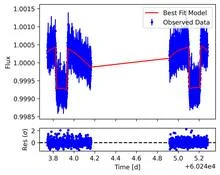
Cosmic Drops: How Gravity Revealed Four New Cold Giants

Astronomers have reported the discovery of four cold giant planets around low-mass stars. They were betrayed by brief anomalies in the light curves — as if a water droplet on a windowpane momentarily focused distant light. All planets lie beyond the snow line, up to 6 astronomical units from their s
arXiv:2607.04594v1 · 2026-07-06

Cosmic Palimpsest: Gravitational Waves Reveal the Story of Ancestor Black Holes

Analysis of two recent events from the GWTC-5.0 catalog showed that, with a probability 6–8 times higher than alternative explanations, the primary black holes in these systems were born in previous collisions. A Bayesian comparison of hypotheses favored the “2G+1G” scenario—a merger of a descendant
arXiv:2607.04663v1 · 2026-07-06

Stellar Nurseries in the Jet's Shadow: JWST Explores Centaurus A

Centaurus A is the nearest radio galaxy to us, where an active supermassive black hole lives at its center, shooting out a powerful jet, while a warped dusty disk whirls around it. For a long time, it remained a mystery whether stars could be born under such extreme conditions. New observations with
arXiv:2607.04942v1 · 2026-07-06

Symphony of Dark Energy: From Heavy Adagio to Explosive Allegro

In the standard cosmological model, two epochs of the Universe speak different languages: the temperature of the cosmic microwave background demands one expansion rate, while supernova explosions demand another. The discrepancy has surpassed the five-sigma threshold, becoming a true crisis. The ECDM
arXiv:2607.05044v1 · 2026-07-06

The Ocean of Spacetime: The Hum of Black Holes and the Precision of Simulations

Recently, pulsar timing arrays have for the first time picked up the low-frequency hum of gravitational waves — a cosmic analog of the noise from distant storms in the ocean of spacetime. Comparing NANOGrav data with the Fable simulation showed that the predicted signal from supermassive black hole
arXiv:2607.05208v1 · 2026-07-06

Catching the Neutrino Wind: Why the Faintest Breeze in the Universe Demands the Impossible

The cosmic neutrino background is a ghostly echo of the Big Bang, billions of neutrinos permeating every cubic centimeter of space. Scientists have been hunting for its direct detection for years, but new work shows that measuring its anisotropy—the 'neutrino wind'—is a task orders of magnitude hard
arXiv:2607.05221v1 · 2026-07-06

Globular Clusters: A Palimpsest of Ancient Gas Clouds

For decades astronomers puzzled over mysterious anti-correlations of light elements in globular clusters. New research based on high-resolution cosmological simulations shows: the chemical anomalies could have arisen long before the birth of the cluster's first stars—in giant gas clouds. This scenar
arXiv:2607.05509v1 · 2026-07-06

Flattened Darkness: Stellar Streams Outline Invisible Halos

Using the STRRINGS catalog of 32 stellar streams, astronomers have for the first time measured the population distribution of dark matter halo shapes beyond the Local Group. Applying Bayesian analysis, they found that for the 17 most reliable streams, the median flattening is about 0.72 — meaning th
arXiv:2607.05510v1 · 2026-07-06

Icy Whisper: O-PTIR Captures Amino Acids Beyond Diffraction

The O-PTIR method shatters the diffraction barrier: infrared heating translates into thermal expansion, read by a visible laser. This enables submicron resolution and sensitivity down to 0.2 µM. Crucially, organics distort the ice's own absorption bands, creating a subtle yet informative spectral fo
arXiv:2607.05629v1 · 2026-07-06

Cosmic Tuning Fork: KLT-Net Neural Network Rewrites the Distance Ladder

Using 1701 Type Ia supernovae, the KLT-Net neural network reconstructs distance modulus for the first time without relying on cosmological models. The harmony of three architectures—KAN, LSTM, and Transformer—captures both local nuances and the global rhythm of expansion. The result: Hubble constant
arXiv:2607.06959 · 2026-07-08

Anchor in the Shallows: Why DESI Data Misses the Universe's Acceleration

Is the Universe accelerating its expansion—or not? The latest DESI survey, combined with Planck cosmic microwave background data, yields no clear answer for the current epoch, unlike older SDSS data. Researchers have shown that the root of the discrepancy is DESI's lack of measurements at low redshi
arXiv:2607.07348 · 2026-07-08