Thoughts and Actions: What Teenagers' Transitions Say About Risk express
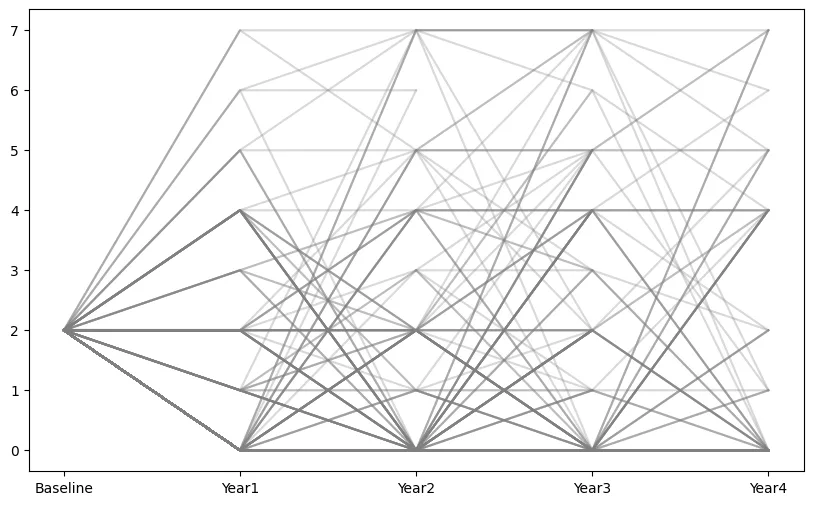
Each year is a new page. From ages 9 to 13, a child's life changes rapidly, and so do their inner experiences. A team of researchers took data from the large ABCD Study survey, in which 11,864 adolescents reported over several consecutive years on their thoughts and actions — whether they had thoughts of suicide, whether they engaged in actions, and whether they harmed themselves without such thoughts. All of this was folded into a mathematical model, a Markov chain, that describes how the state changes from year to year.
The model identified eight states, ranging from no complaints at all to suicidal behavior. The main finding: most children who reported thoughts or even actions returned to a state without complaints a year later. That's encouraging. But when self-harm without suicidal intent (scientifically termed non-suicidal self-injury, NSSI) entered the picture, the trajectory changed. Such children were less likely to return to a "calm" state, more likely to linger in dangerous zones, and their path was less predictable — the model showed greater uncertainty in transitions.
This is like a mountain weather forecast: usually you can say that after rain the sun will come out, but if a particular wind (NSSI) is blowing, the clouds may linger, and the route becomes shaky. The model doesn't predict the future of a specific child, but it gives probabilities for groups, and that's already a tool for doctors and psychologists. Knowing that the transition from thoughts to actions occurs with a certain frequency, you can design monitoring and support more precisely.
This approach works even with incomplete data, and in mental health surveys, missing responses are inevitable. The researchers were able to estimate not only risks but also the stability of trajectories, which was previously hard to capture. The bottom line: self-harm without suicidal intent is not just a red flag but an indicator that the child's path has become more chaotic and requires special attention.
For most children, thoughts of suicide or even actions do not persist — a year later, they no longer report them. This speaks to the high plasticity of the mind at this age, but also to the fact that the moment of risk can be brief.