In classical mechanics, a trajectory is the precise path a particle takes through space as a function of time, determined by its initial position, velocity, and the forcesacting on it. It is a central concept in physics, linking cause and effect: given complete knowledge of a system, its entire future trajectory is predictable. However, in quantum mechanics, the notion of a definite trajectory breaks down, replaced by probabilities of finding a particle in different locations.
History
The formal concept of a trajectory was developed by Isaac Newton in the 17th century, building on the work of Galileo on projectile motion. The mathematical description was later generalized by Lagrange and Hamilton.
How it works
Trajectories are calculated using Newton's laws of motion, which relate force to acceleration. For simple cases, the path is a smooth curve (like a parabola for a projectile). In chaotic systems, tiny differences in initial conditions lead to exponentially diverging trajectories, making long-term prediction impossible even though the underlying laws are deterministic.
In practice
Trajectory calculations are essential for launching satellites, guiding missiles, and predicting the paths of celestial bodies or particles in accelerators.
Fun fact
In the double-slit experiment, electrons do not follow a single trajectory but appear to interfere with themselves, as if taking all possible paths simultaneously.
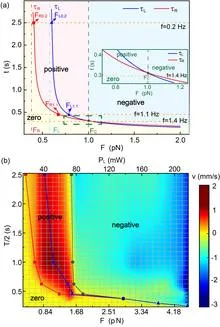
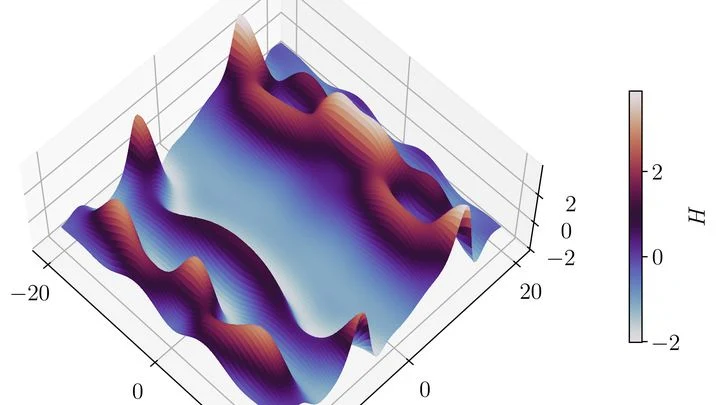
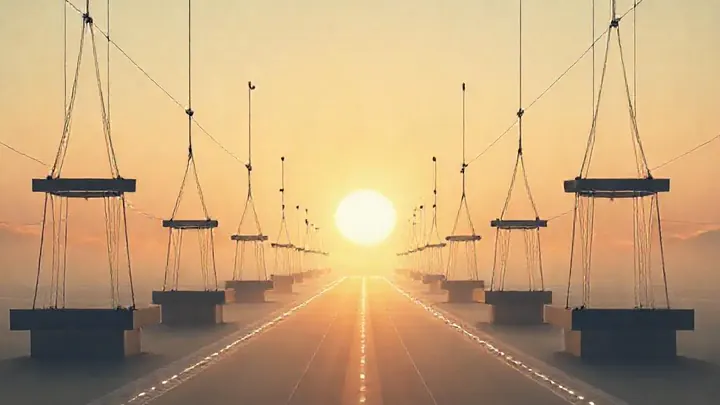
A swing that rocks on a sawtooth hill behaves strangely: without kicks, it gets stuck in the first dip, but with rhythmic pushes it can move uphill, downhill, or stay frozen in place. That is exactly what physicists saw when they placed a single dust grain in a trap with a sawtooth bottom and started pushing it alternately with laser beams.
A sphere rolls down a chute. What shape should the chute be to make the descent as quick as possible? Three centuries ago, the answer was the cycloid — a curve resembling the arc of an upside-down bridge. But submerge the chute in a thick liquid, and everything changes: the fluid slows the sphere, and the fastest path becomes something else.
The Josephson junction is a bridge made of superconductor, separated by an ultra-thin insulating layer. Current flows through it even without voltage. But when the current becomes too large, the bridge starts to oscillate, and even steps, Shapiro steps, appear on the voltage graph. Between these steps hide invisible gaps where the system behaves strangely.
A thrown stone arcs through the air and falls. A planet orbiting a star is the same stone, but it falls forever, looping around the star in a closed curve. In Newton's world, that curve is a perfect ellipse, and the planet returns to the same point each orbit. In reality, the orbit slowly rotates: its closest point to the star, the perihelion, shifts.
Quantum matter rarely treats us to the spectacle of self-motion. Where the classical world teems with starling murmurations, fish schools, and bustling bacteria, quantum thermodynamics long remained serene.
In the mountains, there is a saddle — a point where the trail from one valley crosses over into another. Standing exactly on it, you take a step and are already descending the new slope. In chemistry, such a place is called the transition state: a brief moment when atoms are frozen on the threshold of transformation.
A thrown stone follows a smooth arc: its path is easy to predict. But if the stone skips across water, the trajectory becomes jagged and far more interesting. Quantum particles behave much the same way when their state is not a calm wave with fixed energy but a turbulent mix of several waves at once.
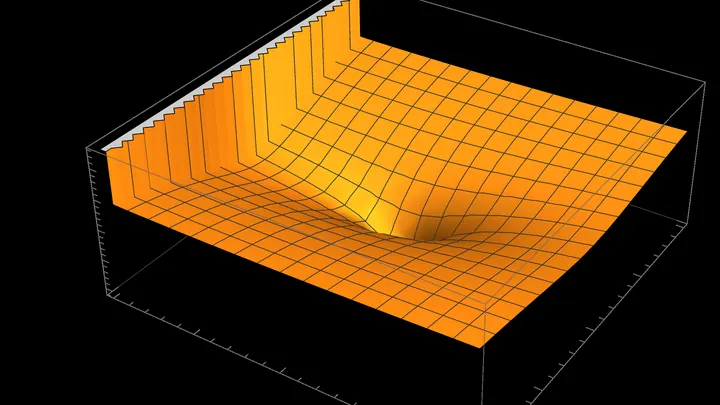
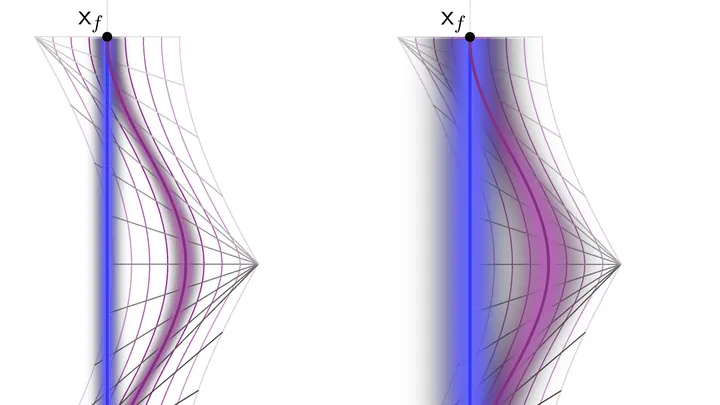
Light cones are not about light; they are boundaries in spacetime that separate causes from effects. These cones are not rigid: a massive object curves them, like a heavy ball pressing into a stretched sheet.
Time crystals are quantum phases of matter that spontaneously oscillate, like a tuning fork with an infinitely decaying echo. If an ordinary spatial crystal repeats an atomic pattern in space, breaking translational symmetry, a time crystal exhibits periodicity in time, breaking time translation symmetry.
The deepest equations of physics, like the Wheeler–DeWitt equation, contain no time. Past and future are scrambled within them, like frames on a film reel with no arrow indicating which way to play it. This symmetry is not a flaw but a feature.
According to Einstein, spacetime is a flexible fabric, curved by matter. But in the quantum world, everything is different: particles are smeared over a probability cloud, governed by a rigid rule discovered by Max Born.
Two phones with identical batteries: one charges in a basement with a weak signal, and the process goes slower. The battery percentage here plays the role of a clock hand. Physicists applied the same logic to the quantum world. Their clock is a microscopic battery that stores energy. The charging rate depends on a hidden quantum 'mode'—like a switch.
An ion channel in a cell membrane is a gate just a few atoms wide. Every second, millions of charged particles, sodium and potassium ions, pass through it. Classical physics said that to get through, an ion must jump over an energy barrier, like a traveler crossing a high mountain pass.
A thin stream of water on a shower glass gathers into winding rivulets that quiver and shift before your eyes. Such a liquid film flowing down a vertical surface is a classic example of chaos in nature: it all flows downward, sure, but the surface lives its own unpredictable life.
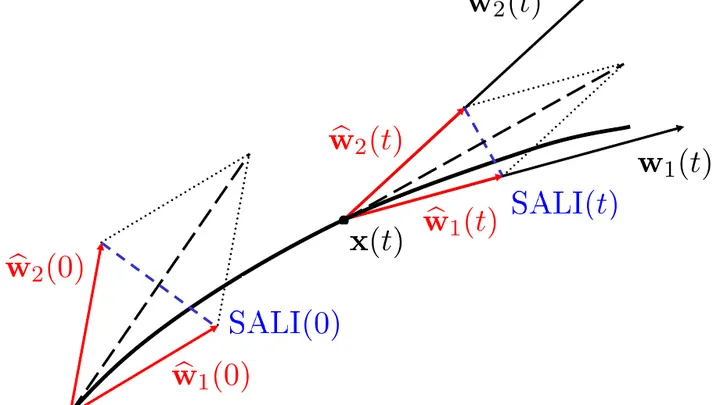
Drop a stone into a calm pond — the ripples spread evenly. Drop it into a churning stream — the water swirls unpredictably. Scientists have long wrestled with a similar question: how can you tell from a single particle's path whether its motion is chaotic? Previously, this meant comparing the particle's path with neighboring ones, which is complicated and time-consuming.
A quantum walk is like a drunk person who turns randomly at every intersection. Except instead of streets, there are graph nodes, and instead of steps, there are quantum transitions. Scientists have discovered that such a walk has a hidden measure — Krylov complexity.
Vortons are invisible cosmic hoops, closed loops of curved spacetime. Thinner than an atom but heavier than stars, these Big Bang relics spin like giant carousels, churning everything around them. Einstein's equations describe how particles dance near such a hoop: paths twist into spirals or dart chaotically.
Time is like a highway: from afar it looks flawlessly paved, but zoom in and every pothole appears. These bumps are the quantum fluctuations of the vacuum, making it impossible to measure the journey exactly. Physicists built a clock model whose operation relies on spontaneous particle creation from the void.
Two seemingly incompatible mathematical languages describe a single quantum reality. The first is the language of quantum walks: here, a particle (such as an electron or even a quasiparticle in a condensed medium) takes a stroll on a graph, simultaneously exploring all possible paths — much like a pedestrian in an unfamiliar city instantly finding…
We are used to thinking that events have causes, objects exist independently, and signals cannot outpace the speed of light. Quantum mechanics, which describes the Standard Model of particles, challenges all these assumptions at once — as if a recipe couldn't use all seven ingredients.
A quantum system, once born, does not forget it. Even after dozens of lifetimes, a trace of the initial state remains in its decay: a slowly decreasing power-law tail. For two fluorescent dyes, erythrosine B and eosin Y, this tail has been observed for the first time in two spectral channels simultaneously.
In 1961, Stanislaw Ulam proposed a simple model: a particle bounces between a fixed wall and a wall that oscillates according to a piecewise-linear law. It seemed like just another billiard. But behind this simplicity lay a question that troubled physicists for decades: can the particle accelerate to infinity?
The answer turned out to be paradoxical. In the classical version, almost never.
A woven basket holds its shape not because it has a rigid frame, but because each strand is interlaced with its neighbors. Pull one out, and the pattern unravels, leaving a heap of twigs. Quantum mechanics, according to a new paper, works the same way: its elementary objects do not exist independently, but only in interweaving with each other.