quantity

probability

A measure of the likelihood that a particular quantum interaction or event occurs.
23 related articles · 6 formulas

Description

Probability in quantum mechanics is not just a tool for predicting outcomes—it is the core of the theory. Unlike classical probability, which reflects our ignorance of hidden variables, quantum probability is intrinsic: even with perfect knowledge of a system's state, many measurement outcomes remain fundamentally uncertain. This is famously illustrated by the double-slit experiment, where a single particle's arrival point is unpredictable, yet the statistical pattern of many particles reveals wave-like interference.

History

Max Born introduced the probabilistic interpretation of the wavefunction in 1926, building on Schrödinger's wave mechanics. His 'Born rule' became a cornerstone of the Copenhagen interpretation, though debates about its meaning continue.

How it works

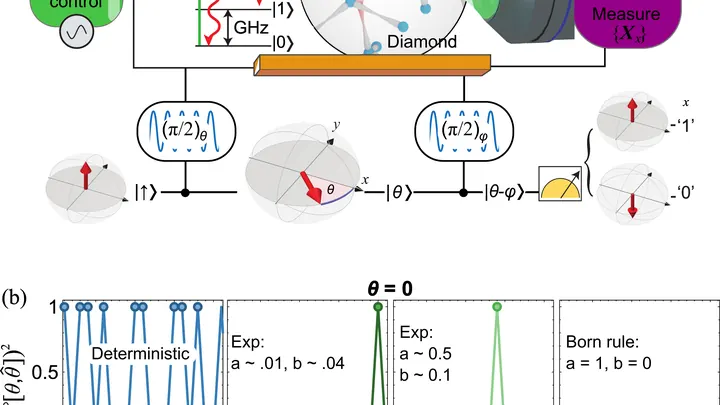
Quantum states are described by wavefunctions, whose squared magnitude gives the probability density for finding a particle in a particular position or state. Measurement 'collapses' the wavefunction to a definite outcome, but the probabilities are governed by the Born rule: the probability equals the square of the amplitude. This probabilistic structure also underlies phenomena like quantum entanglement, where correlations between particles can be stronger than any classical theory allows.

In practice

Quantum probability underpins quantum cryptography, where the inherent randomness of measurement ensures secure key distribution, and quantum computing, where probabilistic outcomes are harnessed for algorithms.

Fun fact

In quantum mechanics, the probability of a particle passing through two slits is not the sum of probabilities for each slit—interference terms can make it zero, meaning the particle 'chooses' neither path.

Concept graph →

Formulas

$$\rho = \sum_i p_i |i\rangle\langle i|$$
A quantum state's density matrix becomes diagonal after measurement.
What is in the formula
ρvariableDensity matrix — density matrix
p_ivariableProbability of state |i⟩ — probability
|i⟩variableEigenstate of the density matrix — quantum state
⟨i|operatorDual vector (bra) of |i⟩ — bra operator
$$P(t) \propto t^{-\alpha}$$
Probability decays as a power law in time.
What is in the formula
Pvariableprobability of survival or decay — probability
tvariabletime — time second
αvariablepower-law exponent — exponent
$$P(t) = e^{-\Gamma t}$$
Survival probability decays exponentially with time.
What is in the formula
P(t)variableSurvival probability at time t — probability
tvariableTime — time second
ΓvariableDecay rate (inverse lifetime) — decay rate per second
$$P \sim e^{-\frac{2\pi M c^2}{\hbar a}}$$
Particle detection probability decays exponentially with mass and acceleration.
What is in the formula
PvariableDetection probability of a particle — probability
MvariableMass of the particle — mass kilogram
avariableProper acceleration of the detector — acceleration metre per second squared
cconstantSpeed of light in vacuum — speed of light = 299792458 metre per second
ħconstantReduced Planck constant — reduced planck constant = 1.054571817e-34 joule second
$$P \propto \exp\left(\frac{24\pi^2}{V(\phi_*)}\right)$$
Probability of inflationary universe creation suppressed for large inflaton potential.
What is in the formula
PvariableTunneling probability — probability
V(φ_*)variableInflaton potential at the tunneling point — potential energy density joule per cubic metre
$$P = \sin^2(\theta)$$
Probability oscillates with a phase angle.
What is in the formula
Pvariableprobability of oscillation — probability
θvariablemixing angle or phase — phase angle radian

Related articles · 23

Quantum Physics2026-08-111 minarXiv:2608.10663express
Quantum Bridge Between Nodes
An ordinary random network is like a road map: to connect four cities with a complex interchange, you need to lay down many highways. In the quantum world, things are different.
Quantum Physics2026-07-261 minarXiv:2607.23773express
How to Tell a Tangled Ball from a Thread
The quantum world is full of strange connections. Two particles can become “entangled”: the state of one instantly affects the other, even if they are kilometers apart. But how do you know if they are truly entangled? It's like a ball of yarn: at first glance, you can't tell whether it's a single tangled ball or just a mess of loose threads.
Quantum Physics2026-06-192 minarXiv:2606.21664express
Quantum Games Crack a Classic Math Theorem
In 1953, mathematician Alexander Grothendieck proved a theorem that became a cornerstone in the theory of tensor products. It states that for ordinary function spaces, two natural norms, the projective and the injective, are equivalent up to a universal constant. In other words, two ways of measuring the 'size' of combinations of vectors give similar results.
Quantum Physics2026-06-191 minarXiv:2606.21768express
Quantum Twins and the Secret of the Common Cause
Twins enter a room from different doors. Each gets a box with a button, and each time they press it, either a red or a green light flashes. If the twins are perfectly identical, you'd expect their lights to follow the same internal rules. But what if the rules differ even though the twins are exact copies? That's precisely the scenario the authors explored.
Quantum Physics2026-05-292 minarXiv:2605.31442express
Quantum Roulette with a Winning Ticket
Imagine a library where instead of books, you have every conceivable combination of a few dozen quantum particles. The number of combinations grows like a snowball: add one particle, and the volume doubles. For fifty particles, there are more shelves than atoms in the visible universe.
Quantum Physics2026-05-221 minarXiv:2605.23862express
Fuzzy Probabilities in a Blurry Spacetime
The quantum world is known for uncertainties: for example, you can't measure a particle's position and its speed at the same time. But new research shows that in a 'fuzzy' spacetime, even probability itself — the measure of chance — loses sharpness. A foggy compass doesn't give an exact direction: its needle wavers.
Quantum Physics2026-05-191 minarXiv:2605.19706express
Quantum Droplets: Precision Unattainable
The quantum world is usually drawn with points, but real instruments only see blurry spots. Heisenberg and von Neumann long suspected: precision is unattainable.
HEP Theory2026-05-022 minarXiv:2605.01453express
Hidden Symmetry: How Particles Negotiate Their Own Rules
In particle physics, it has long been taken for granted that the forces of nature (electromagnetism, the weak and strong interactions) obey a strict symmetry called gauge symmetry. It's like a set of rules by which particles exchange force carriers. But where do the rules themselves come from?
HEP Theory2026-04-282 minarXiv:2604.26045express
The Universe as a Size Lottery
A handful of sand lands on the table. The grains settle in different ways, but if the handful is large, the total volume barely changes. That's roughly how classical gravity works: space appears smooth and definite. But look closely at the individual grains, and you'll find that at the quantum level, volume itself is no longer fixed.
General Relativity2026-04-222 minarXiv:2604.20922express
Black Hole Loses Its Quantum Compass
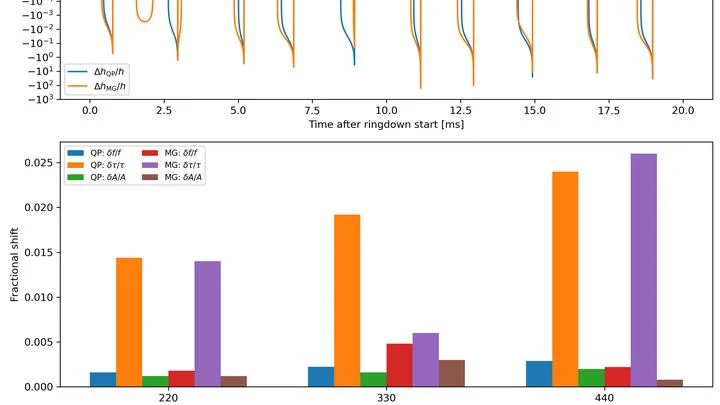
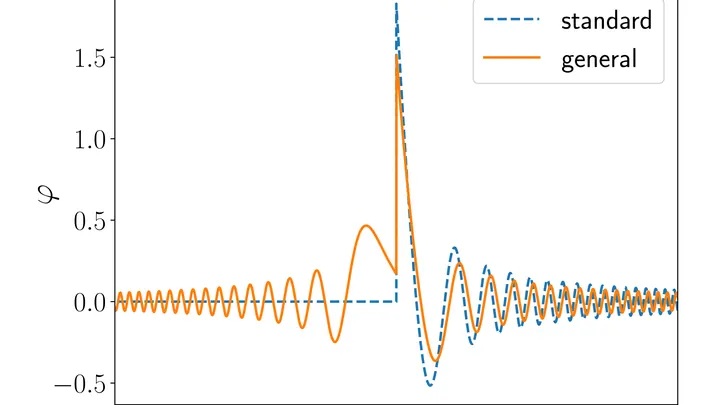
A bell struck by a hammer hums softer and softer. Its ring fades smoothly, like ripples on water after a stone is tossed in. A black hole behaves much the same way after colliding with another hole: it shudders, and those shudders, gravitational waves, fly off into space, gradually weakening.
General Relativity2026-04-211 minarXiv:2604.19418express
The Quantum Fabric of Spacetime
According to Einstein, spacetime is a flexible fabric, curved by matter. But in the quantum world, everything is different: particles are smeared over a probability cloud, governed by a rigid rule discovered by Max Born.
Quantum Physics2026-04-132 minarXiv:2604.11968express
The Secret Link Between Past and Future in the Quantum World: A Model with Backward Time
A typical recipe explains how to cook a dish: step by step, from the initial ingredients to the finished result. The new approach flips the logic: imagine that the future pie itself dictates how much flour to add now. In the quantum world, researchers suggest, a particle receives signals from the future measurement outcome.
The Prisoner's Paradox: The Old Bicycle of Classical Probability
Two accomplices are interrogated separately: betray or stay silent? If neither knows what the other will do, their choice breaks the classical rule of probability. It’s like riding an old bicycle over bumps — the hard seat jolts you off. The textbook rule, the classical model, fails. The authors of a new study found a simple fix: the cyclist needs a soft saddle.
Quantum Physics2026-03-141 minarXiv:2603.13974express
The Evergreen Tree of Probabilities
In quantum theory, a particle can run along two paths at once. When measured, we catch it on just one. According to Niels Bohr, all other possibilities vanish instantly — like a branch snapped off a trunk. Yet Hugh Everett insisted: the tree of reality grows all its branches at once, and we only see the one we’re on.
Quantum Physics2026-03-081 minarXiv:2603.07538express
A Click Before Its Time
In quantum communication, a secret key is transmitted using single photons. Eavesdropping on such a channel is supposedly impossible: any interception attempt disturbs the particle and leaves a trace. But the idea has a weak spot — the real hardware, which sometimes behaves differently than theory dictates.
Quantum Physics2026-02-282 minarXiv:2603.00401express
Randomness Without Trust
A coin toss seems random, but in reality, physics decides everything: the force of the throw, air resistance, the surface's elasticity. If you knew all the details, you could predict the outcome. True randomness lives deeper — in the quantum world.
Quantum Physics2025-12-011 minarXiv:2512.01982express
Seven Truths That Can't Coexist in the Quantum World
We are used to thinking that events have causes, objects exist independently, and signals cannot outpace the speed of light. Quantum mechanics, which describes the Standard Model of particles, challenges all these assumptions at once — as if a recipe couldn't use all seven ingredients.
Quantum Physics2025-11-131 minarXiv:2511.10155express
Quantum Particles: When Moving Backward Becomes Reality
A quantum particle quantum particle can exhibit backward motion even if its overall direction is forward. Imagine a river: the main current rushes toward the mouth, but individual currents suddenly swirl and momentarily dart against the flow, creating local disorder.
Quantum Conductor: Entangled Photons Take the Concert Stage
In September 2024, the concert hall in Linz had more than just an orchestra on stage. Next to the musicians, a setup was generating pairs of entangled photons: a laser with a wavelength of 405 nm passed through a nonlinear crystal and split into two photons at 810 nm, which flew off to two measurement stations, Alice and Bob.
Orchestra Without a Conductor: Quantum Order Beyond Time
In an empty concert hall, two musicians play a single part. First the violin, then the cello, or the other way around. It has always been this way: every note has its place in time, its own "earlier" and "later." But what if an orchestra could play both versions at once, in a quantum superposition of two orders?
Quantum Physics2025-06-031 minarXiv:2506.02637express
Pilot droplets: a new look at quantum reality
In the quantum world, particles do not have precise properties until they are measured. The official model refuses to explain what lies behind this uncertainty. But the idea that invisible 'pilots' control particles has been around since the 1920s.
Quantum Dance at the Mirror Wall: Angular Momentum in a Closed Universe
A century ago, quantum mechanics gave the world a neat picture: a particle rotating around a point can only have certain discrete amounts of angular momentum, integer multiples of Planck's constant. This rule seemed as solid as the law of gravity, and it followed from simple algebraic arguments.
Quantum Measurement as a Deformation of Perception: The Bloch Sphere and the Birth of Categories
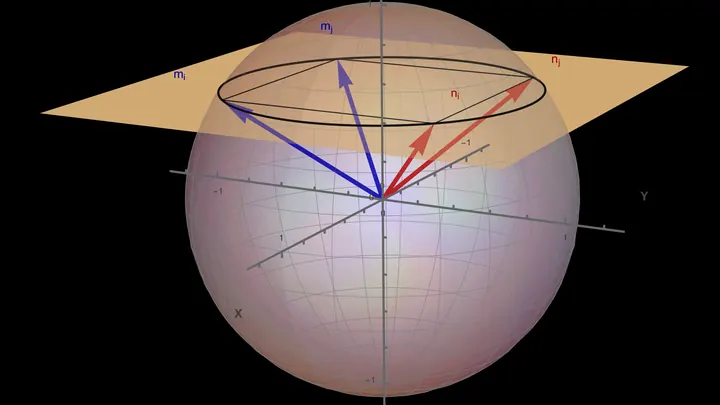
Quantum mechanics gave us a captivating image: a system’s state is not a frozen point but a wave of possibilities, dancing in an abstract space. Thanks to the work of Шрёдингера and Дирака, we represent it as vectors in Hilbert space.