Stability, in physics, refers to a system's ability to maintain a particular state—such as a fixed distance, position, or motion—despite internal fluctuations or external perturbations. It is a central concept across mechanics, electromagnetism, and quantum physics, where 'stable' often means that small disturbances lead to small responses rather than runaway changes. In the context of the provided articles, stability is examined critically: for example, quantum stabilizers in error correction appear reliable but can harbor subtle vulnerabilities, and ecological systems can exhibit hidden fragility despite apparent steadiness.
History
The formal concept of stability in physics was developed in the 19th century, notably by Aleksandr Lyapunov, who introduced rigorous mathematical criteria for stability of dynamical systems in his 1892 doctoral thesis.
How it works
Stability arises when a system's restoring forces or feedback mechanisms counteract perturbations. In mechanics, a stable equilibrium is a potential energy minimum: displace the system slightly, and a force pushes it back. In quantum systems, stability can be enforced by symmetries or conservation laws, but it may also be conditional—for instance, a state might be stable only within certain parameter ranges. The articles highlight cases where stability is not absolute: genetic processes can be precise without being stable, and cosmic structures like strings can melt, indicating that stability often depends on timescales and environmental conditions.
In practice
Stability analysis is used in engineering to design safe structures, in control systems to maintain desired outputs, and in quantum computing to assess the reliability of error correction codes.
Fun fact
A star with negative mass, if it existed, would be unstable in a peculiar way: it would repel ordinary matter, yet could still form stable orbits under certain conditions.
A forest does not live in a static world. Between winter and summer, day and night, conditions shift, and each fluctuation is like a rhythm that all its inhabitants must keep pace with. Yet until now, ecologists have mostly studied how communities of living beings persist in an unchanging environment, like testing a bridge's strength only in calm weather.
A light switch clicks, and the light comes on. But imagine a switch that, with the same press, can either turn on the lamp or leave the room dark. It also remembers what it did last time, and sometimes it seems to flip a coin to decide whether to light up.
This kind of behavior was found in a crystal of black phosphorus — a semiconductor just a few atomic layers thick.
Two pieces of sandpaper are pressed tightly together. As you start to slide them, they first catch on the rough spots, then suddenly slip. A fault in the Earth behaves much the same way during an earthquake. But there's a crucial detail: how far do you need to push the edges before the grip gives way? This distance is called the critical slip distance.
A stable system behaves like a ball in a bowl: give it a push, and it rolls back to the bottom. The spread of possible trajectories, uncertainty, shrinks over time. But the speed depends on the slope of the bowl's walls. In complex systems, this 'bowl' has sections of varying steepness.
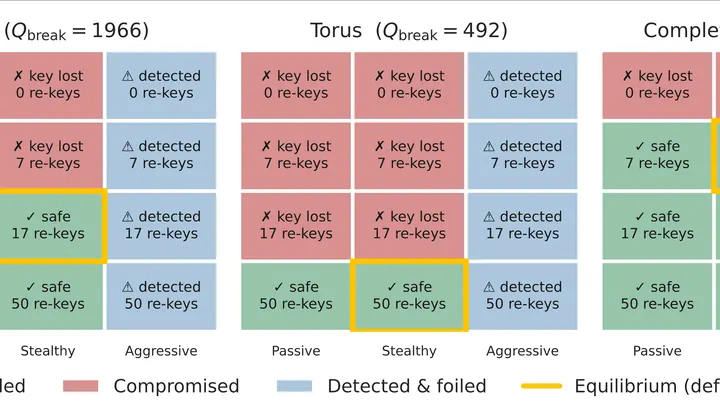
A cloud service dishes out commands to a drone swarm without any knowledge of their movements. The signals are encrypted, but each maneuver leaves a barely visible trace in the cipher, like ink bleeding through paper from the pressure of a pen. Over time, these ink stains coalesce into a pattern, and the hidden data is no longer a secret.
In the conventional Heisenberg picture, spins at low temperatures are supposed to line up in a strict pattern. But there are crystals — like pyrochlore — where geometry has its own way. Each ion sits at a vertex of a tetrahedron, and the main interaction enforces a rule: two spins point inward, two outward.
Eight hundred participants, firms and workers, enter the market. Each holds a strict preference list in mind. The challenge: pair up so that no one wants a do-over. In mathematics, this is called a game theory with a ban on repeat alliances, and its roots trace back to the work of John von Neumann and Oskar Morgenstern.
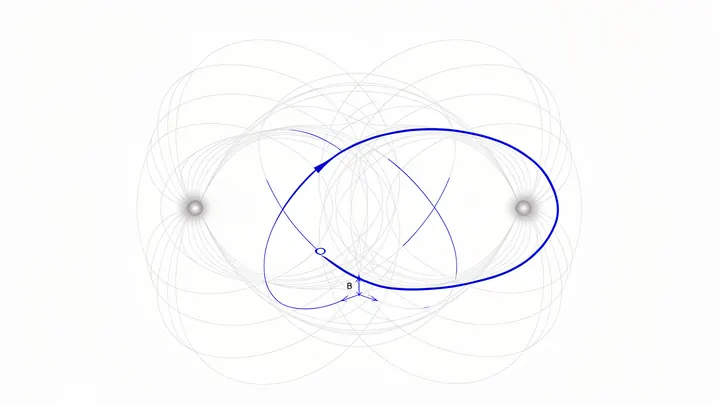
The three-body problem is the eternal stumbling block of celestial mechanics. Even Poincaré realized in the late 19th century that its chaos defies general analytical solutions. In this gravitational madness, islands of regularity appear only rarely — periodic orbits.
When a grain of sand falls on a table, its impact is predictable. But if you squeezed it down to the size of an atomic nucleus, the familiar laws of gravity would break down — the force of gravity would grow without bound.
A string sounds perfectly pure until a draft touches it. That's roughly how a superradiant laser works: a beam of atoms, pre-charged with energy, flies through a room made of two mirrors — an optical resonator (a trap where light bounces back and forth).
In the world of atoms and particles, everything tends toward rest: particles lose energy, just as a swing slows down due to energy loss (friction). But many devices — from hydrogen masers to atomic clocks — live by repetitive cycles.
An atomic nucleus is like a crowded bus. To free up space, a group of two protons and two neutrons — a helium nucleus, an alpha particle — exits through the front door: this is alpha decay, described by George Gamow as tunneling under an energy barrier.
You can zoom into a high-resolution photo for a long time — until suddenly a smooth face dissolves into individual pixels. Something similar, according to a new study, happens to spacetime itself. The authors propose that tiny intervals of length are not pre-existing 'parts' of the universe but results of measurements.
Quantum batteries harness quantum effects to circumvent the limitations of ordinary devices imposed by entropy — a measure of disorder and energy losses. Imagine a bucket under a powerful jet: filling is lightning-fast. But the bucket has holes: the environment constantly drains the energy.
Throw a stone into a pond, and ripples spread across the water. Throw two stones nearby, and the ripples intersect, creating a pattern of reinforced and canceled waves. That's interference.
A quantum battery is not a box of chemicals but a chain of tiny magnets (spins) capable of storing energy. Its main trick: charge many particles at once, using their quantum entanglement. But there's a catch — not all entanglement works.
When hot soup cools, clumps form on the surface — similarly, as the early universe cooled, it gave birth to threadlike clumps of energy: cosmic strings. Some of them are like a stretched rubber band: as long as it's intact, it's stable. But if you nick the band, it snaps.
A thrown stone arcs along a clean trajectory, but an electron's position in an atom is smeared out like fog. The transition from one to the other is a puzzle. New work shows that the fuzziness disappears not because of an observer, but because of the particle's own gravity.
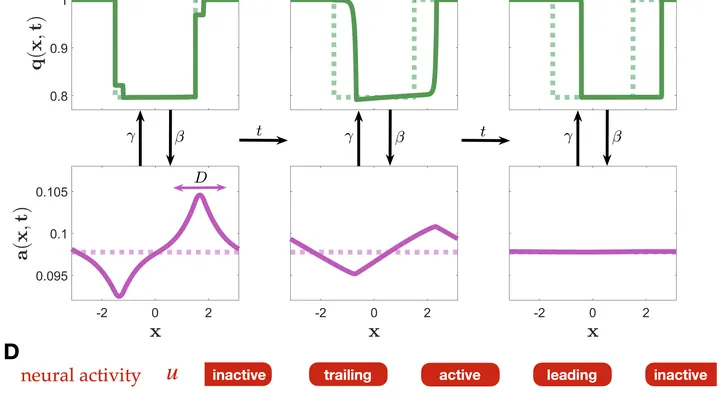
Holding a phone number in your head while you dial it: that's working memory. In the brain, a group of cells is responsible for this, sending signals to each other like people passing a bucket along a chain. But every transfer has a cost: it requires messenger substances that get used up.
A drop of ink falls into a glass of water, and ripples spread out from it. Water seems simple, but if you look inside, each molecule isn't just moving forward: it's also spinning like a tiny top. Physicists call this intrinsic rotation spin. Usually, it goes unnoticed: in calm water, the tops spin every which way, and their rotation doesn't affect the fluid's overall motion.
You can edit a cell perfectly, and it still turns out useless. The gene is fixed exactly as planned, yet the cell behaves unpredictably: it drifts, changes fate, loses safety. It's like fixing one gear in a watch, but the watch still runs wrong because the whole mechanism is out of sync.
Previously, a cell was viewed as a list of independent parts.
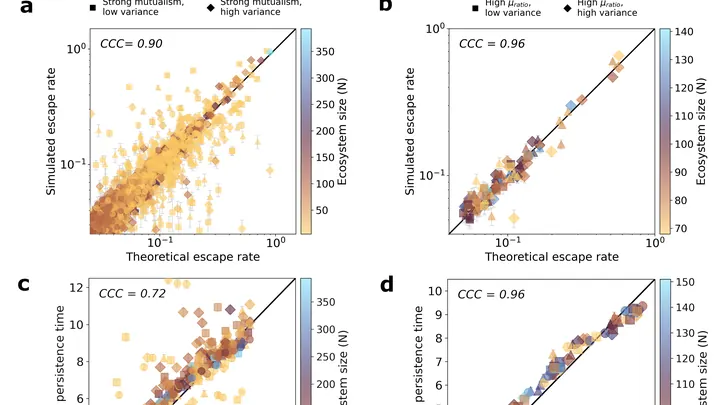
An ecosystem is like a swing that someone is subtly pushing. Previously, it was thought that the main concern was that the swing wouldn't swing too wildly. But the authors of this work showed that the greater danger is when the equilibrium point itself slides toward a place where the swing can no longer return.
A quantum computer is like an orchestra where every musician must play with precision down to a billionth of a second. If one instrument goes out of tune, the whole symphony collapses. So scientists spent a year watching 27 qubits — the simplest cells of quantum memory.
A rubber band is stretched, and suddenly snaps. In the atomic world, a similar picture emerges: the string binding particles can break. In a new study, physicists took a chain of Rydberg atoms and tracked how such a string breaks.
Under weak tension, the string breaks completely, and the system splits into several independent pieces, as if a rubber band shattered into segments.
A quantum state under continuous measurement is not a frozen picture but a random dance. Each measurement outcome nudges the state one way or another, and to predict the future you have to track the entire trajectory.
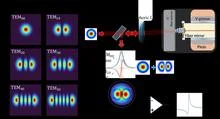
Tuning a string: higher harmonics help hold the pitch without drowning out the fundamental note. In an optical microcavity, a tiny resonator made of two mirrors, light bounces between the reflective surfaces, and any jitter in the spacing knocks it off resonance.