Electricity Changes How the Foot Feels express
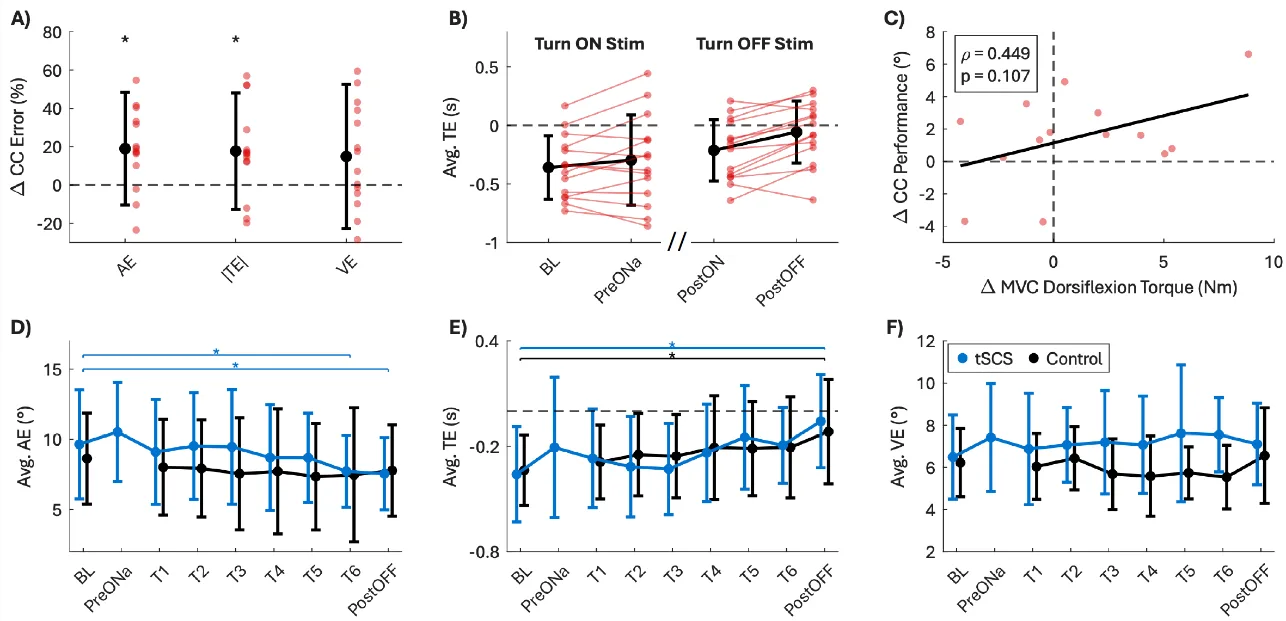
Give your back a mild electric zap, and your leg starts to live its own life. That's exactly what researchers discovered when they tested how transcutaneous spinal cord stimulation affects healthy people. Fourteen volunteers tried to move their ankles precisely while a robotic trainer measured errors. It turned out that after brief stimulation, the sense of foot position worsens — errors increase. Muscles, meanwhile, work as usual; strength doesn't change.
Gait transforms too. People began walking more cautiously: steps became narrower, and the body swayed less from side to side. The brain, it seems, plays it safe when receiving unusual signals from the legs. But the most interesting part came after several training sessions. Those who trained under current became better at sensing their ankles, and this improvement persisted even when stimulation was turned off. The control group without current didn't gain such memory.
Gait, however, changed differently depending on direction. Forward-backward movements returned to normal or even improved, while sideways sway remained stiff. The nervous system seems to have chosen a safer, narrower corridor for walking, sacrificing left-right freedom. So, simple stimulation of the skin over the spine opened a window into our body's remarkable ability to relearn under a new stream of sensations.
Original abstract
as written by the authors arXiv:2608.05635v1
Transcutaneous spinal cord stimulation (tSCS) modulates spinal sensorimotor circuits primarily through activation of afferent networks. While prior work has emphasized locomotor performance and spinal excitability, how tSCS affects conscious proprioceptive perception and the extent to which such effects parallel changes in locomotor control remain unclear. We investigated the acute and training-related effects of tSCS on ankle proprioception and gait in unimpaired adults (n = 14), with an independent control group (n = 14) completing identical proprioceptive training without stimulation. Proprioception was quantified using a bilateral robotic assessment of dynamic ankle localization ability (Crisscross), gross motor output using maximum dorsiflexion strength, and gait during normal and tandem treadmill walking using spatiotemporal, trunk-sway, and mediolateral center-of-mass (CoM) excursion measures. Acute tSCS increased ankle proprioceptive error (p < 0.001) while dorsiflexion strength was unchanged (p = 0.30). Gait shifted toward a modestly more constrained locomotor pattern, characterized by reduced step width and ML CoM excursion (p < 0.05). With continued training under stimulation, proprioceptive error decreased and, unlike the control group, the tSCS group showed progressive improvement that persisted after stimulation ended. Sagittal-plane gait measures recovered toward or beyond baseline, whereas mediolateral measures remained constrained, revealing a direction-dependent reorganization of locomotor control. Together, these findings show that tSCS influences multiple aspects of the sensorimotor control loop, disrupting conscious proprioception while reshaping locomotor behavior, and that the nervous system can adapt to altered afferent input through training.
The error in ankle sensation after stimulation was statistically highly significant (p < 0.001), meaning the effect is almost certainly not random, the current truly confuses the foot's "sensors."