Flexible bristles in a flow: how viscosity makes them bend together express
Blades of grass in a stream sway individually, but when several grow side by side, they can bend as one. Something like this happened with flexible plates in a new experiment with a fluid that changes its thickness when flowing.
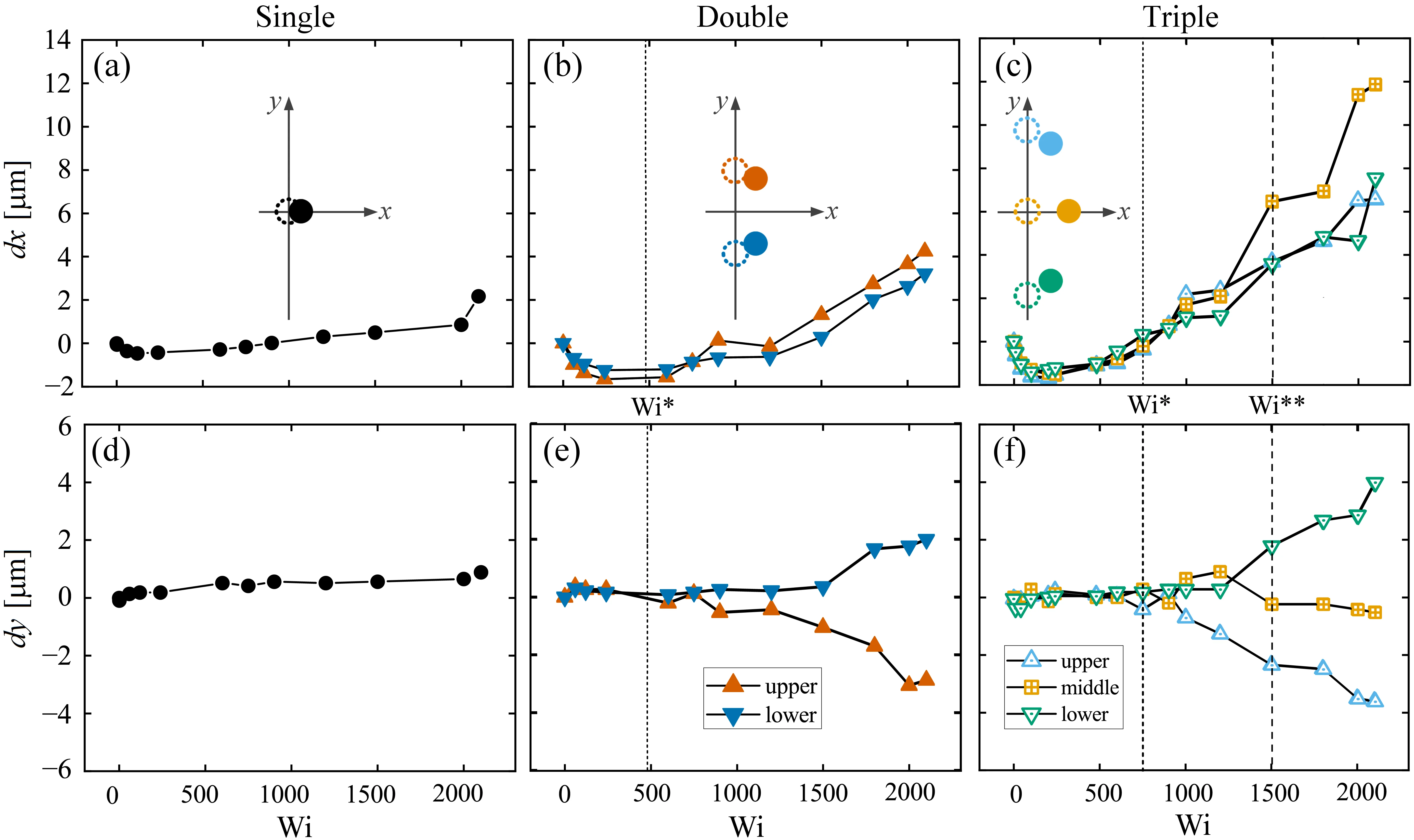
Scientists submerged rows of flexible plates, from one to three, into the fluid and watched the wake trailing behind them, like a tail. In a fluid that becomes slightly more fluid when moving fast, a single plate left a long tail. But when there were two or three plates, their tails merged into one wide stream, and the plates themselves tilted toward each other. For three plates, the fluid had to be driven faster than for two.
In another fluid, which loses its thickness very abruptly, tails appeared but did not merge, and the plates did not move closer. So the mere appearance of a tail is not enough: both the special fluidity of the fluid and the proximity of the plates are needed.
This discovery will help create tiny devices where flexible parts must move in concert, for example, microscopic pumps without moving parts.
Original abstract
as written by the authors arXiv:2608.13908v1
Fluid-structure interaction (FSI) in viscoelastic flows past deformable structures at low Reynolds numbers remains poorly understood, despite its relevance to biological systems such as cilia and flagella, and to engineered microsystems. We investigate viscoelastic FSI in side-by-side flexible cantilever arrays using a bottom-up approach that systematically varies the number of cantilevers and the rheology of the test fluid, comparing weakly shear-thinning (WS) and highly shear-thinning (HS) polyethylene oxide solutions. For both fluids, with increasing Weissenberg number (Wi), an elongated elastic wake develops behind a single isolated cantilever. For multiple cantilevers, the WS fluid undergoes a transition at a critical Weissenberg number (Wi*) from separated to merged elastic wakes, accompanied by the emergence of a divergent flow field and coordinated inward spanwise cantilever deflection. The critical Wi* increases as the number of cantilevers in the array is increased from two to three, demonstrating a strong dependence of the onset on the array configuration. For the HS fluid, wake merger, flow divergence, and inward cantilever deflection are suppressed across the full range of Wi investigated, despite comparable elasticity and the formation of elastic wakes. This contrast shows that elasticity alone promotes wake formation but is insufficient to produce the collective instability, which instead requires both shear-thinning and interactions between neighboring cantilevers. These findings demonstrate that viscoelastic FSI in flexible arrays is governed by the combined effects of fluid elasticity, shear-thinning, and geometric configuration, with elastic wake interactions mediating the collective instability and linking local elastic wakes to array-scale structural response.
The cilia in our lungs beat in a liquid mucus that also does not behave like water: when moving fast, it becomes more fluid.
In the movie "Fantastic Voyage," scientists shrink a submarine to the size of a cell: there the fluid flow behaves quite differently than in our world.