Fluid Dynamics physics.flu-dyn

139 articles

Turbulence, incompressible and compressible flows, aero- and hydrodynamics, biological fluid dynamics, complex fluids, mathematical methods for fluid flow analysis.

articles

Climate seesaws that get stuck
A seesaw with two children rarely balances perfectly. It tips either left or right, pausing at the extremes for a moment before swinging back. The tropical Pacific behaves similarly: it either warms up off the coast of Peru (El Niño) or cools down (La Niña), and these states can last for months, sometimes over a year.
An Orchestra Without a Conductor: Slow Rossby Waves Set the Climate's Rhythm
Over the tropical Pacific, air pressure breathes with periods from two to fourteen years. The barometer on Tahiti rises while it falls in Darwin, Australia, and the entire planet's climate shudders: El Niño arrives. Meteorologists call this the Southern Oscillation and have tracked it for 138 years, but until now they couldn't answer a simple question: where do such periods come from?
Sumatra's Cyclone Factory: Ten Years of Observations
Sumatra's mountain range works like a stamping press: easterly winds hitting the slopes leave a chain of rotating imprints in the air behind the island. These vortices, like blanks on an assembly line, detach from the land and drift over the ocean, where some of them grow into tropical cyclones.
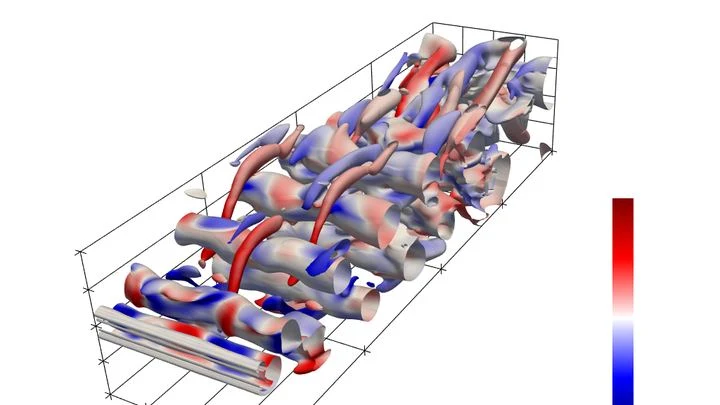
Three Translators and the Dance of the Vortex
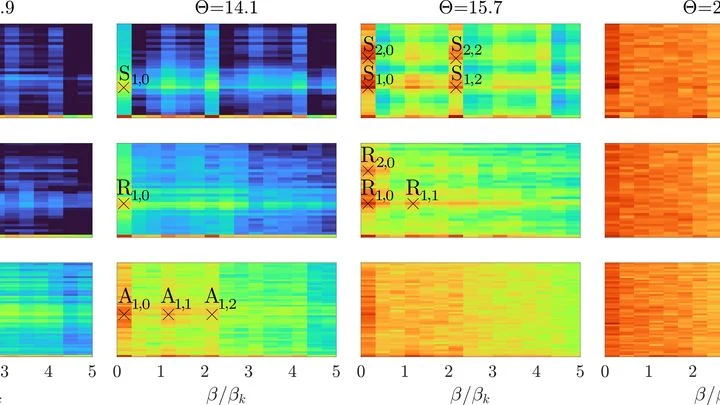
A vertical pipe with a sudden expansion is a classic testbed for turbulence. Air swirling like a tornado rushes into a wider chamber and spawns vortices, recirculation zones, and regions where glass particles 45 μm in diameter, about half the thickness of a human hair, dart along intricate paths.
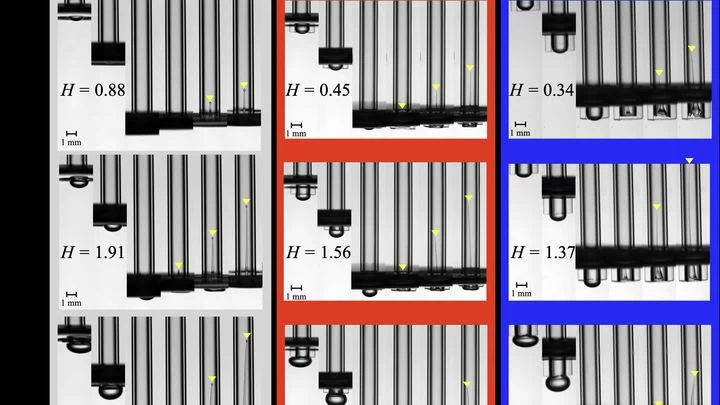
Balloon Drop: How Elasticity Makes a Liquid Bounce Off Whole
A water droplet falls onto a lotus leaf and bounces off without leaving a trace. Nature has perfected this self-cleaning marvel over millions of years, and engineers have long tried to replicate it. But if the droplet hits too fast, it shatters into splashes, losing mass and leaving wet marks on the surface.
Vortices on the Quantum Stage
Two vortex rings launched one after the other pass through each other and swap places. This dance, first seen in the 19th century with smoke rings, has now been reproduced on a quantum processor. Vortices are the actors on a quantum stage where time plays the role of an extra dimension.
Fluid Dynamics2025-11-071 minarXiv:2511.05351express
How a Whirlpool in a Cup Becomes a Black Hole Bomb
When liquid is swirled in a cup, a vortex with an empty center forms. In this empty core, waves find a trap: bouncing off the walls, they siphon energy from the vortex and grow like a flame along a fuse — each wave stronger than the last, until a surge breaks loose. Astrophysicists have described the same chain reaction around black holes.
Fluid Dynamics2025-12-021 minarXiv:2512.03240express
How Honey Flows Through a Sponge: New Equations
Drop honey onto a sponge. It lazily creeps, avoiding the voids. But if the honey becomes thinner under pressure, the flow gets trickier. Liquid with variable thickness in an uneven labyrinth of pores — a problem that had defied calculation. The authors of the new work averaged the chaos of microchannels into simple equations.
Quantum Gases2025-12-081 minarXiv:2512.07935express
Quantum Leapfrog: How Vortices Play in Liquid Light
In superfluid helium, a state where liquid flows without friction, quantized vortices spontaneously arise: microscopic funnels resembling whirlpools in ordinary Water, but governed by quantum mechanics.
cs.CE2026-01-011 minarXiv:2601.00505express
How a Drug's Charge Alters Its Path Under the Skin
After an injection under the skin, a drug doesn't just spread out like ink in water. Antibody molecules carry an electric charge, and that charge makes them interact with surrounding tissues — much like a magnet attracts or repels iron filings.
Turbulence doesn't always grow raindrops
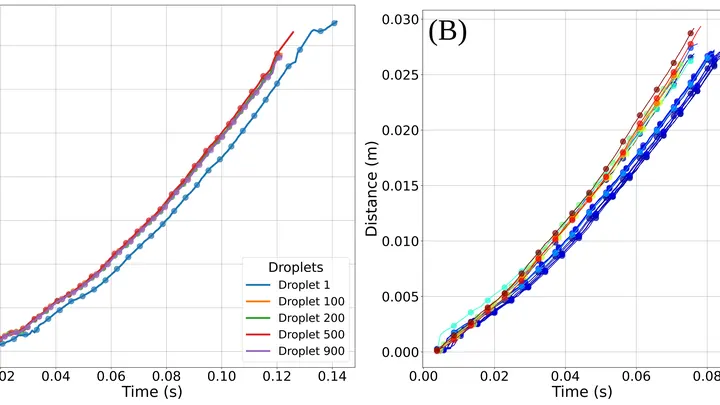
In a cloud, billions of droplets swirl around, collide, and merge: that's how rain is born. But exactly how turbulence, those invisible air swirls, helps or hinders droplet growth has been unclear. In the lab, researchers recreated a slice of a cloud and tracked every droplet.
Threads in the Flow: How Noise Creates Order and Chaos
A thin thread in a water flow is like a hair in a shower stream. If you jerk the water back and forth, the hair either stretches out with the flow or crumples up. The researchers took real protein threads (actin, which makes up muscles) and placed them in a microscopic channel where the fluid oscillated at different frequencies.
Fluid Dynamics2026-01-021 minarXiv:2601.00724express
How a Trickle Becomes an Ice Ridge
A thin stream of water flows down a cold inclined board and, before your eyes, turns into an ice ridge. At first, the water paves itself a straight icy path, as if reinforcing its own banks. Then the trickle starts to meander, and the ice quickly spreads sideways. Finally, the ridge stops growing outward and begins to thicken, smoothing out irregularities.
Fluid Dynamics2026-01-031 minarXiv:2601.01258express
How Bottom Friction Reshapes Vortices in Shallow Water
Water in a puddle after rain swirls differently than in a deep lake. A thin layer of fluid feels the bottom, and that changes the nature of its vortices. Scientists created such a layer in the lab: they poured in an electrolyte, ran a current and a magnetic field, and the fluid began to move.
Applied Physics2026-01-032 minarXiv:2601.01267express
Getting Genes into Living Cells Without Damaging Them
Primary human cells, taken straight from the body, are the most honest material for studying diseases and testing drugs. But getting foreign genetic material into them is tricky: cells don't like intruders. Standard methods either damage the cell or work unevenly, especially when the sample is heterogeneous — which it almost always is. The new platform tackles this with a vortex flow.
Fluid Dynamics2026-01-042 minarXiv:2601.01476express
Invisible Waves in the Ocean's Depths
The ocean is like a layered cake: warm, light water on top, cold, heavy water below. Between the layers, at the interface, invisible waves roam. They don't lift crests like a storm; instead, they slowly rock the entire water column, as if someone were shaking a giant aquarium from within.
Fluid Dynamics2026-01-112 minarXiv:2601.06942express
Vortex Rings Without a Grid
Water swirls into a ring, and that ring flies through the bulk without breaking apart. Such vortex rings, from smoke rings to underwater currents, follow laws that are hard to capture on paper. Usually, the flow is divided into millions of cubic cells, and each one is tracked.
Plasma Physics2026-01-111 minarXiv:2601.06952express
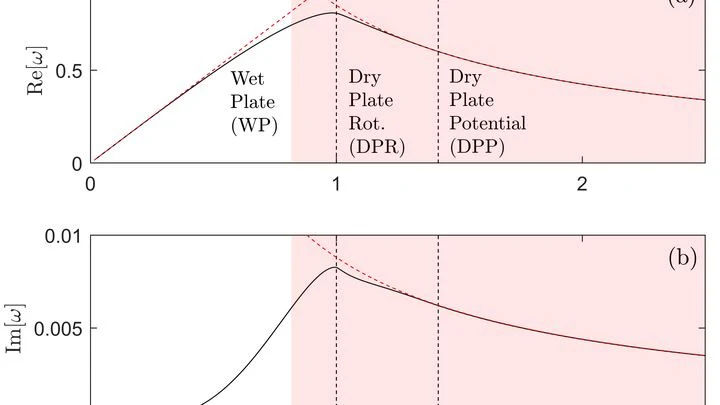
Viscosity Awakens Hidden Energy
Water in a glass settles down once you stop stirring it. Oil in an engine dampens vibrations. It seems viscosity is always about damping. But in some flows, it's the opposite: add friction, and waves start to grow as if from nowhere. Physicists have found a simple explanation.
Fluid Dynamics2026-01-111 minarXiv:2601.06955express
Who's Touching the Wall: Finding the Culprits of Friction
Water in a pipe or air over an airplane wing doesn't slide freely: right at the wall, the flow catches and slows down. This friction isn't born uniformly but in specific spots — where the flow forms elongated streaks, like long tongues stretching along the current and pressing against the wall.
Medical Physics2026-01-111 minarXiv:2601.07881express
How Tilting the Tube Saves the Brain During Heart Surgery
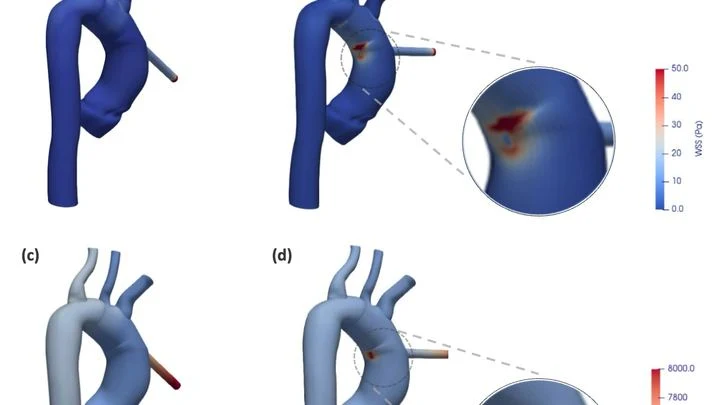
A surgeon inserts a tube into the aorta to reroute blood around the heart. The jet from the tube hits the vessel wall like a garden hose blasting a flowerbed, dislodging particles that can then travel to the brain. Scientists built computer models of aortas from four individuals: a child, a teenager, an adult, and an elderly person.
Fluid Dynamics2026-01-141 minarXiv:2601.09358express
How Saturn Hides Its Magnetic Field
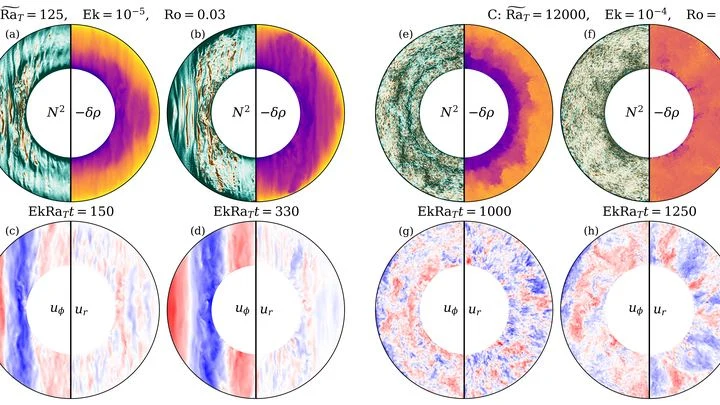
Inside giant planets like Jupiter and Saturn, heat doesn't always rise freely. Heavy elements, which are more abundant in some layers than others, prevent hot fluid from floating up. This creates semiconvection — a type of mixing where heat and composition spread at different rates.
Fluid Dynamics2026-01-172 minarXiv:2601.11946express
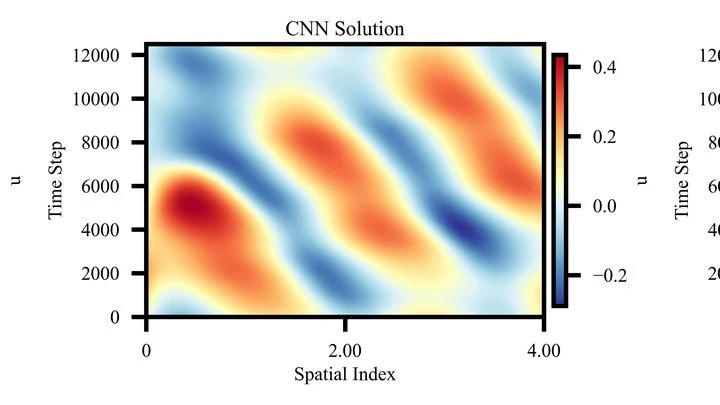
The Secret of Transparency: How a Neural Network Learns from Water
Water in a stream bends around rocks, but the math of that motion hides in a black box: that's how ordinary neural networks work. They give an answer but don't say why. Engineers can't trust a prediction if they can't see its reasoning. Fluid dynamics now has a transparent model.
Fluid Dynamics2026-01-181 minarXiv:2601.12528express
Wind Gusts and Water Ripples: What Do They Have in Common?
The wind blows steadily, but suddenly a gust hits, and leaves swirl up in a vortex. Inside such a gust, the air speed changes not smoothly but in jumps — sometimes sharply forward, sometimes sideways. These rare and strong bursts are called intermittency, and they are the main mystery of turbulence.
Fluid Dynamics2026-01-192 minarXiv:2601.12642express
A Drop That Flows First, Then Hardens
A drop of a thick cornstarch-water mixture falls onto a table. Normally, such a mixture solidifies instantly upon a sharp impact: you can even run across a pool filled with it. But in this experiment, things went differently. The high-speed camera captured that in the first instant after contact, the drop spreads out like an ordinary liquid.
Fluid Dynamics2026-01-202 minarXiv:2601.13582express
How Ultrasound Scatters Particles
In a glass of water, ultrasound creates tiny bubbles. They grow and shrink, and sometimes they collapse sharply, like a popping soap bubble, but thousands of times faster. Near these bubbles float small particles — for example, nickel spheres the size of dust motes.
Fluid Dynamics2026-01-202 minarXiv:2601.13594express
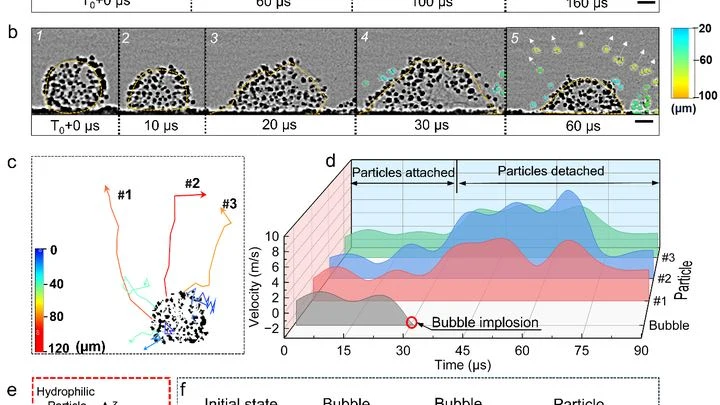
A Hundred Billion Atoms Show How Acoustic Cavitation Is Born
Ultrasound in a liquid is like shaking a bottle of soda vigorously: shake it, and bubbles appear. In science, this is called cavitation, and the bubbles don't just float around: they are born, grow, and collapse with tremendous force.
Fluid Dynamics2026-01-201 minarXiv:2601.13971express
A Falling Plate Without a Supercomputer
A sheet of paper released from a window flutters, tumbles, and sometimes pauses flat for a second. Until now, to honestly predict such behavior, you had to run millions of equations on supercomputers for every drop of air. That's like simulating every atom of a cash register to count change at a store. The new approach is smarter.
Fluid Dynamics2026-01-201 minarXiv:2601.14043express
Vortices That Warn of Slowdown
Water in a glass settles down, but before that, vortices go through a stage where energy losses spike. Physicists seek early signs of this stage to predict flow behavior — from the atmosphere to pipelines. In a new study, they test one such sign: the curvature spectrum of vortex lines, that is, how twisted small and large eddies are.
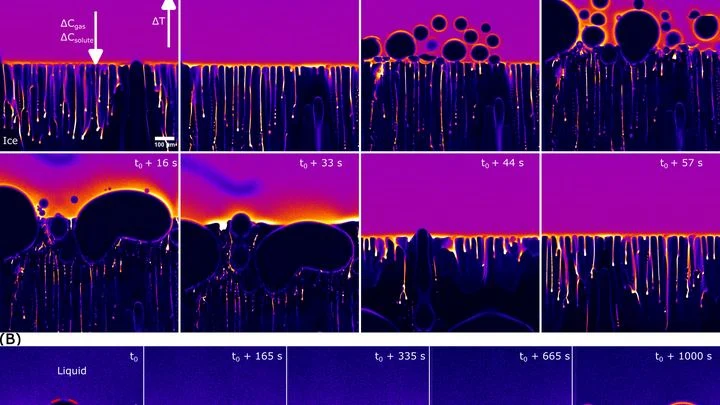
Bubbles Trapped in Ice
In a glass of soda, bubbles merrily rise to the top. But if you freeze the water, some bubbles end up trapped in the ice. How do they get there? After all, ice grows, pushing gas aside, but it doesn't always manage to.
Fluid Dynamics2026-01-231 minarXiv:2601.16436express
Turbulence: Why Measuring Energy Isn't So Simple
When water churns behind a boat, the energy of motion is converted into heat through a cascade of vortices. Measuring how quickly this happens directly is difficult: you'd need to track all the vortices at once. So scientists use a simplification: they look at only one velocity component at a single point.
Fluid Dynamics2026-01-241 minarXiv:2601.17341express
A Thin Plate Wakes Turbulence Early
A thin plate stands across a flow of water or air. Behind it, a wake forms — a region where the flow becomes tangled and mixed. Usually, such a wake becomes turbulent when the flow speed is high enough, quantified by the Reynolds number.
Oscillations of a rarefied gas: how to speed up calculations a thousandfold
Inside a tiny accelerometer, gas behaves nothing like the air in a room. There are so few molecules that they rarely collide with one another, and the familiar laws of viscosity and thermal conductivity stop working.
Fluid Dynamics2026-01-251 minarXiv:2601.17674express
Turbulence That Doesn't Get in the Way of Order
Bacteria in a drop of water jostle and swim: each on its own, but together they create patterns. With weak motion, the fluid churns like soup on a high flame: vortices collide, and the flow direction changes every second. This is called bacterial turbulence.
High Energy2026-01-252 minarXiv:2601.17955express
Magnetic Fields That Rearrange Themselves
In a pot of boiling soup, small bubbles churn, but gradually large-scale flows come to dominate. Something similar happens in cosmic plasma, where magnetic fields behave like tangled threads.
Fluid Dynamics2026-01-262 minarXiv:2601.18465express
The Hidden Force on Leaves
A water droplet races across a taro leaf like a bead on a freshly waxed floor. But it doesn't just glide: it picks up electricity. Thirty years ago, scientists explained why lotus leaves stay dry: their surface is covered with microscopic bumps that trap air. Now it turns out that water on leaves has another, hidden power.
Fluid Dynamics2026-01-272 minarXiv:2601.19994express
Predicting Blood Damage in Pumps
In a heart-lung machine, blood flows through narrow tubing and past rapidly spinning pump blades. Sometimes red blood cells can't take it: their membranes rupture, and hemoglobin spills into the plasma. For a patient, this is like pouring sand into a car's fuel system — small damages accumulate and wreck the whole mechanism.
Fluid Dynamics2026-02-031 minarXiv:2602.03185express
Bubble Catapult: How Bubble Curvature Controls the Jet
A drop falls into a glass, and a tiny jet, a thin fountain, shoots up from the surface for an instant. Something similar happens with a bubble stuck to the wall of a tube when you yank the tube downward. Water around the bubble rushes in, and a jet fires from its top. The speed of this jet depends on the bubble's shape — how much it bulges, like an umbrella dome.
Fluid Dynamics2026-02-032 minarXiv:2602.03617express
Roughness That Decides a Flight's Fate
A blunt cylinder flying at six times the speed of sound isn't the most elegant object, but it's the star of a new simulation. The surface of such a vehicle is never perfectly smooth: during atmospheric entry, the heat shield ablates, leaving bumps and pits.
Fluid Dynamics2026-02-062 minarXiv:2602.06281express
Vortices in Liquid Helium: How Superfluidity Maps Out a Vortex Chart
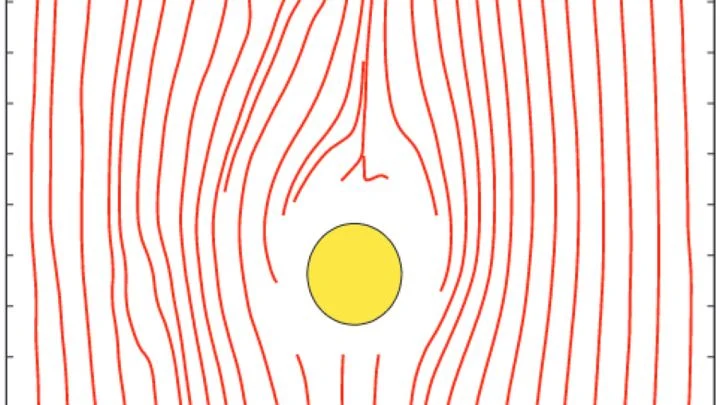
Liquid helium cooled to near absolute zero behaves like two fluids at once: a normal viscous part and a superfluid part that flows without friction. When such a flow hits a cylinder, vortices are born behind it. But sometimes vortices appear in front of the cylinder — where classical laws say they shouldn't be.
Fluid Dynamics2026-02-141 minarXiv:2602.13601express
How a Neural Network Speeded Up Molecular Collision Calculations
Atoms in a gas behave like billiard balls: they fly, collide, and scatter in different directions. But instead of solid balls, they have a soft "coat" of attractive and repulsive forces. At close range, atoms repel sharply; at longer range, they attract slightly. Scientists need to calculate these collisions precisely to model gas flows around airplanes or inside microchips.