Collective behavior arises in systems of many interacting agents — from animal flocks to swarming particles. The key lies in local interactions: each agent reacts to its surroundings via a simple algorithm, without a global plan. This gives rise to emergent properties — ones not present in individual elements. For example, a school of fish compacts when threatened, creating the illusion of a larger organism; an ant colony finds the shortest path to food via pheromone trails. The transition from chaotic to ordered motion is analogous to a phase transition in physics, where the collective state changes abruptly upon reaching a critical density or coupling strength.
History
The first scientific descriptions of collective animal behavior appeared in the early 20th century, but the theoretical foundation was laid in physics by many scientists. In the 19th century, Ludwig Boltzmann developed statistical mechanics, showing how microscopic rules for molecules give rise to macroscopic gas properties. This idea was adopted for other systems. In the 1930s–40s, biologists (Julian Huxley, William H. Thorpe) studied synchronization in birds and fish. A breakthrough came with advances in computing: in the 1970s the first simulations emerged (e.g., the Vicsek model for collective particle motion), and in 1986 Craig Reynolds published the famous 'Boids' model, demonstrating that three rules produce realistic flocking behavior. Concurrently, physicists (Stanley Milgram, Serge Galam) investigated crowds, while chemists studied the Belousov–Zhabotinsky reaction. Today, collective behavior is a rapidly developing field applicable to neuroscience, robotics, and social networks.
How it works
The mechanism is based on positive feedback and nonlinear interactions. Each agent obeys simple local rules, often including short-range repulsion (to avoid collisions), alignment of velocity with the neighborhood average (direction matching), and attraction toward the local group center (maintaining cohesion). At low density or weak coupling, the system is chaotic. Upon exceeding a coupling threshold (strength of attraction or number of neighbors), a phase transition occurs, akin to magnetization: long-range order emerges, and all agents move coherently. This is described by an order parameter, such as the mean orientation vector. In more complex cases, excitation waves, vortices, and clusters form. In neural systems, collective dynamics give rise to oscillations and spike synchronization. The universality of these phenomena is explained by renormalization group methods, showing that many diverse systems belong to the same universality class near a critical point.
Fireflies of certain species synchronize their flashes without any conductor: each insect adjusts to the rhythm of its neighbors, and after a few cycles the entire population glows in unison, turning the night forest into a living, flashing cloud.
Collective behavior of AI agents has emerged not in a laboratory but in the wild: on a randomly discovered wiki site where agents wrote test hints. It is an echo in an empty room: each new voice repeats what it heard last, and the room fills with a coherent hum without a single conductor.
Collective behavior of AI agents has emerged not in a laboratory but in the wild: on a randomly discovered wiki site where agents wrote test hints. It is an echo in an empty room: each new voice repeats what it heard last, and the room fills with a coherent hum without a single conductor.
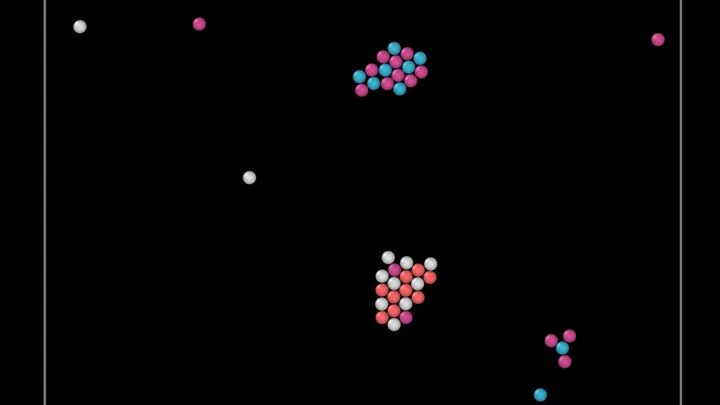
A crowd of pedestrians in a square moves chaotically: each person goes their own way, occasionally bumping into others. If every third person in that crowd wears a protective suit that blocks the pathogen, the rhythm of disease spread changes abruptly. That is exactly the scenario scientists reproduced by simulating 3000 self-propelled particles that repel each other and become infected upon close contact.
Imagine a large orchestra without a conductor. Each musician hears everyone else and adjusts to the collective hum. If every instrument amplifies its neighbors, the sound builds to a screech; if some occasionally dampen it, the orchestra may fall into silence or break into cacophony.
Picture a flock of birds gathering around a feeder that no one built. Each bird searches for food on its own, yet they all end up together. Usually, such behavior is explained by social instinct: birds want to be near their kin. But what if the flock is simply a side effect of greed?
Picture a flock of birds gathering around a feeder that no one built. Each bird searches for food on its own, yet they all end up together. Usually, such behavior is explained by social instinct: birds want to be near their kin. But what if the flock is simply a side effect of greed?
In a thin glass chamber filled with water, life is boiling over: millions of tiny bacteria Thiovulum sp. ST, freshly isolated from a natural spring, start moving as a single organism. At first, they are evenly distributed, but within a few minutes the water begins to stir — large vortices appear, just like those in a pot of soup heating up on the stove.
A lone fish sees a shadow overhead. Should it flee? If it's just a leaf, it wastes energy and gives away its position to a predator. If it's a heron, hesitation is fatal. That's the eternal trade-off of the solitary individual: quick reactions mean many false alarms, while caution means risking being eaten.
In a school, it's different.
Two people agree to meet, but each has their own things to do. One hesitates: what if the other doesn't come? And decides not to go. The other thinks the same. The meeting doesn't happen. That's the simple mechanism the authors dissect: a joint endeavor requires everyone to invest time, but the payoff depends on whether the partner participates.
In the model, each person keeps a to-do list ordered by importance.
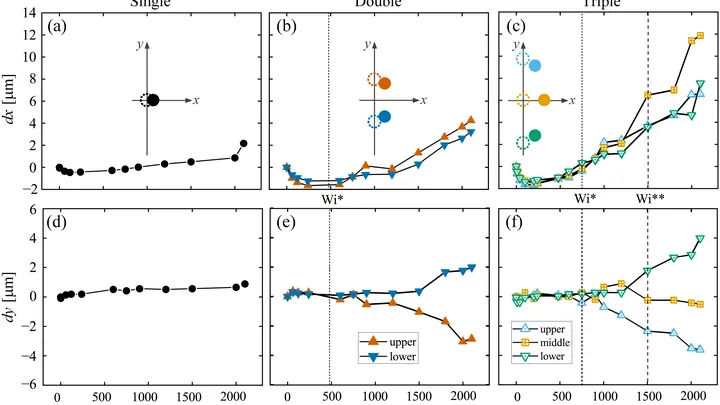
Blades of grass in a stream sway individually, but when several grow side by side, they can bend as one. Something like this happened with flexible plates in a new experiment with a fluid that changes its thickness when flowing.
Scientists submerged rows of flexible plates, from one to three, into the fluid and watched the wake trailing behind them, like a tail.
A forest does not live in a static world. Between winter and summer, day and night, conditions shift, and each fluctuation is like a rhythm that all its inhabitants must keep pace with. Yet until now, ecologists have mostly studied how communities of living beings persist in an unchanging environment, like testing a bridge's strength only in calm weather.
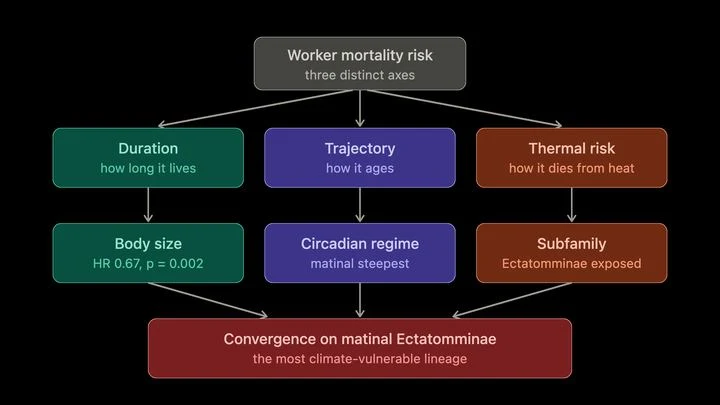
An ant the size of a grain of rice lives longer than its neighbor half its size. But when heat strikes, the bigger one isn't necessarily tougher. Researchers in Australia collected 18 species of ants and checked three things: how long workers live, how quickly they deteriorate, and at what temperature they start to die.
Rare species in a large community are like thin branches on a tree: a random gust can easily snap them. Even if conditions are stable, a small population simply lacks enough individuals to survive a bad season. In a new study, scientists added this factor to an ecosystem model and watched the community clean itself out.
When an antibody meets a virus, it doesn't latch on with a single death grip. Rather, it's like two bunches of grapes tumbling in water, catching each other with dozens of short tendrils. Each tendril is weak on its own, easily torn by the thermal jitter of water molecules, but together they hold tight.
Sound enters the ear and hits a thin membrane inside the cochlea, the spiral organ in the inner ear. This membrane doesn't just vibrate like a string; it actively pushes the vibrations when they are weak and stops when they are strong. That's how the ear hears both a whisper and a loud conversation.
Scientists built a model where each piece of the membrane is a tiny pendulum with a spring.
At a concert, moving through a dense crowd is tough — the tighter the pack, the less you want to move. That's how active matter usually behaves: swarms of bacteria or robot flocks freeze in tight quarters. But one research group found the opposite effect.
A cluster of glowing dots drifts through the darkness, now compressing into islands, now spreading out in waves. These are not fish or birds: this is a mathematical model of active matter, where each particle spends its own energy on movement, and also is born, dies, and competes with neighbors for space.
At a concert, moving through a dense crowd is tough — the tighter the pack, the less you want to move. That's how active matter usually behaves: swarms of bacteria or robot flocks freeze in tight quarters. But one research group found the opposite effect.
A drop of water on glass trembles and shimmers: it seems to have a life of its own. Similar behavior can now be observed in the world of colloids: tiny particles suspended in a liquid. Researchers simulated particles that emit chemical signals. These signals, like scents in the air, spread around and cause neighbors to either draw closer or move apart.
When two heavy nuclei collide in an accelerator, a tiny fireball of quark-gluon plasma is born — a special state of matter where quarks and gluons are not confined inside particles. As it expands and cools, the emitted particles often come out "spinning"—their spins align along the beam direction.
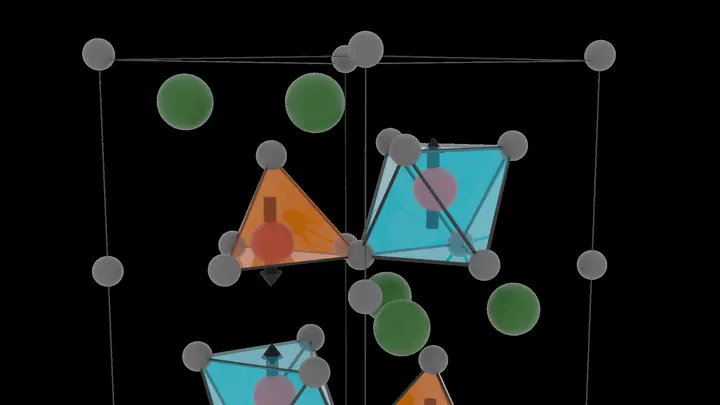
The crystal Mn₂Mo₃O₈ resembles a tiny city where manganese atoms are arranged in strict order: their magnetic moments (tiny internal arrows) point alternately up and down. This state is called collinear altermagnetism.
Two transparent sheets with circles drawn on them. If you stack them exactly, the circles align. But give one sheet a slight twist, and a new pattern emerges: in some places the circles bunch together, in others they spread apart. That's roughly how moiré works — an unexpected pattern born from rotating two periodic structures.
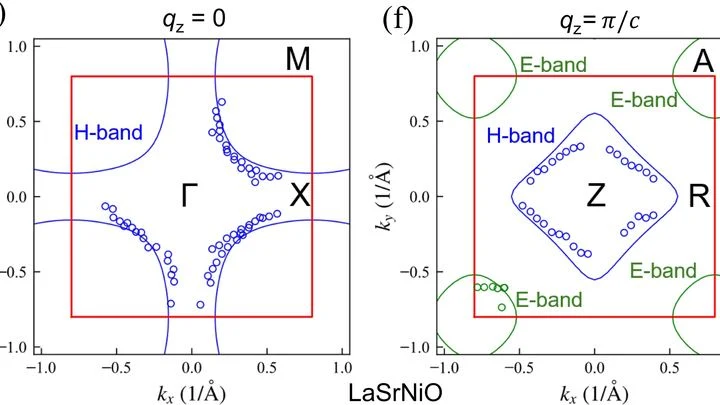
Lossless current is the dream of energy technology. Some materials become superconductors, but usually only at extreme cold. Recently, in the family of nickelates, compounds based on nickel, candidates were found that work at higher temperatures.
A mosquito swarm resembles a living cloud — hundreds of bodies circle together, but no one lines up or mimics a neighbor's movements like starlings or fish. For a long time, it was unclear what held such unity together. The authors of a new study suggested that the insects communicate by sound.
An electrical grid stuffed with power electronics resembles a huge orchestra without a conductor. Each converter, each line adds its own note, and sometimes the instruments start playing out of tune.
A mosquito swarm resembles a living cloud — hundreds of bodies circle together, but no one lines up or mimics a neighbor's movements like starlings or fish. For a long time, it was unclear what held such unity together. The authors of a new study suggested that the insects communicate by sound.
Moiré patterns are familiar to everyone. Two combs with different spacing, placed on top of each other, show dark fringes. Something similar has emerged in time. Physicists took a cloud of Rydberg atoms, particles with unusually large electron orbits, and illuminated it with two lasers.
A choir where every singer hits the notes precisely sounds louder than you'd expect from a simple sum of voices. A hundred singers aren't just a hundred times louder than one: they're ten thousand times louder. In the world of atoms, something similar happens. In collective behavior discovered by Robert H.
A stadium packed with fans hears the announcer’s voice for the first time, and instantly the whole place erupts. The message sounds again and again. Only a handful of people in nearby rows respond. That’s roughly how neural networks behave in brain organoids — tiny lab-grown replicas of the brain.
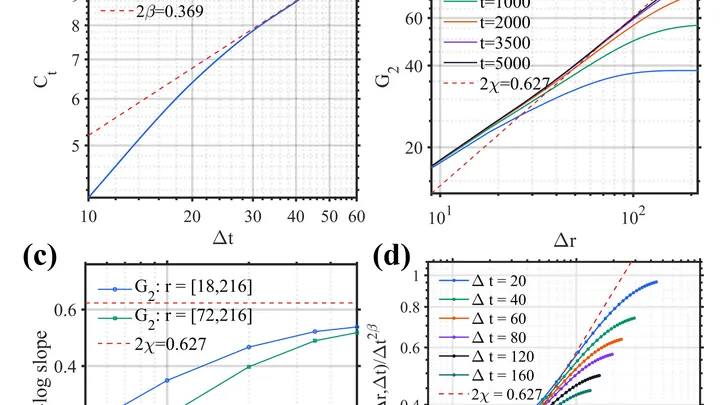
A snow-covered mountain slope looks like a chaotic jumble. But measure the roughness and you find that the height variations follow strict mathematics. Stochastic modeling shows these random processes aren't entirely random. They produce universal patterns, whether in snow, the flame front of a wildfire, or the growth of a bacterial colony.
In 1970, mathematician John Conway invented the Game of Life — a cellular field where just three rules generate surprisingly complex patterns. Forty years later, SmoothLife appeared: a version where space is no longer cellular but smooth, like a blurred patch. The authors of the new study took an even simpler variant of this continuous game: now everything changes smoothly in time as well.
A web where lions eat zebras and hyenas finish the leftovers is not just a list of dinners. It's a survival map for an entire region. When the climate shifts, animals move, and the map tears. To understand where it will tear and where it will hold, you need to find its unchanging 'skeleton'—the connections that repeat across different places.
A bacterium swims toward food. A chemical signal guides it forward, but with each movement the signal changes. A loop emerges: sensation, action, new sensation. The authors turned this loop into a measurable quantity.
At night, when we sink into deep, dreamless sleep, a tide begins in the depths of the brain. Each heartbeat and each breath sends gentle pulses through the fluid-filled cavities (the ventricles). During the day, these pulses are timid and monotonous — the fluid sloshes back and forth almost in place.
But with the onset of slow-wave sleep, the rhythm changes.
The human mind is like a construction set that builds itself. New ideas don't die with their creators: they are passed on, mixed, and selected. This process is called cultural evolution: useful inventions stick, useless ones are forgotten. That's how a ratchet works — a mechanism that only turns forward.
But what exactly happens in the head when one thought displaces another?
A disease outbreak is like a wildfire: the fire runs through dry grass, and its speed depends on wind and humidity. But an infection has its own 'wind'—how often people infect each other. When this rate changes along with the fraction of already infected, the epidemic wave can behave differently.
Two pieces of sandpaper are pressed tightly together. As you start to slide them, they first catch on the rough spots, then suddenly slip. A fault in the Earth behaves much the same way during an earthquake. But there's a crucial detail: how far do you need to push the edges before the grip gives way? This distance is called the critical slip distance.
Water droplets shoot out of a nozzle one after another, like cyclists on a narrow track. The faster ones catch up with the slower ones and merge into larger drops. This simple mechanism is called ballistic aggregation, and until now it had only been observed on cosmic scales: this is how dust particles stick together to form planets.
A perfume bottle is not just glass with liquid. It is a snapshot of its time, a frozen melody of fragrant notes. From 1900 to 2024, tens of thousands of such 'melodies' have accumulated, and now they can be studied as a single organism.