Viscosity is a measure of the resistance of a liquid or gas to sheardeformation. It characterizes internal friction between layers moving at different speeds. There are dynamic (absolute) viscosity and kinematic viscosity (dynamic divided by density).
History
The concept of viscosity evolved from empirical observations to molecular kinetic theory. Isaac Newton in his 'Principia Mathematica' (1687) formulated the law of internal friction. In the 19th century, Claude-Louis Navier and George Stokes generalized it in the equations of fluid dynamics. The kinetic theory of gases (James Clerk Maxwell) connected viscosity with momentum transfer by molecules. Later, Ludwig Boltzmann (not from the list, but a key figure) derived an equation for the distribution function allowing calculation of viscosity; his work was continued by Maxwell and others.
How it works
In liquids and gases, viscosity arises from momentum transfer between layers moving at different speeds. In gases, molecules fly freely from layer to layer, carrying momentum and equalizing speeds; in liquids, intermolecular forces dominate, making shear difficult. According to Newton's law of viscosity, shear stress is directly proportional to the transverse velocity gradient. In a microscopic picture, the viscosity of a gas can be expressed in terms of the mean free path and average molecular speed.
In practice
The viscosity of motor oil protects the engine, and that of lava determines the style of eruption.
Fun fact
In some liquids, viscosity increases when stirred — this is dilatancy, like a mixture of cornstarch and water: you can run on its surface, but if you stop, you sink.
In 1934 Jean Leray proved that the Navier–Stokes equations always have solutions "in a generalized sense". Whether a solution stays smooth or can break down into a singularity he could not tell, and nobody could for ninety years. In 2000 the Clay Institute made the question one of its seven Millennium Prize problems.
An airplane wing, like a skier on a ski jump, remembers its acceleration. Change the angle of attack sharply, and the lift does not immediately reach its new value. It builds up gradually, as if the wing is not yet sure the maneuver is for real.
This effect was discovered by engineer Herbert Wagner in 1925.
A lake in a drought doesn't dry up all at once. First, islands of dry land appear on the water's surface, they expand and merge, and only then does the water recede from the exposed bed. A mirabilite crystal behaves similarly when it loses water: round patches of anhydrous salt appear on its surface, growing outward and then beginning to deepen.
Two mica plates, smooth as mirrors, slowly approach each other in a calcium solution. At a distance of fifty nanometers, an invisible barrier suddenly appears between them: as if someone had stretched a web of molecules between the walls. This web prevents the plates from touching, even though by all calculations they should glide freely toward each other.
Water confined between two cylinders flows in smooth layers when the inner one rotates. But once the speed crosses a certain threshold, the layers crumple into toroidal rolls, like a stack of bagels. Physicists call these Taylor vortices: the flow loses stability and a regular pattern emerges.
Water confined between two cylinders flows in smooth layers when the inner one rotates. But once the speed crosses a certain threshold, the layers crumple into toroidal rolls, like a stack of bagels. Physicists call these Taylor vortices: the flow loses stability and a regular pattern emerges.
Swimming season opens when the water feels tolerable. But everyone has their own threshold: one person shivers at twenty degrees, another swims comfortably at fifteen. Scientists decided to figure out where this difference comes from.
They compared a swimmer's body to a house trying to keep heat in while a cold wind blows outside.
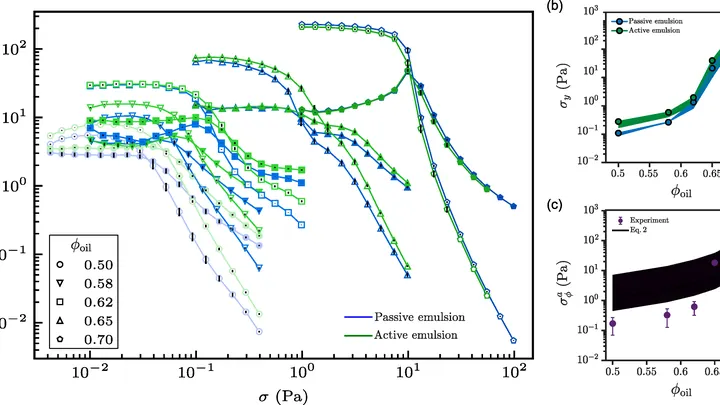
An oil droplet in water is like a ball in a crowd. When the crowd is sparse, the balls move apart freely. But if there are many people, each is squeezed by its neighbors, and the whole mass behaves like a single body. That's roughly how an emulsion works — a mixture where oil droplets float in water or vice versa.
Space construction today is a costly hassle with prefabricated parts: every panel has to be lifted from Earth, then assembled in zero gravity, like building a model kit while wearing thick gloves. Engineers from a new study propose a different path: not hauling or printing, but letting the liquid itself sculpt the structure.
A sphere rolls down a chute. What shape should the chute be to make the descent as quick as possible? Three centuries ago, the answer was the cycloid — a curve resembling the arc of an upside-down bridge. But submerge the chute in a thick liquid, and everything changes: the fluid slows the sphere, and the fastest path becomes something else.
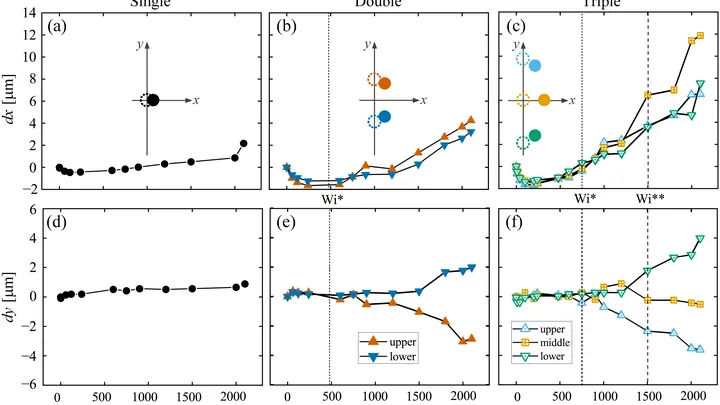
Blades of grass in a stream sway individually, but when several grow side by side, they can bend as one. Something like this happened with flexible plates in a new experiment with a fluid that changes its thickness when flowing.
Scientists submerged rows of flexible plates, from one to three, into the fluid and watched the wake trailing behind them, like a tail.
A raindrop falls on glass and flattens into a pancake. Add a bit of polymer to the water, and it becomes elastic, like jelly. You'd think such a jelly would spread differently.
A raindrop falls on glass and flattens into a pancake. Add a bit of polymer to the water, and it becomes elastic, like jelly. You'd think such a jelly would spread differently.
When an antibody meets a virus, it doesn't latch on with a single death grip. Rather, it's like two bunches of grapes tumbling in water, catching each other with dozens of short tendrils. Each tendril is weak on its own, easily torn by the thermal jitter of water molecules, but together they hold tight.
At night, when we sink into deep, dreamless sleep, a tide begins in the depths of the brain. Each heartbeat and each breath sends gentle pulses through the fluid-filled cavities (the ventricles). During the day, these pulses are timid and monotonous — the fluid sloshes back and forth almost in place.
But with the onset of slow-wave sleep, the rhythm changes.
Two pieces of sandpaper are pressed tightly together. As you start to slide them, they first catch on the rough spots, then suddenly slip. A fault in the Earth behaves much the same way during an earthquake. But there's a crucial detail: how far do you need to push the edges before the grip gives way? This distance is called the critical slip distance.
A speed of 7,5 kilometers per second is the threshold beyond which a cosmic collision turns dust grains into a chemical reactor. In the interstellar medium drift tiny cosmic dust grains — the legacy of dying stars.
A stable system behaves like a ball in a bowl: give it a push, and it rolls back to the bottom. The spread of possible trajectories, uncertainty, shrinks over time. But the speed depends on the slope of the bowl's walls. In complex systems, this 'bowl' has sections of varying steepness.
Soil is not a solid sponge but a labyrinth of pores of various sizes. After rain, water does not fill them all at once: first the narrowest ones, then the wider ones. Physicists built a theory of this process based on a simple image — a set of communicating vessels.
An ocean current hundreds of kilometers wide lives its own life, fed by energy from tiny eddies. Something similar happens in the atmosphere: small swirls pass their power on to huge air currents. This process, the inverse energy cascade, has been known for a long time.
In the intricate dance of active turbulence, where invisible engines spawn chaos, a soft droplet takes on the role of a detective. Its shape is not merely an outline but a sensitive cipher: it reads the hidden signals of its environment.
When physicists drive electrons through an ultrapure gallium arsenide channel at helium temperatures, they expect to see a well-behaved, almost ideal fluid.
In a hot mug, water sometimes freezes faster than in a warm one. This paradox is over half a century old and is called the Mpemba effect. It is usually attributed to fluid motion or evaporation. Now physicists have shown that a similar trick is possible without water, just through radiation of heat.
A hot liquid flows easily: molecules dart around, collide, and quickly find new spots. But cool it below its freezing point, and everything changes. Motion nearly freezes, and viscosity skyrockets. The key question isn't that particles are lazy, but where they can even go.
The authors combined two established ideas.
A living sheet of cells resembles a crowd on an escalator. In a calm state, everyone moves smoothly, but as soon as a crush occurs, movement comes to a halt. Similarly, cell layers under load can suddenly stiffen, turning from a pliable mass into an elastic scaffold.
A stone falls into a pond, and ripples spread evenly in all directions. But some media behave as if the wave knows which way to turn, like water that only swirls clockwise. This asymmetry comes from odd viscosity and odd elasticity — properties of media with broken mirror symmetry.
If you squeeze water between two glass plates so that only two layers of molecules fit, it becomes something between a liquid and ice. At room temperature, molecules in such a trap still move but arrange themselves into a semblance of a crystal lattice.
Imagine a slide with three dips: the deepest one is a stable position for a ball, the middle one is precarious. A slight push and the ball rolls down. Yet, constant vibration of the right strength can hold it in the middle hollow for a long time.
In the 1950s, physicists Lee and Yang discovered that all states of matter are separated by invisible points in the world of imaginary numbers.
Imagine two immiscible liquids, such as oil and water. Under normal conditions, they tend to separate, forming a clear interface. But introduce microscopic swimmers (bacteria, whose basis is carbon) and the picture changes dramatically.
Ordinary ice at very low temperatures and high pressures does not melt but transforms into another solid — equally shapeless (amorphous) but much denser. For a long time, no one could understand exactly what happens at the moment when low-density ice begins to become dense.
A steel cylinder that has held hydrogen for a long time sometimes breaks not along the usual grain boundaries but right through the crystal grains, leaving a strange pattern, as if the crack chose the wrong road. For a long time, people looked at this and wondered: why?
Millions of cilia, thin hairs, work inside the tiny ducts of our bodies. They beat in synchrony, like the oars of a galley, pushing viscous mucus or fluid along. The authors of a new study propose viewing the ciliary carpet as an active porous medium — something like a sponge that squeezes and releases itself, driving water through.
A drop of honey spreads slowly across a table, while water spreads quickly. The resistance to flow, viscosity, differs from one fluid to another. But what if the viscosity changes on the fly, as the substance compresses or expands?
A drop of oil in a glass of water forms a sphere. Inside a living cell, a similar separation occurs, but instead of oil, proteins and nucleic acids form dense droplets — condensates. These droplets act as temporary workshops: they gather needed molecules, speed up reactions, and break apart when the task is done.
A lump of plasticine, when kneaded, behaves like an amorphous solid — not a crystal, but not a liquid either. Inside such a material, avalanches can occur: one tiny rearrangement triggers neighboring ones, and a wave sweeps through the entire sample.
A drop of thick shampoo falls into water and freezes into a strange rope. A liquid that both flows and springs back is called viscoelastic. In it, tiny particles under ultrasound behave quite differently than in water. Viscoelasticity is a material's ability to both spread like honey and return to shape like rubber.
When you squeeze ketchup out of a bottle, you're battling its stubbornness: it sits still at first, then suddenly shoots out in a blob. That's typical non-Newtonian behavior — resistance to flow changes with how hard you push. But the authors of a new study found a way to almost completely eliminate that resistance.
A cell crawls over a gel (sometimes viscous, sometimes elastic) and decides on its own when to speed up. It doesn't just glide: its internal chemical motor (noise in gene expression can affect the production of 'fuel') pushes the leading edge, while the rear detaches from the substrate.
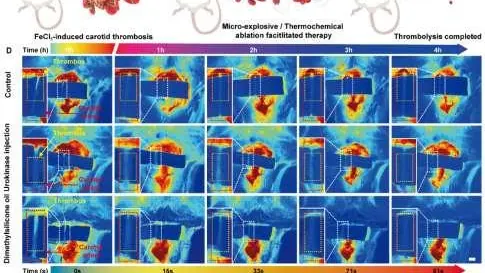
A blood clot in a vessel is like a cork stuck in a narrow pipe. Standard drugs dissolve it slowly, like hot water melting a sugar cube. But while the drug works, the cork can shift and block blood flow entirely.
The new approach works differently. Instead of slow dissolution, the clot is attacked with micro-explosions.
If you don’t stir a layered cocktail, the heavy syrup sinks to the bottom. A young planet is much the same — a seething ocean of molten rock. As it cools, minerals crystallize: some, like iron, get heavy and sink, while others float. You’d think a dense layer would pile up at the core.