How a Silicon Detector Times Particles ✛
A particle enters a silicon wafer like a courier arriving in an unfamiliar city. It needs to leave a precise record of when it visited. The 3D sensor on the Timepix4 chip does this with 245-picosecond precision, which is less than the time light takes to cross the thickness of a human hair.
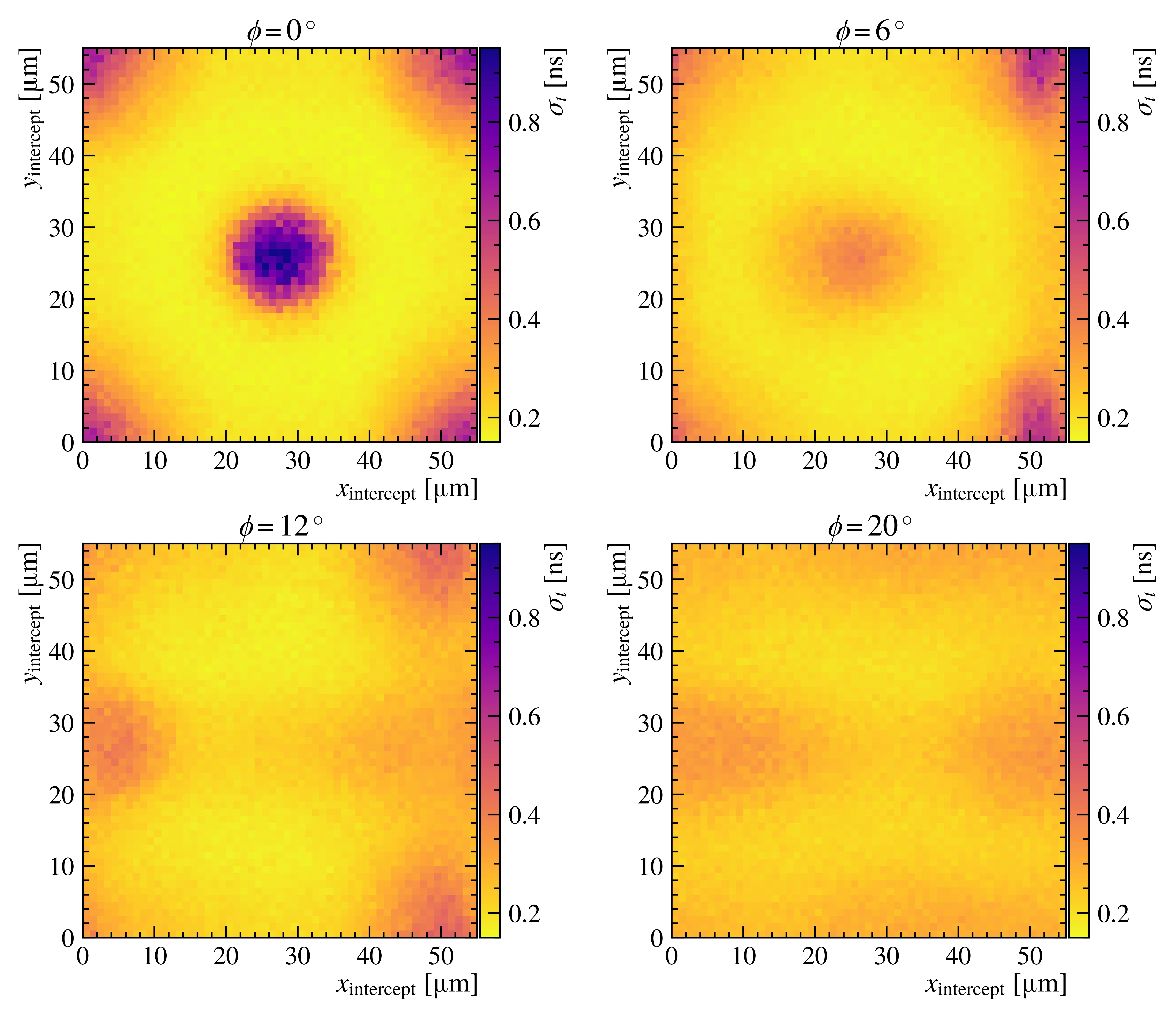
Inside the silicon, electrode columns run like lampposts. When a particle passes between them, it creates a charge that spreads across pixels, like light spilling onto streets. But near the columns themselves, the field is nonuniform, and timing degrades. It turns out that if a particle lands exactly between electrodes, the precision improves to 153 picoseconds. If it grazes the edge of the wafer, where there are no columns, the precision drops to 720 picoseconds.
To sidestep these dead zones, the sensor was tilted by 8 degrees. Then particles passed through at an angle, improving the precision to 233 picoseconds, and the hit position was determined to within 7 micrometers. This trick works because tilting lengthens the particle's path, so the charge spreads over more pixels.
These results are already helping to choose the electrode shape for the future LHCb Upgrade II detector. The courier entering an unfamiliar city now knows which neighborhoods to avoid in order to deliver the signal on time.
The local oscillators on the Timepix4 chip are designed to run at 640 MHz, but due to manufacturing variations their frequency drifts between 627 and 641 MHz. Without correction, this would cause timing errors up to 0.5 ns, so the frequency of each pixel was calibrated using beam data.