Time resolution is the smallest time interval a detector can distinguish between two separate events. In particle physics and imaging, it determines how precisely an instrument can timestamp the arrival of a photon or a particle. A detector with high time resolution can tell that two events happened at slightly different moments rather than merging them into one, which is crucial for tracking fast-moving particles or reconstructing complex interactions.
History
The concept has been central to particle physics since the mid-20th century, but the specific term and its quantitative limits evolved with the development of fast electronics in the 1960s and 1970s. No single inventor is credited.
How it works
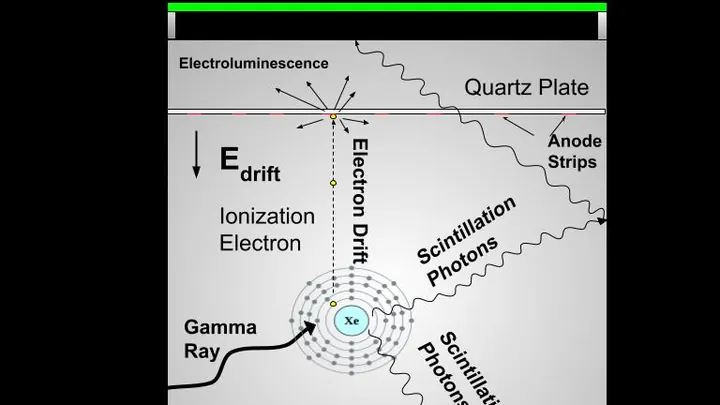
The mechanism depends on the detector type. In a scintillator, an incoming particle produces a flash of light; the time resolution is limited by how quickly the scintillator emits and how fast the photodetector responds. In a semiconductorpixel detector, the charge generated by a particle is collected and compared against a clock; the resolution is set by the electronics' speed and the timing jitter of the signal. Modern detectors achieve picosecond-level resolution by using fast materials and specialized readout circuits that minimize delays.
In practice
Time resolution is used in time-of-flight positron emission tomography (PET) scanners to improve image clarity, and in high-energy physics experiments like those at CERN to distinguish particles produced in collisions.
Fun fact
The fastest detectors today can resolve events separated by just a few tens of picoseconds—less than the time it takes light to travel one centimeter.
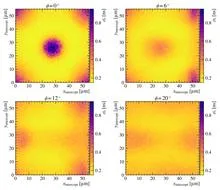
A particle enters a silicon wafer like a courier arriving in an unfamiliar city: it must not only deliver its signal but also leave an accurate record of when it arrived. The 3D sensor on the Timepix4 chip makes that record to within 245 picoseconds, and it pinpoints the meeting spot to just 7 micrometers.
A protein is like a tiny machine that switches on and off on command. The command arrives when another molecule sticks to it, like a key in a lock. The protein then changes shape and passes the signal along. But exactly how the signal travels inside the protein has long been a mystery.
Inside a fusion reactor, plasma rages — a gas heated to millions of degrees. There are no direct windows, and cameras and sensors quickly fail. Engineers see only fragments of information: a few sensors at scattered points. It's like trying to grasp a symphony from the sound of three microphones in a vast hall.
In the constellation Scorpius, 3,000 light-years from Earth, a dead star steals matter from a living one. A white dwarf in the system IGR J17014-4306 — a superdense carbon-oxygen ball with the mass of the Sun but the size of Earth — siphons hydrogen from a normal companion star.
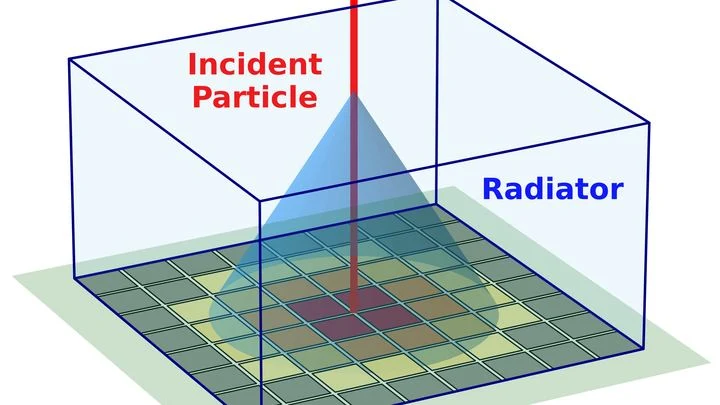
A charged particle streaks through a silicon sensor, leaving behind a trail of free electrons. The time it takes for this charge to be collected at the electrode depends on how deep in the crystal it was born. A particle entering head-on carves identical paths through neighboring pixels: their signals arrive almost simultaneously.
A silicon detector is like photographic film, but instead of light, it senses charged particles. When a particle flies through the silicon, it knocks out electrons, and we see a signal. But how do you look inside the detector itself and see where the electric field is strong and where it's weak? One way is to use a laser.
In giant accelerators, particles zip through detectors in billionths of a second, and telling one from another requires a stopwatch of incredible precision. The new µRWELL-PICOSEC detector acts as such a stopwatch: it captures the moment a particle passes with a precision of 48 picoseconds: that's 48 trillionths of a second.
The camera that hunts for tumors works like a highly sensitive camera: it catches the faint glow from a substance that accumulates in diseased cells. In conventional machines, the light is born in a crystal — a solid piece that resembles glass. But a crystal doesn't always convey exactly where the light flashed, so the image comes out slightly blurry.
A regular camera captures the world as a series of frames: twenty-four, sixty, or even a hundred images per second. That's enough for filming a falling drop, but inside a living cell, events unfold a thousand times faster. Protein molecules carry cargo, membranes bubble, ions slip through channels — all in fractions of a millisecond.
A particle zips through silicon in billionths of a second, and the sensor manages to click, recording the exact time. This isn't science fiction; it's the result of testing the MiniCACTUS-v2 prototype at CERN in July 2025. The best result: 48.88 picoseconds — in that time, light travels just 1.5 centimeters.
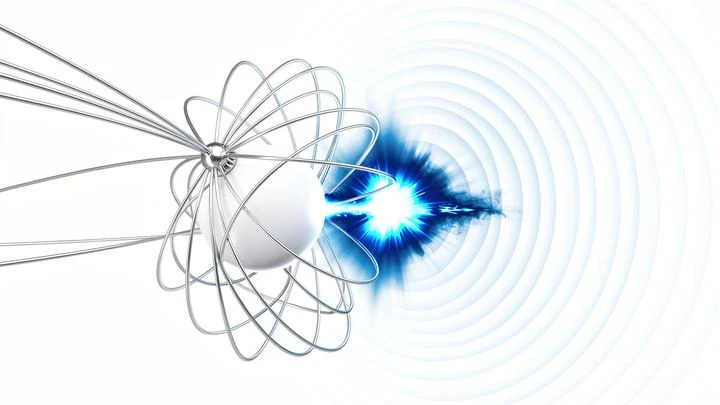
When a particle zips through a transparent material faster than light can travel through it, it leaves behind a faint blue flash, just as a jet breaking the sound barrier creates a shock wave. This Cherenkov radiation fires instantly, with no delay, making it perfect for ultra-precise timing in the world of elementary particles.
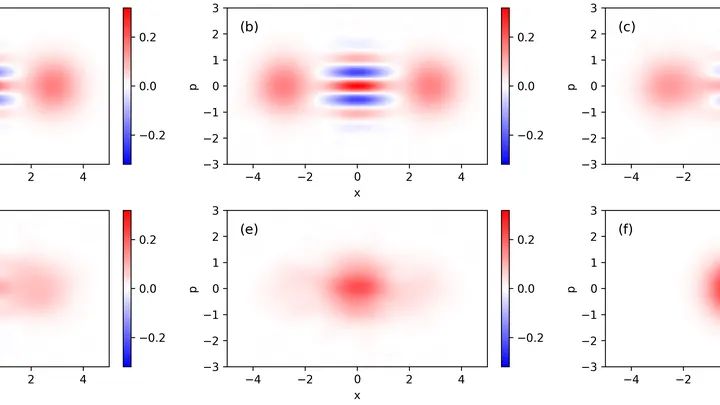
Light can be more than just a stream of particles; it can be a wave with a specific shape over time. Sometimes this shape changes so rapidly that capturing it is like photographing a bullet in flight. Scientists have devised a way to measure such fleeting quantum states of light.
For this, they use a device called a balanced homodyne detector.
A ruler made of light: that's one way to describe a new method for measuring tiny time delays. In 1987, Chong Ki Hong, Zhe-Yu Ou, and Leonard Mandel noticed that when two indistinguishable photons hit a beam splitter simultaneously, they always exit together from the same port.