Silicon detector catches particles in 245 picoseconds ✛
A particle enters a silicon wafer like a courier arriving in an unfamiliar city: it must not only deliver its signal but also leave an accurate record of when it arrived. The 3D sensor on the Timepix4 chip makes that record to within 245 picoseconds, and it pinpoints the meeting spot to just 7 micrometers. Such a city map was built on a particle beam at CERN, where the sensor was irradiated with 180 GeV hadrons.
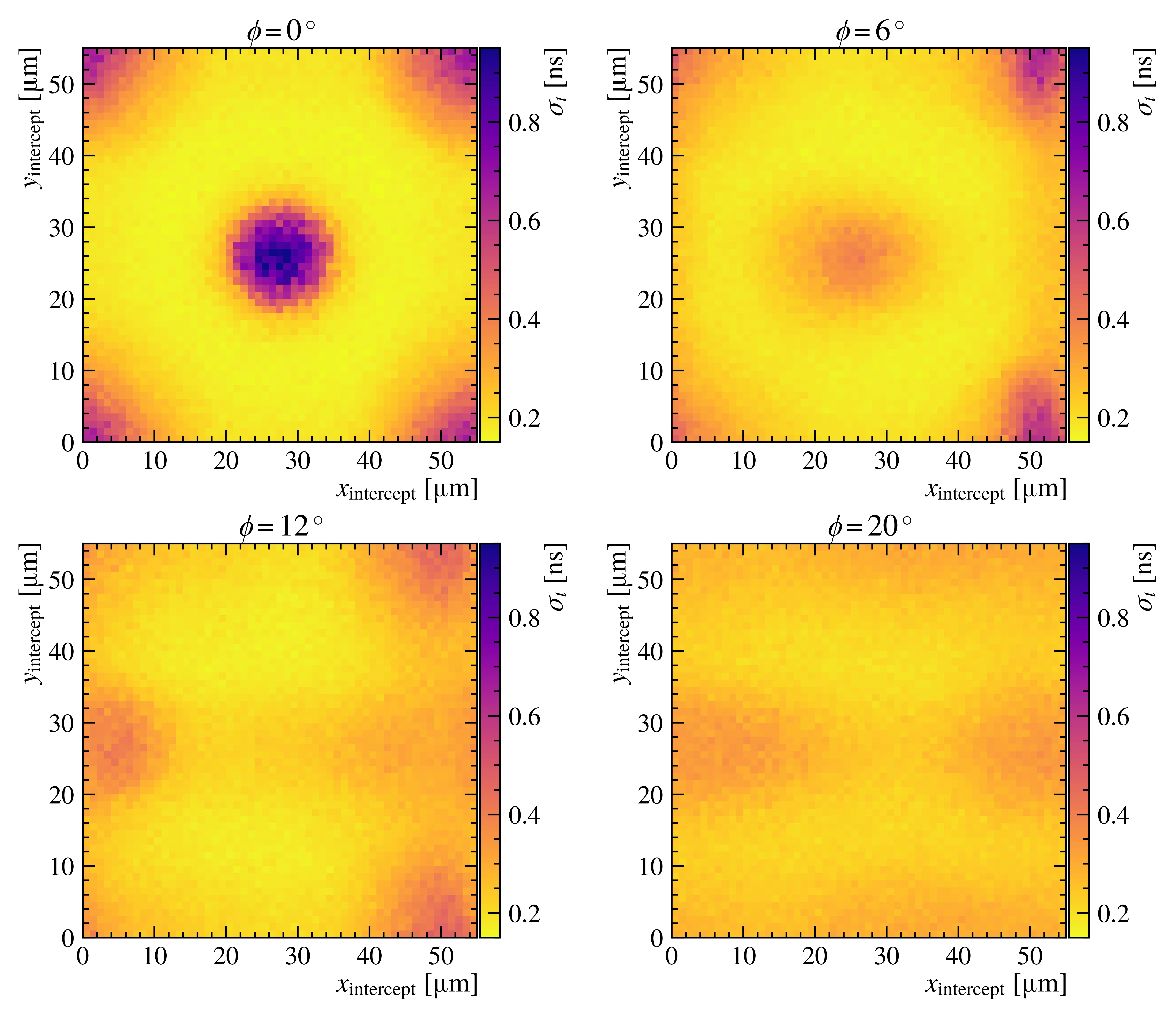
This city is laid out unusually: instead of flat streets, the silicon is threaded with electrode columns that enter from both sides. When a particle lands between them, it creates a charge that spreads across pixels like a crowd fanning out through alleyways. But not all neighborhoods are equally good: near the columns themselves, the field is uneven, so time measurements there are worse. It turned out that if you look only at hits between electrodes, the resolution improves to 153 picoseconds, whereas near the surfaces, where there are no opposing columns, it degrades to 720 picoseconds for single particles.
To bypass these dead neighborhoods, the sensor was tilted by 8 degrees. Particles then passed through at an angle, pushing detection efficiency above 99% and improving the time resolution by another 6%, down to 233 picoseconds. The spatial precision reached 7 micrometers, comparable to the thickness of a spider's thread. This trick works because tilting lengthens the particle's path, so the charge spreads over more pixels.
But why does this matter? The future high-luminosity collider will smash particles so often that each event will contain several simultaneous collisions. The detector must tell which particle came from which collision, which requires a time resolution better than 50 picoseconds. For now, 245 picoseconds is only a step toward that goal, but the work shows exactly where precision is lost. That means the electrode geometry needs to change, not just the chip.
These results are already helping to choose the electrode shape for the vertex detector of LHCb Upgrade II. That courier who flew into an unfamiliar city now knows which neighborhoods to avoid in order to deliver the signal on time. And the map of those neighborhoods was drawn not by guesswork but from real particle-beam data.
The local oscillators on the Timepix4 chip are designed to run at 640 MHz, but due to manufacturing variations their frequency drifts between 627 and 641 MHz. Without correction, this would cause timing errors up to 0.5 ns, so the frequency of each pixel was calibrated using beam data.