Silicon detector catches particles in 245 picoseconds ✛
Context
The future High-Luminosity collider will require detectors that can distinguish particles born in neighboring collisions. This calls for sensors with a time resolution around 50 ps and a spatial resolution better than 10 μm. Nearby on the archive are papers on seeing the invisible field inside silicon, on how pixel patterns reveal a particle's incidence angle, and on a tiny detector that catches particles in 49 picoseconds. All of them seek ways to speed up and sharpen particle detection, but it is 3D sensors that promise to combine radiation hardness with fast charge collection.
Methods
The sensor, with columnar electrodes entering the silicon from both sides, was exposed to a 180 GeV hadron beam on the H8 line at CERN. Particle positions were reconstructed with a Timepix4 telescope to an accuracy of 2.3 μm, and time was measured by two microchannel plate photomultipliers with 12 ps accuracy. For each pixel, the local oscillator frequency and a timewalk correction were calibrated. Spatial resolution was improved with a nonlinear η correction, built separately for each tilt angle.
Results
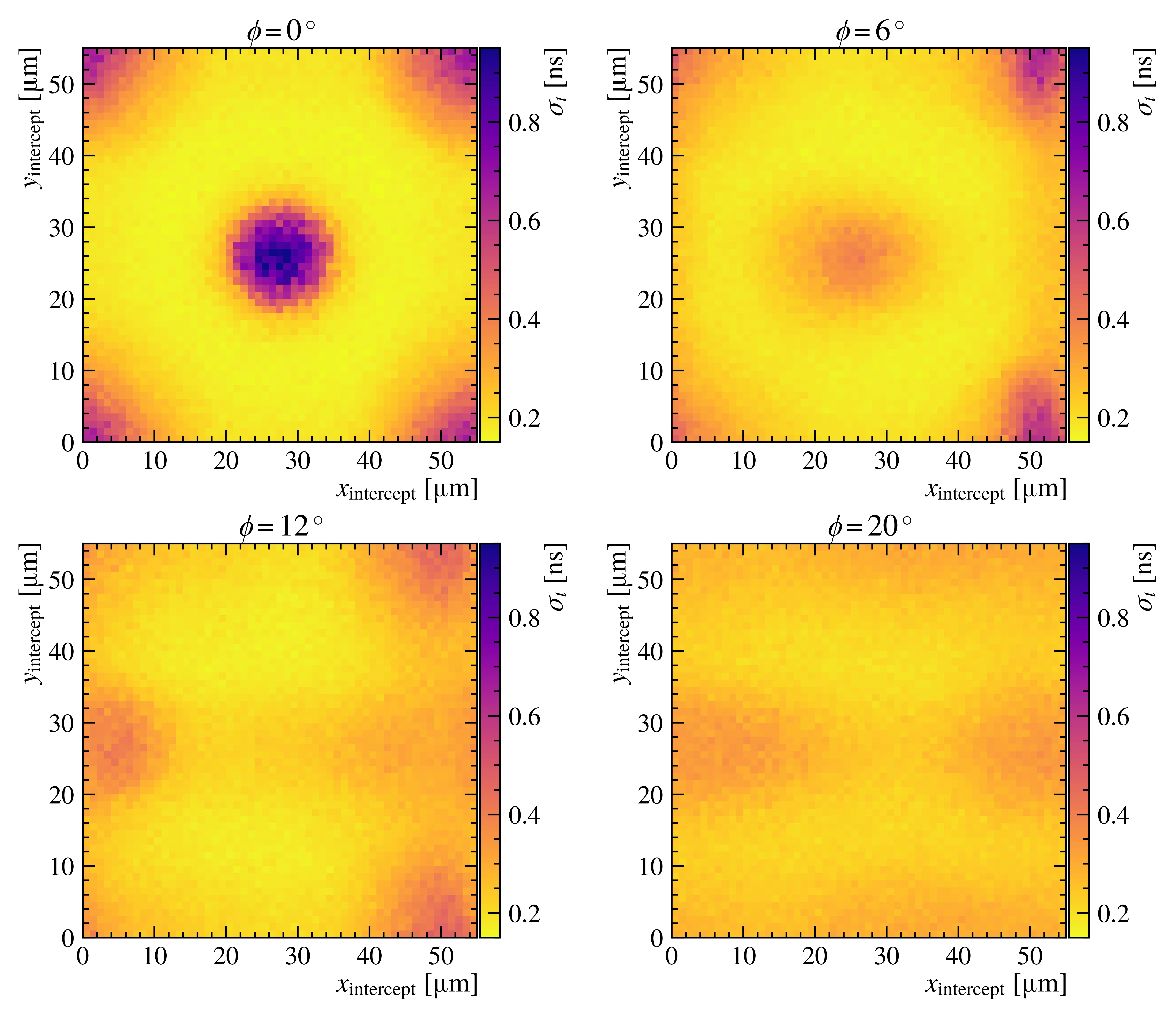
At perpendicular incidence and a bias voltage of 65 V, the time resolution was 245±3 ps with a detection efficiency of 97%. Considering only hits between electrodes improves the resolution to 153±0.4 ps. Tilting the sensor by 8° raises efficiency above 99%, improves time resolution by 6% (to 233±3 ps), and brings spatial resolution to about 7 μm. Studies at grazing angles showed that near the sensor surfaces, where opposing electrodes are absent, time resolution degrades to 720 ps for single hits, but averaging over the 40 pixels of a cluster improves it to 170 ps.
Implications
This work stands somewhat apart: its nearest neighbors study how pixel patterns reveal a particle's incidence angle, how a tiny detector catches particles in 49 picoseconds, and how to keep a signal within a single pixel. The difference is that here, for the first time with a 3D sensor on Timepix4, it is shown that the timing limit comes not from the electronics but from the sensor itself: field non-uniformity and dead zones near electrodes. This shifts design priorities: to improve timing, one must change the electrode geometry, not just the chip.
Future development
The topic could evolve toward electrodes that pass all the way through the silicon, removing the depth dependence of the field. Another direction is a configuration with two readout electrodes per pixel (2E), which promises a more uniform field but increases capacitance. It is also worth testing n-type readout sensors, since Timepix4 works better with electrons than with holes.
Impact
The results will directly influence the sensor choice for the LHCb Upgrade II vertex detector and the design of fast silicon detectors for future colliders.
Next steps
Test a 3D sensor with through-silicon electrodes and compare its time resolution with the current one. Measure correlations between pixels in a cluster to understand how to approach the chip's limit of 60 ps.
Key open problems
For detector physics, an open question remains how to achieve a time resolution of 50 ps in a pixel sensor that withstands enormous radiation doses. This work shows that the main barrier is the field non-uniformity inside the 3D sensor, and it provides a quantitative map of where exactly the precision is lost.
The knowledge machine's view
This section is addressed to the author of the paper and their colleagues. Neighbouring works were found by meaning-based search across our archive, not by word overlap. We do not review: we show the field around the work.
What the work does
A 300 µm thick three-dimensional silicon sensor, bump-bonded to a Timepix4 chip, has been tested in a 180 GeV hadron beam at CERN. Detection efficiency, spatial and time resolution were measured at different tilt angles, bias voltages, and thresholds. The best time resolution was 245 ps for perpendicular incidence; at an 8° tilt it improved by 6% while maintaining an efficiency above 99%. It was shown that the timing accuracy is limited by the sensor itself, not by the readout electronics.
Where its strength is
For the first time with a 3D sensor on Timepix4, it is demonstrated that the time resolution is limited by the electrode geometry and field non-uniformity, not by the chip. This provides a clear direction for further improvements: modify the sensor design, not just the electronics.
Where it could go next
- It might be interesting to explore ways of visualizing the invisible field inside silicon: field-imaging methods could help optimize the electrode geometry of 3D sensors for more uniform charge collection.based on: Seeing the Invisible Field Inside Silicon arXiv:2604.16250
- A related approach is to confine the signal to a single pixel: if the cluster size is reduced, the time resolution could improve because the contribution from peripheral pixels with worse timing is smaller.based on: A Maze for the Signal: How to Keep a Particle in a Single Pixel arXiv:2505.05642
- A tiny detector with a time resolution of 49 ps shows that significantly better times are achievable; it may be worth studying which design features make it faster and transferring them to 3D sensors.based on: Tiny detector catches particles in 49 picoseconds arXiv:2602.19890
Worth trying
- Test a nonlinear η correction separately for regions between electrodes and near them, to smooth out the non-uniformity in the time response.
- Investigate how cluster-time averaging with weights that depend on the distance to the electrode improves the resolution for perpendicular incidence.
- Compare the time resolution at different bias voltages to find the optimum between charge collection speed and noise.
Why this may matter
If 3D sensors can be sped up to 50 ps, they would become candidates for trackers at future high-luminosity colliders, where separating events from adjacent collisions is essential.
Nearby works in our archive
- Tiny detector catches particles in 49 picosecondssimilarity 0.56
- A Detector That Catches Time in Picosecondssimilarity 0.56
- Light Faster Than Thought: Catching Particles in 33 Picosecondssimilarity 0.54
- X-ray snapshot of a chip in minutessimilarity 0.52
- Funnel-Shaped Pixels: How Gamma Rays Are Caught More Preciselysimilarity 0.52
- A Maze for the Signal: How to Keep a Particle in a Single Pixelsimilarity 0.52
- Seeing the Invisible Field Inside Siliconsimilarity 0.52
The archive is sparse around this work: the closest review is only 0.56, against a usual 0.64. It looks like few have drilled nearby.
The local oscillators on the Timepix4 chip are designed to run at 640 MHz, but due to manufacturing variations their frequency drifts between 627 and 641 MHz. Without correction, this would cause timing errors up to 0.5 ns, so the frequency of each pixel was calibrated using beam data.
Key numbers
- time resolution: 245 ps
- spatial resolution: 7 μm
- detection efficiency: 99.3%
- sensor thickness: 300 μm
- pixel pitch: 55 μm