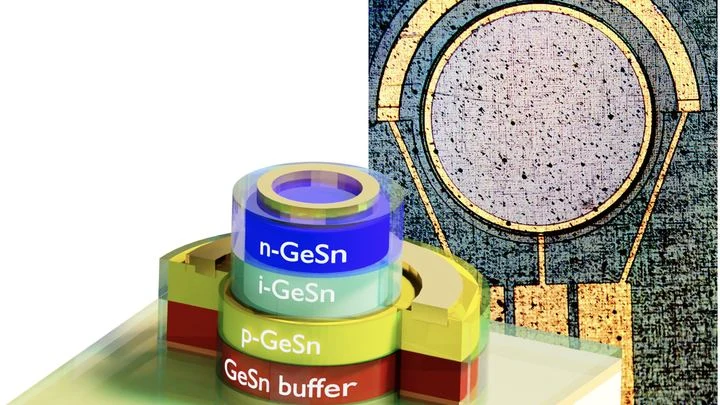
Silicon (Si) is a metalloid, i.e., an element with properties intermediate between metals and nonmetals. Its atoms are arranged in a diamond-like lattice. It is the second most abundant element in the Earth's crust, found in quartz and silicates. A bandgap of 1.1 eV makes it a classic semiconductor: doping with phosphorus creates free electrons (n-type), and with boron—holes (p-type). The contact of p- and n-regions forms a p–n junction, the basis of diodes, transistors and solar cells.
History
Jöns Jacob Berzelius isolated amorphous silicon in 1824, and Henri Sainte-Claire Deville obtained crystalline silicon in 1854. The first point-contact transistor (1947) worked on germanium, but silicon quickly replaced it. In 1954, Morris Tanenbaum created the first silicon transistor at Bell Labs. Leo Esaki contributed to the understanding of junctions by investigating quantum tunneling and inventing the tunnel diode. Since then, miniaturization has progressed exponentially, approaching physical limits.
How it works
When n- and p-regions come into contact, a depletion region arises, creating a potential barrier. Under forward bias, the current increases exponentially; under reverse bias, it is blocked. This rectifying property is described by the diode equation. In metal-oxide-semiconductor field-effect transistors (MOSFETs), the voltage on the gate controls the conductivity of the channel. Operation is based on electrostatics, the Poisson equation, and carrier statistics (Fermi–Dirac distribution). In solar cells, the p–n junction separates photogenerated electron-hole pairs, generating an electric current.
In practice
Microchips in every phone and laptop; solar panels on roofs; glass and concrete around us.
Fun fact
The whole Silicon Valley is named after this element. The first silicon transistor was made in 1954, and since then the number of transistors on a chip has been doubling approximately every two years (Moore's law).
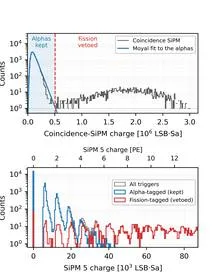
The stage is bathed in icy light, and on it stand silicon spectators. Each is an array of tiny avalanche diodes capable of spotting a single photon, but only if the surrounding temperature drops to 165 K.
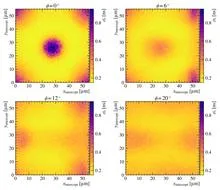
A particle enters a silicon wafer like a courier arriving in an unfamiliar city: it must not only deliver its signal but also leave an accurate record of when it arrived. The 3D sensor on the Timepix4 chip makes that record to within 245 picoseconds, and it pinpoints the meeting spot to just 7 micrometers.
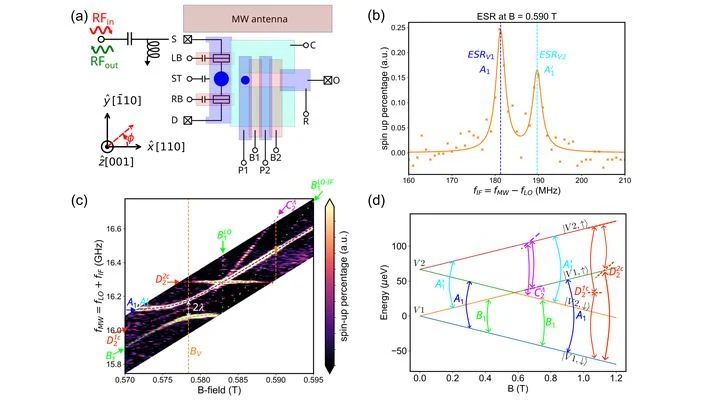
In a quiet room with no magnets anywhere, two electrons in a silicon trap still feel a faint trembling. It comes from the nuclei of silicon and germanium atoms, which spin randomly like the needles of broken compasses. This trembling was once considered noise, but now it has become a measuring instrument itself.
In a quiet room with no magnets anywhere, two electrons in a silicon trap still feel a faint trembling. It comes from the nuclei of silicon and germanium atoms, which spin randomly like the needles of broken compasses. This trembling was once considered noise, but now it has become a measuring instrument itself.
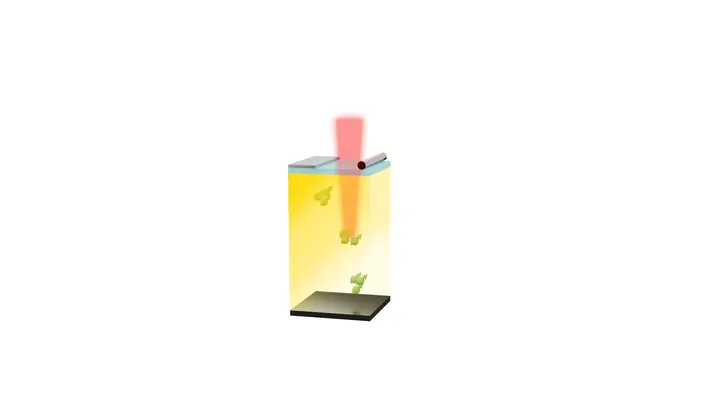
The laser beam in an optical tweezer is not just a spot of light but a force bag. A particle caught in it usually rolls toward the brightest point, like a ball into a dimple.
Building a quantum network node is like teaching a dancer to balance on a carbon thread over an abyss. One leg must spring lightly from the wire, hurling photon-messengers into the external world. The other must grip the rope tightly, guarding precious quantum information.
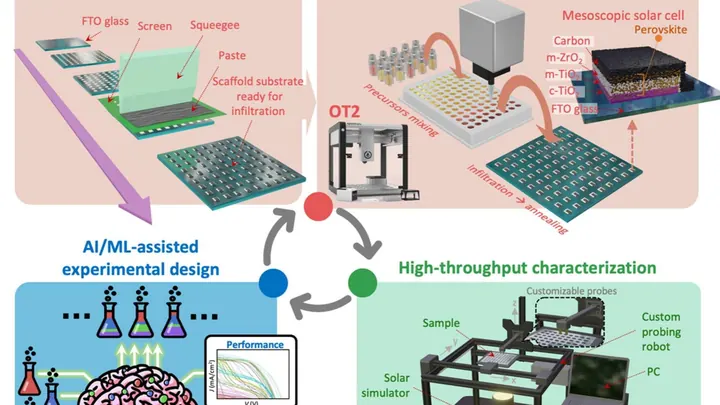
Perovskite crystals harvest sunlight almost as well as silicon, but cost pennies. Their trouble is an inborn fragility: from warmth and ordinary water in the air, they “get sick.” Inside, disorder builds up, and the shiny plate turns cloudy, losing its abilities within a couple of days.
The young super-Jupiter TWA5B, a scorching ball 25 times Jupiter's mass, floats just fifty light-years away. Its faint infrared glow long hid its chemical makeup. Now, high-resolution spectroscopy with CRIRES+ has registered the ghostly trace of SiO — silicon monoxide.
A quantum computer is like an orchestra: each musician plays their own part, but the slightest noise from the audience can throw off the whole ensemble. The particles that store information easily lose their coherence from thermal jolts or stray magnetic fields.
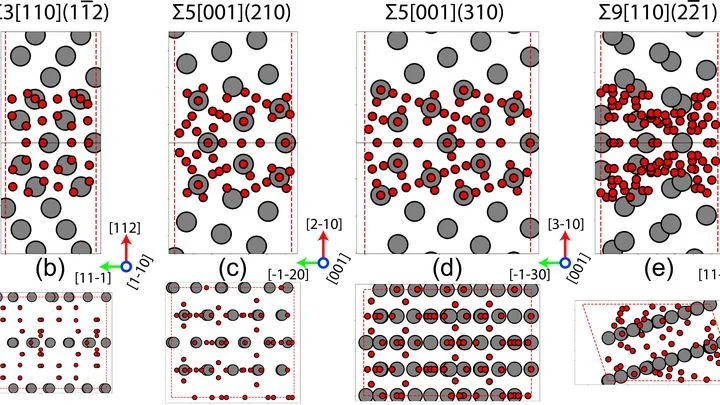
Steel is not a monolith but a mosaic of microscopic grains fused together. Their seams, the grain boundaries, are the most vulnerable spots: this is where cracks begin. Impurity atoms, even in negligible amounts, accumulate at these seams like sand between gears, and they can either lubricate the mechanism or jam it completely.
Diamond is the hardest natural material and usually does not conduct electricity. But if you add a few foreign atoms to its crystal lattice, it can become a semiconductor, like silicon in computer chips.
Silicon is the very material that powers the processors in every phone and laptop. Now, researchers have learned to trap a single electron in it and control its spin — a tiny magnet that can point 'up' or 'down'. It's like holding a spinning top: you can tilt and turn its axis, but here, instead of hands, you use an electric field.
Silicon carbide is the material used to armor electronics. It withstands heat, impacts, and radiation like the ceramic tiles on a spacecraft's heat shield. But even this armor has a weak spot: ordinary metal contacts quickly degrade under X-rays.
A quantum computer is like an orchestra where every musician must play their part perfectly, or the melody falls apart. Previously, controlling qubits — the quantum 'musicians'—required a room full of equipment, and every extra wire added noise.
A woven bamboo basket is not just a household item: it's an exact blueprint for how atoms are arranged in the crystal YMn₆Sn₆. Six manganese atoms form hexagons that assemble into a pattern reminiscent of the Japanese kagome. In such a lattice, electrons usually behave uniformly, like passengers in a crowded subway car.
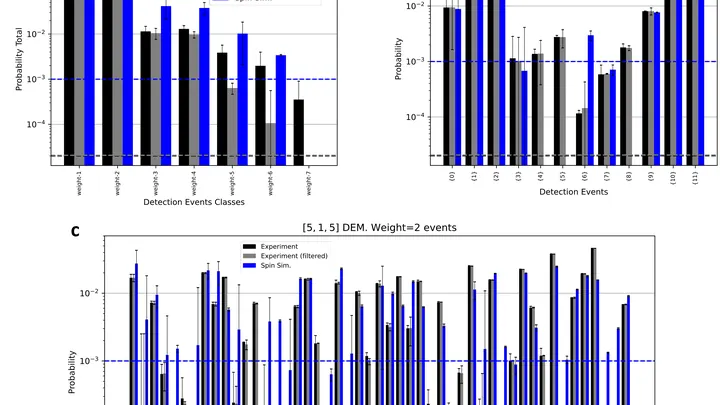
In a particle accelerator, nuclei shatter into fragments like a porcelain cup dropped on the floor. Each fragment flies through silicon wafers, which register the impact and its strength. But to distinguish a real signal from random noise, you need a threshold: below it, readings are considered interference.
Deep inside every hard drive or flash drive lies a material that can 'remember' an electric field. Such a material is called a ferroelectric. When you apply a voltage, tiny regions inside the crystal (domains, like compass needles) flip. Flip the needle one way, you've written a one; flip it back, a zero. But what happens to the atoms at the moment of that flip?
A power transistor made of silicon carbide operates under voltages thousands of times higher than what comes out of a wall outlet. If the field inside it becomes uneven, the device burns out. Previously, this field was invisible: it is too strong for ordinary sensors, and the device must remain under voltage.
A silicon chip the size of a fingernail holds billions of tiny switches. But a quantum computer needs not switches but individual electrons trapped in microscopic pits. These pits are quantum dots. And here's the catch: two neighboring pits that look identical can hold an electron differently. One is slightly deeper, the other slightly shallower.
Silicon is like a universal building block: it goes into the chips in your phone, solar panels, and lasers. But if you squeeze it with immense force, the atoms rearrange into new patterns: these forms are called allotropes. One of them, Si-XIII, was first spotted more than twenty years ago, but its exact pattern remained a mystery.
An ordinary superconductor works like a perfect conductor: electrons pair up and flow without resistance. In the new material TaPtSi, the pairs are arranged differently: their internal symmetry is skewed, and when cooled below the critical temperature, tiny magnetic fields spontaneously emerge inside the crystal.
A blazing furnace in a workshop or the hot exhaust of a turbine is not just heat: it's light, invisible to the human eye. Regular solar panels catch visible light, but here you need a receiver for invisible thermal radiation.
A crystal is like a perfectly laid mosaic of atoms. But growing such a mosaic is a tricky task: if the order slips even slightly, 'seams' appear — boundaries where rows of atoms don't align. For ordinary electronics, that's a minor issue, but for a quantum computer, it's a disaster.
A photon is like a car in a multi-story parking lot, where each floor is its frequency (color). Usually it gets stuck on one level, but scientists added an elevator — a programmable modulator that moves the photon between floors on command.
Electronics get hot. The more powerful the processor, the more heat you need to get rid of, or it will fail. One bottleneck is the boundary between two materials: heat hits it like a seam between tiles and slows down.
Every electron is like a spinning top: it twirls around its own axis. This rotation is called spin. In conventional electronics, we don't use spin — only charge. But that's a missed opportunity: if we learn to control spin, chips could become faster and more efficient.
Twisted layers of atoms in a material form a pattern of tiny regions, domains, each of which can be electrified in one of two directions, like a compass needle pointing north or south. Previously, such materials were studied only as a whole, measuring thousands of domains at once, and their collective behavior was like a choir where individual voices are not heard.
Heat one end of a conductor and keep the other cold, and electrons start flowing from hot to cold. Usually, this creates a voltage along the conductor, like water running down a tilted trough. But in some materials, electrons veer sideways, and the voltage appears across the conductor.
An atomic nucleus usually has a well-defined shape — elongated like a melon or flattened like a pumpkin. But silicon-30 behaves differently: it seems unable to make up its mind.
In a silicon crystal, a phosphorus atom holds an extra electron on two very closely spaced orbits. These orbits are like two neighboring floors in a building where the staircase is almost invisible. A short laser pulse in the mid-infrared range pushes the electron from the lower floor to the upper one, and it starts swinging between them like a pendulum.
In a silicon carbide crystal, which looks like a transparent stone, there are hidden defects — places where atoms are out of line. One such defect acts as a quantum node: an electron inside it spins and processes information, while the nucleus of a neighboring atom quietly stores it.
A quantum computer is a machine where qubits replace ordinary bits. A qubit can be not just a 0 or a 1, but both at the same time. One way to make a qubit is to take an electron and make it hover above the surface of liquid helium. The helium is cooled to below two degrees above absolute zero.
A quantum computer is like an orchestra where electrons and nuclei play different instruments. Usually, the conductor needs two batons: microwaves for electrons and radio waves for nuclei.
In Chile's Atacama Desert, at an altitude of nearly five kilometers, stands a radio telescope that catches millimeter waves from the depths of space. These waves carry the heat of distant galaxies, but first they must pass through a window — a thin plate of silicon that separates the cold receiver from the warm outside world.
A silicon wafer is like cookie dough. Heat it in an oven, and tiny raisins appear inside — defects in the crystal lattice that can emit single photons. These "raisins" are called color centers, and they are needed for quantum computers and secure communication.
Tuning a piano is delicate work. Strike one string, and its neighbors resonate. A silicon chip with crystal defects, being prepared for quantum computing, behaves similarly.
In a silicon carbide (SiC) crystal, there are special spots — silicon vacancies. There, an electron behaves like a tiny magnet with four states.
A crystal one atom thick is like a sheet of paper you can write on with electricity. Such a material promises to become the foundation for tiny, fast microchips. But before putting it into production, you need to know exactly what it's made of. And that's where the usual formula falls apart.
A tiny crystal flake rests on a substrate like an autumn leaf on a palm. It's thinner than a human hair, yet inside it quantum effects are simmering: superconductivity, magnetic order, quantum spin liquid.
A handful of lead sulfide nanocrystals coated with charged molecules spontaneously assembles into a perfect crystalline lattice. Each nanocrystal is like a brick just a few nanometers across, while the charged molecules on its surface act as the mortar.