How an Electron Snaps One Bond in a Molecule ✛
An electron flies into an alcohol molecule like a saboteur who knows exactly where to strike. It doesn't destroy everything in its path; instead, it finds the weak spot, the bond between carbon and the hydroxyl group, and snaps it, leaving behind a negatively charged hydroxide ion.
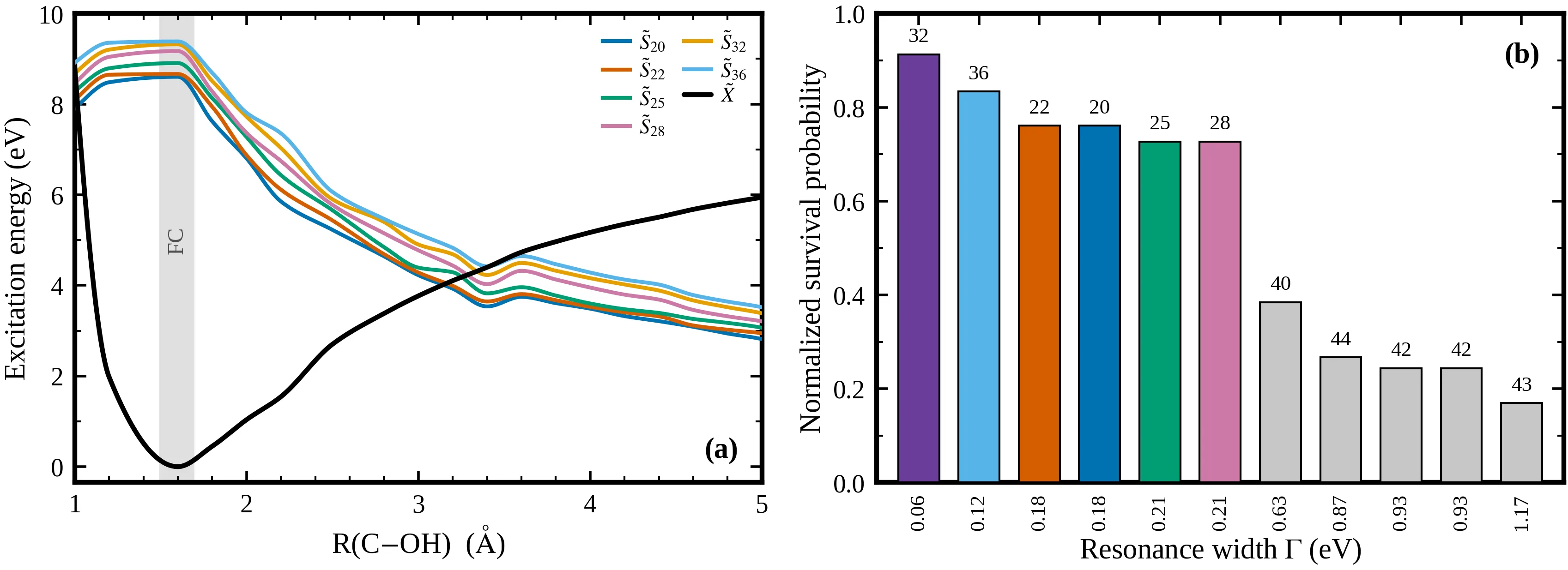
Previously, it was unclear how the electron chooses this bond. Researchers thought it simply stuck to the molecule temporarily, like a guest lingering at the doorstep. But calculations showed that the electron penetrates inside and rearranges the molecule's electron cloud. This creates special states that live unusually long. Six such states were found, each acting like a lever that directs energy into breaking precisely the C–OH bond.
The experiment confirmed the calculations: the yield of hydroxide ions shows a broad peak with a maximum at 8.6 eV. This peak looks like a single feature, but it is actually a superposition of dozens of states, of which only six survive. The rest quickly eject the electron back. Now it is clear that the electron saboteur operates through long-lived resonances, which helps assess the radiation resistance of molecules and interpret negative-ion mass spectra.
The resonance at 8.6 eV is so broad that it could be mistaken for a single peak, but it is actually a superposition of dozens of anionic states, of which only six survive.