Atomic and Molecular Clusters physics.atm-clus

11 articles

Atomic and molecular clusters and nanoparticles: geometric, electronic, optical, chemical, and magnetic properties, spectroscopy, computational methods.

articles

Physics and Society2025-11-261 minarXiv:2511.20976express
How Artificial Intelligence Becomes a Scientist's Partner
Science is a vast kitchen where scientist-cooks seek new recipes. Once, they sifted ingredients by hand; now artificial intelligence, a seasoned chef, lends a hand. AI memorizes millions of flavors and suggests surprising pairings: through information search, the algorithm uncovers hidden patterns.

Salt, Water, and Invisible Pairs
Salt in a glass of water is a crowd of charged particles. When there's plenty of water, each particle floats on its own, wrapped in a thick fur coat of water molecules. But as you keep adding salt, the water runs out for everyone, and the particles start seeking each other out. First, they stick together in pairs, then in larger clumps.
Exoplanets2026-02-151 minarXiv:2602.14334express
Cosmic Oven: How Heat Baked the Building Blocks of Life on Jupiter's Moons
Life may be hiding in the oceans beneath the ice of Europa, Ganymede, and Callisto. Its carbon-based building blocks perhaps baked before the moons were born — in a disk of gas and dust around a young Jupiter. This giant cosmic oven ran on slow frictional heating, not harsh ultraviolet light.
Materials2026-03-231 minarXiv:2603.22254express
A Foldable Anode for Sodium Batteries
A conventional graphite anode in a sodium battery is like a cramped garage that barely fits a large truck. Sodium is larger than lithium and doesn't fit well between graphite layers, so batteries quickly lose capacity.
Mesoscale2026-03-301 minarXiv:2603.28399express
Golden nanocrystal: how shape controls defects
A gold particle a few nanometers across looks like a tiny faceted diamond, but with five faces instead of the usual ones. Inside it hides a defect, like a crack in glass that can either heal or shatter the whole object. Scientists set out to discover what makes this defect move and disappear.
An Ionic Spinner in a Cosmic Trap
A tiny charged top is locked inside a freezer the size of a pea. The temperature is four degrees above absolute zero, and thermal jitter is nearly halted. This top is a molecular ion — OH⁺ — stripped of an electron, leaving a positive charge.
Gravitational Radio Forest: How a Hydrogen Quantum Detector Reveals Dark Matter
Dark matter is the great cosmic invisible. It neither emits, absorbs, nor reflects light, yet its gravitational grip is felt in every motion of galaxies. Seventy years ago Vera Rubin showed that the outskirts of galaxies rotate too fast — as if spurred on by an unseen shepherd.
Quantum Physics2026-07-042 minarXiv:2607.03820express
Transparency for atoms: how collisions clear the way
A beam of light enters frosted glass and fades — nothing unusual. But physicists have long known how to make light pass through without losing a single photon. This trick is called electromagnetically induced transparency: two light waves cancel each other at the right point, and absorption disappears. Now a similar feat has been pulled off with atoms.
Chemical Physics2026-08-062 minarXiv:2608.05590express
Space Chemistry on a Grain of Sand
In dark interstellar clouds where new stars are born, chemistry starts with a tiny particle — the trihydrogen ion (H₃⁺). It collides with other atoms and sets off a cascade of reactions that build ever more complex molecules. For a long time, it was thought that the main reaction producing it, H₂⁺ colliding with H₂, only happens in the gas phase.
Optics2026-09-062 minarXiv:2609.06454
An Attosecond Orchestra at Kiloelectronvolts: Tuning Harmonics in Unison
Tuning a string to the right note: the laser pulse is adjusted so that harmonics play in unison at kiloelectronvolt frequencies. Visible light oscillates at hundreds of trillions of times per second.
The Electron Saboteur: How a Single Particle Severs a Bond in an Alcohol Molecule
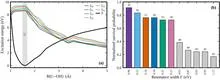
An electron enters a 2-propanol molecule like a saboteur who knows exactly where to strike. It doesn't destroy everything in its path; instead, it finds the weak spot, the bond between carbon and the hydroxyl group, and snaps it, leaving behind a negatively charged hydroxide ion.