The Electron Saboteur: How a Single Particle Severs a Bond in an Alcohol Molecule ✛
An electron enters a 2-propanol molecule like a saboteur who knows exactly where to strike. It doesn't destroy everything in its path; instead, it finds the weak spot, the bond between carbon and the hydroxyl group, and snaps it, leaving behind a negatively charged hydroxide ion.
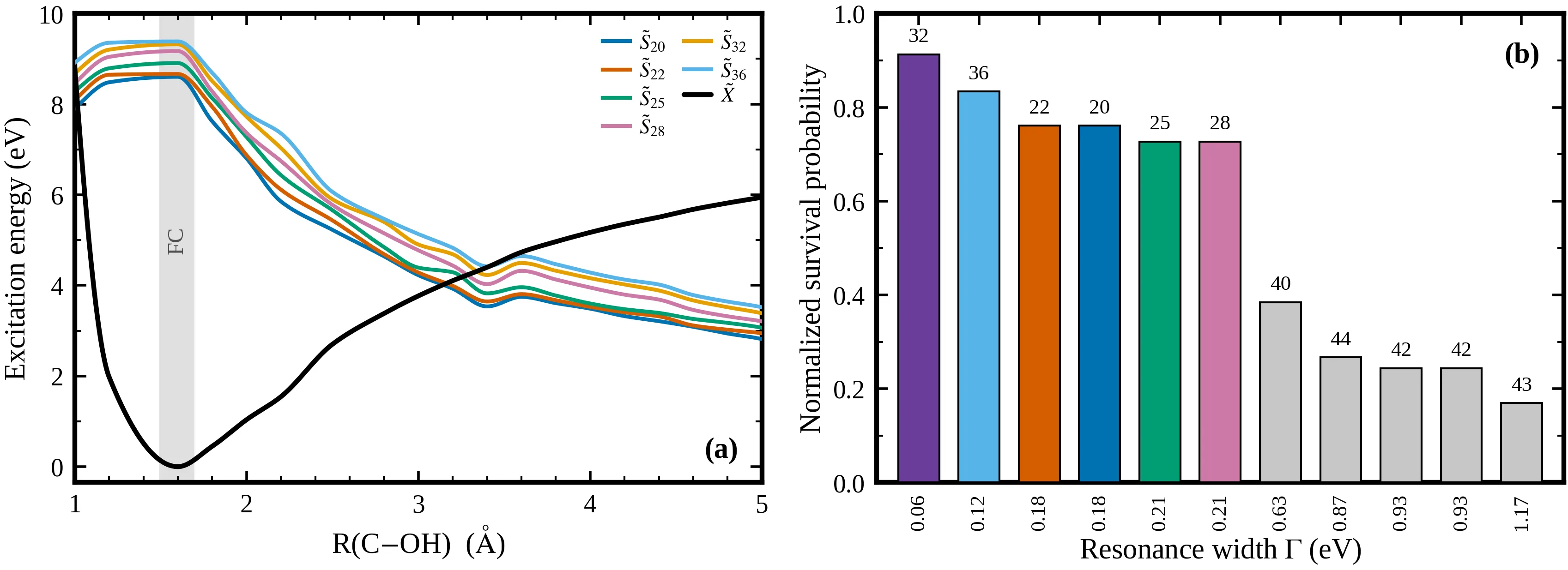
For a long time, it was unclear how the electron picks out this particular bond. Earlier thinking held that it simply sticks to the molecule temporarily, like a guest lingering at the doorstep. But calculations revealed that the electron doesn't stay on the surface; it penetrates inside and reshuffles the molecule's electron cloud. This gives rise to special states that live unusually long, longer than the typical time it takes for the electron to fly back out.
Six such long-lived states were found, and each acts like a lever that channels energy into breaking the C–OH bond. Two of them are nearly perfect: they concentrate the electron on an orbital that weakens the bond, like a crack in a wooden beam.
The experiment confirmed the calculations: the yield of hydroxide ions shows a broad peak with a maximum at 8.6 eV. This peak looks like a single feature, but it's actually a superposition of dozens of states, of which only six survive. The rest quickly eject the electron back, like an impatient guest who doesn't wait for the host.
It was known before that hydroxide ions form from alcohols at energies of 7–11 eV, but the exact mechanism responsible for bond cleavage remained controversial. Now it's clear: long-lived Feshbach resonances dominate, in which two electrons occupy excited orbitals. This discovery generalizes the concept of site-selective dissociation, the ability of an electron to break one specific bond in a molecule without touching the others.
The same kind of saboteur is at work in radiation biology, where electrons damage DNA, and in cold plasmas, where chemical reactions take place. Understanding how an electron chooses a bond helps assess the radiation resistance of organic molecules and interpret negative-ion mass spectra. If a molecule has a hydroxyl group, the electron will find it and break its bond to carbon, just as it does in 2-propanol.
The resonance at 8.6 eV is so broad that it could be mistaken for a single peak, but it is actually a superposition of dozens of anionic states, of which only six survive.