Resonance occurs when a system is driven at a frequency that matches its natural oscillation frequency, causing a dramatic increase in amplitude. This phenomenon appears across physics, from mechanical systems like bridges and pendulums to electromagnetic circuits, acoustic instruments, and quantum systems. In particle physics, resonances are short-lived states that appear as peaks in scattering cross-sections, revealing the existence of new particles. In condensed matter, resonances can explain unusual heat transport, light scattering, and the pairing of electrons in superconductors.
History
The concept of resonance has roots in ancient music and mechanical vibrations, but it was formalized in the 19th century by physicists like Hermann von Helmholtz and Lord Rayleigh. In quantum mechanics, resonance was introduced by George Breit and Eugene Wigner in 1936 to describe nuclear reactions.
How it works
When an external force oscillates at a frequency close to a system's natural frequency, energy is efficiently transferred into the system, leading to large oscillations. In the absence of damping, the amplitude grows linearly with time; with damping, it reaches a finite peak. In quantum systems, resonance corresponds to the absorption of energy quanta that match the energy difference between discrete levels, as in atomic transitions. In scattering, resonance occurs when a projectile forms a temporary bound state with the target, enhancing the interaction probability.
In practice
Resonance is exploited in MRI imaging, microwave ovens, radio receivers, and the design of bridges and buildings to avoid destructive oscillations. In research, it is used to detect exotic particles and study material properties.
Fun fact
The Tacoma Narrows Bridge collapse in 1940 was not caused by resonance but by aeroelastic flutter, yet it remains a popular—and incorrect—example of resonance in textbooks.
In a crystal, heat travels on waves. Atoms vibrate, and these vibrations, called phonons, carry energy from the hot edge to the cold one. For a long time, it was believed that if phonons hit resonance (their frequencies exactly match) and can exchange energy, heat would flow like an avalanche. It turns out that's not the case.
A massive aluminum cylinder weighing a ton hangs in a vacuum. A gravitational wave, a ripple in spacetime, passes through it, and the bar begins to tremble almost imperceptibly. That trembling can be heard as sound: gravitational waves turn into a phonon — a quantum of sound vibrations.
Immediately after the Big Bang, the Universe underwent ultra-fast expansion, an idea proposed by Alan Guth and developed by Andrei Linde. When the expansion stopped, the field-energy began to oscillate like a giant swing.
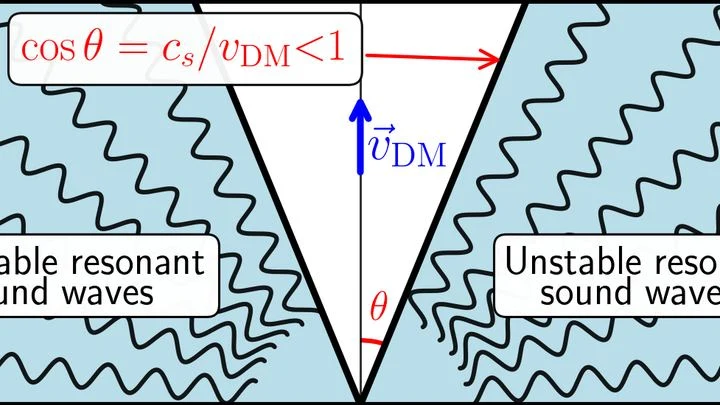
After the Big Bang, dark matter and ordinary matter (mostly hydrogen) went their separate ways in terms of speed. Their gravitational pull acts like a bow gliding across a string: when frequencies match, resonance occurs, and sound waves start to rapidly grow in ordinary matter.
In a dark room, an infrared laser flashes, and a speck of black K3C60 powder conducts electricity without resistance for a split second. The light strikes at 10 terahertz — a thousand times faster than a microwave oven. The effect is a hundred times stronger than at other frequencies. Why this particular frequency?
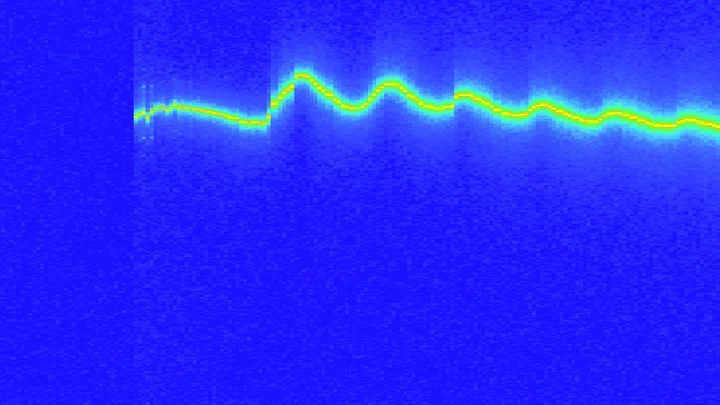
A tiny diamond bridge vibrates so strongly that it starts to 'sing' at many frequencies at once. Previously, such vibrations would dampen themselves: the harder the resonator swung, the harder it was to add energy. Physicists found a loophole in this rule.
They used light to drive the diamond. Light pushes on the bridge, making it tremble.
Two tiny emitters, each about the size of an atom, can together do what neither can do alone. We're talking about light scattering — when light hits particles and bounces off in all directions. Usually, a pair of particles scatters light only slightly more than a single one.
An ordinary superconductor loses resistance when cooled, and current flows through it without loss. But in ultrathin films, things are different: the material fluctuates between normal and superconducting states, and in this transition zone, strange resistance waves emerge. Resistance rises and falls as if someone were turning a volume knob.
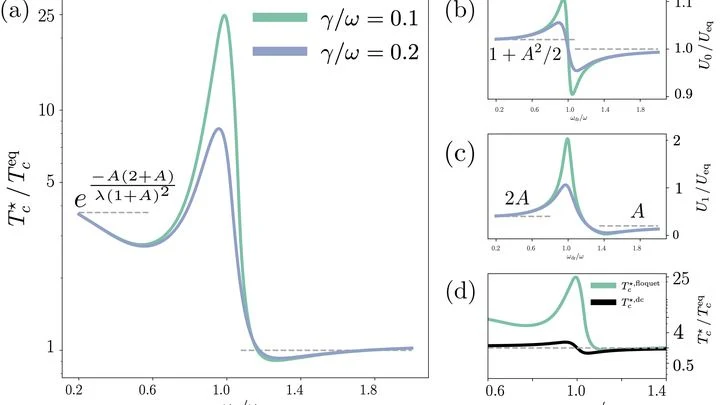
An ordinary superconductor works only in nature's freezer — at temperatures below minus one hundred degrees. The carbon-ball material K₃C₆₀ is no exception: without cold, it resists current like a crowd in a narrow corridor. But physicists noticed something strange: if you shine a laser on it, it starts conducting without loss even in warmth.
Quantum particles in a strongly disordered environment behave like dancers executing steps in sync: each knows its own move and never collides with others. This kind of coordinated, frictionless flow, superfluidity, unexpectedly emerged in an experiment on a superconducting quantum chip.
Run a current through a contact between a superconductor and a ferromagnet, and you will hear the whisper of the quantum world. In the lab at 0.3 K, that whisper turned into a roar: the shot noise—electrical noise due to the discreteness of charge—was a hundred times louder than theory allows for ordinary contacts.
In a large concert hall, sound bounces off the walls, and even if you stand in a corner, the echo can reveal the shape of the room. That is essentially the problem the authors tackle: how to recover a system's hidden rhythms from the 'echo' in data collected from only part of the system.