How an Electron Breaks a Bond: Hydroxyl from 2-Propanol ✛
Context
The hydroxyl group is involved in radiation damage to DNA, atmospheric and interstellar chemistry, and combustion processes. Earlier, OH⁻ formation was observed in many alcohols and acids at energies of 7–11 eV, but the nature of the resonances remained unclear. This work sits alongside studies of electron-molecule collisions, superconductivity, and quantum knots, yet it stands out for directly combining high-precision calculations with experiment for a specific dissociative electron attachment reaction.
Methods
The authors used two approaches. Theoretically, they applied the CAP-EOM-EA-CCSD method with the aug-cc-pVDZ basis set, which describes metastable anionic states through a complex absorbing potential. Potential curves were constructed along the C–OH bond stretching coordinate from 0.8 to 5.6 Å. Experimentally, they recorded negative-ion mass spectra on a time-of-flight spectrometer equipped with a thermionic electron gun and an energy spread of 0.8 eV. Mass calibration was performed using SO₂, and the energy scale was calibrated using O⁻ from O₂ and CO₂.
Results
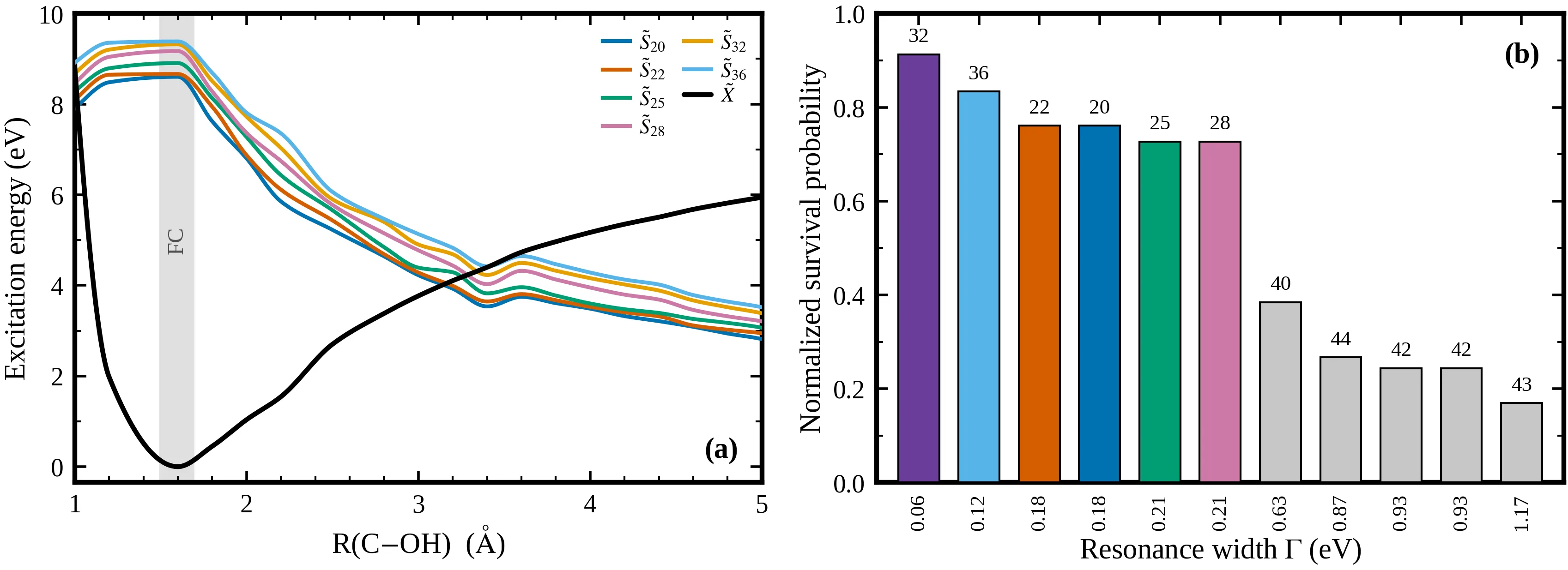
The experimental OH⁻ yield shows a broad resonance peaking at 8.6 eV. Calculations reveal a dense manifold of anionic states in this region. Among them, six states (20, 22, 25, 28, 32, 36) have widths below 0.25 eV and drop below the neutral ground state at a bond stretch of 4.1 Å, where autodetachment becomes energetically forbidden. States 25 and 28 have almost pure 2p-1h character (R₂² norms of 0.9954 and 1.0000) and are localized on the σ*(C–OH) antibonding orbital. Survival probabilities for these six states are 0.1–0.3, whereas for broader resonances they fall below 0.01.
Implications
This work provides the first quantitative evidence that OH⁻ from alcohols at 7–11 eV forms via 2p-1h Feshbach resonances, not via single-particle shape resonances. Unlike neighboring studies that focus on other molecules or phenomena, here high-precision calculations and direct experiment are combined for the same process. This confirms and extends the concept of site-selective dissociation proposed earlier for simple molecules.
Future development
The topic may evolve toward more complex biomolecules, where hydroxyl groups play a key role in radiation damage. The influence of solvation and intermolecular interactions on resonant states could be explored. Applying nonadiabatic dynamics methods to model population transfer between states in detail is also promising.
Impact
The results are important for radiation biology, astrochemistry, and low-temperature plasma physics, where dissociative electron attachment dictates chemical pathways.
Next steps
A next step could be calculating dissociative attachment cross sections for other alcohols and comparing with experiment. It would also be useful to investigate the role of vibrational excitations in accessing states 28, 32, and 36.
Key open problems
This work directly addresses the unresolved problem of quantitatively predicting fragment yields in dissociative attachment to polyatomic molecules. It shows that accounting for nonadiabatic transitions and long-lived resonances is essential for correctly describing selective bond breaking.
The knowledge machine's view
This section is addressed to the author of the paper and their colleagues. Neighbouring works were found by meaning-based search across our archive, not by word overlap. We do not review: we show the field around the work.
What the work does
The authors investigated the formation of OH⁻ from 2-propanol via dissociative electron attachment, combining CAP-EOM-EA-CCSD calculations with time-of-flight mass spectrometry. They showed that in the 7–11 eV region, two-particle-one-hole Feshbach resonances dominate, which, upon stretching of the C–OH bond, evolve into long-lived states and selectively break the bond.
Where its strength is
This work provides quantitative evidence for the mechanism of OH⁻ formation through Feshbach resonances, merging high-level calculations with direct experiment for a single process, thereby allowing the concept of site-selective dissociation to be extended to molecules bearing a hydroxyl group.
Where it could go next
- It might be interesting to look at analogous processes in other hydroxyl-containing molecules, such as water, where resonant phenomena under electron impact are also observed. In our archive, there is a nearby work on the conversion of water into alkali and back, which may hint at how the dissociative attachment mechanism varies with the environment around the hydroxyl group.based on: How Water Turns into Alkali and Back arXiv:2605.01045
- Since the paper discusses resonances sensitive to nuclear dynamics, it may be useful to compare with approaches used to describe electron correlations in other systems. Nearby, there is an analysis of how electrons repel each other, which considers many-electron effects that could be relevant for refining the description of 2p-1h resonances.based on: How Electrons Jostle Each Other arXiv:2608.12040v1
Worth trying
- Test whether the Feshbach resonance mechanism persists for deuterated 2-propanol to probe the isotopic effect on resonance widths.
- Compare calculated dissociative attachment cross sections with experimental yields at higher energy resolution to verify the predicted narrow resonances.
- Apply the same computational protocol to other alcohols with different carbon chain lengths to assess the universality of resonance localization on σ*(C–OH).
Why this may matter
Understanding the mechanism of OH⁻ formation from alcohols is important for modeling radiation chemistry in biological media and the atmosphere, where hydroxyl radicals play a key role. Generalizing to the class of molecules with a hydroxyl group could improve predictions of radiation damage and chemical processes in various environments.
Nearby works in our archive
- How Water Turns into Alkali and Backsimilarity 0.48
- Short Laser Pulse Twists Light into a 3D Corkscrewsimilarity 0.47
- How Electrons Jostle Each Othersimilarity 0.47
- The Mystery of Two Gaps in a New Superconductorsimilarity 0.46
- How to Catch an Invisible Electronsimilarity 0.46
The archive is sparse around this work: the closest review is only 0.48, against a usual 0.64. It looks like few have drilled nearby.
The resonance at 8.6 eV is so broad that it could be mistaken for a single peak, but it is actually a superposition of dozens of anionic states, of which only six survive.
Key numbers
- energy of OH⁻ yield maximum: 8.6 eV
- width of long-lived resonances: less than 0.25 eV
- critical C–OH distance: 4.1 Å
- survival probability of six states: 0.1–0.3
- electron beam energy spread: 0.8 eV (FWHM)