Atomic and molecular structure, spectra, collisions, and data. Atoms and molecules in external fields. Molecular dynamics and coherent and optical control. Cold atoms and molecules.
Scientists used a precise laser pulse—a delta-kick—to cool molecules almost to a standstill. The molecules' internal vibrations don't mess with their motion, so they stay intact. Supercold molecules will open the door to ultra-precise tests of gravity.
Armed with a quantum magnetometer that reads nuclear spins with incredible precision, scientists hunted for exotic forces that break mirror symmetry. A tandem of rotating lead masses and a cloud of neon atoms improved previous constraints by a thousandfold. The setup works like a miniature gravitati
Quantum sensors based on Rydberg atoms can detect minuscule electromagnetic fields, but optical readout usually destroys almost all signal photons. Physicists from Warsaw went against the grain and deliberately enhanced nonlinear losses through dipole-dipole collisions of excitations. This paradoxic
Aluminum fluoride molecules resemble microscopic dumbbells—incredibly sturdy. Until now, traps only captured fragile objects. Now physicists have thrown a lasso of laser light and magnetic field over AlF, cooling them to a near standstill. The leap in measurement precision is akin to the jump from p
Physicists have created an 'anti-qubit' — a quantum bit that evolves backward, like a film in reverse. Paired with an ordinary qubit, it becomes a gold standard sensor that even picks up the hidden direction of weak fields.
Physicists held six charged barium atoms in a vacuum trap, creating a flat crystal. By changing the electric field, they made the ions rearrange between two stable configurations, just like isomers. They estimated the temperature from the frequency of random switches. Now this platform can be used t
By cooling atoms to near absolute zero and arranging them with laser tweezers, scientists created a ruler that directs light into a narrow beam. The more atoms in the row, the sharper the beam. An effect previously known only in crystals made of billions of atoms emerged for the first time in just a
Exotic quantum states typically exist only in the chill of liquid helium. But here, scientists replaced cooling with a light lattice, where atoms move in unison like an orchestra. The collective glow drowns out random noise, making it impossible for chaos to break through. They not only reproduced t
New theoretical research reveals how the weak interaction—normally imperceptible—gets massively amplified during crystal growth. The amplification depends on a critical number of atoms in the seed of the new phase. This mechanism might have played a decisive role in the early universe, turning a mic
The study describes a quantum web of many atomic groups. Atoms within are entangled like knots in a spiderweb, reacting sensitively to gravity changes. The network can notice how gravity alters time’s flow: at different heights, clocks tick differently. This is a first step toward testing gravity’s
Scientists used special Rydberg atoms at room temperature to make light move in only one direction. This motion triggers collective oscillations, similar to a time crystal. The discovery helps understand how to control light in tiny optical chips and non-equilibrium systems.
Ion-based quantum computers usually need near absolute zero to suppress particle jitter. A new “smooth gate” method sidesteps extreme cooling: changing the laser frequency during the operation itself cancels out excess jitters. It’s like gently stopping a swinging swing with a single precise push. E
When one atom is excited, its neighbors go quiet—this simple rule, known as Rydberg blockade, allows quantum braids to be woven. In such a pattern, the connections are protected from noise by the pattern itself. Scientists have shown how to build such a system by solving an inverse problem—they tail
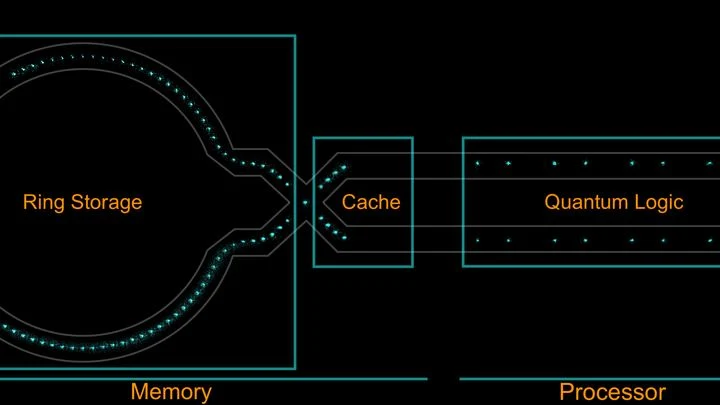
Scientists have created a quantum computer called Helios with 98 ions. It uses a rotating ring so that ions can communicate with each other wirelessly. Calculation errors have become very small. This brings quantum computers closer to solving real-world problems.
In thorium-229 nuclear clocks, one 'tick' lasts 641 seconds — like a pendulum in syrup. The hardest part is eliminating interference from the crystal. If successful, the clocks will surpass everything created before and pave the way for testing fundamental theories.
Physicists turned a rubidium atom into a supersensitive detector that responds only to light of a very specific shade. This makes it possible to count individual photons even with a background billions of times brighter from the sun. The technology paves the way for daytime laser communication and s
Scientists observed for the first time how a group of atoms kept formation despite losses. Strong interaction made them act like dancers: one’s mistake was instantly corrected by the rest. This paves the way to stable quantum devices.
An experiment with giant atoms sensitive to electric fields showed how an unstable emptiness transforms into a stable one, forming bubbles. The rate of the process depends on external influences exactly as theory predicts, as long as everything is perfectly calibrated. The slightest imprecision brea
Physicists have produced a directed stream of muonium — an atom where the nucleus is replaced by an antimuon, while the electron remains ordinary. Superfluid helium allowed them to achieve nearly identical velocities for all particles, paving the way for wave experiments and precise measurement of g
Physicists measured with unprecedented precision how the glow colors of different ytterbium isotopes differ. They compared these atomic 'voices' using a King plot—a tool for hunting unknown forces. It turned out that the anomaly previously thought to be a hint of a fifth force was due to inaccurate
Scientists assembled a node from a rubidium atom and a mirror-dish: it catches the atom's radiation and links it with light particles. Entanglement fidelity is 93%, and the simple design is ready for mass production. This module will become the foundation of quantum networks.
Conformal field theory describes the universal behavior of systems near quantum phase transitions, where the notion of scale disappears. These predictions long remained unverified. Now, in a chain of Rydberg atoms, physicists tuned to a critical point and recorded the excitation spectrum, finding ch
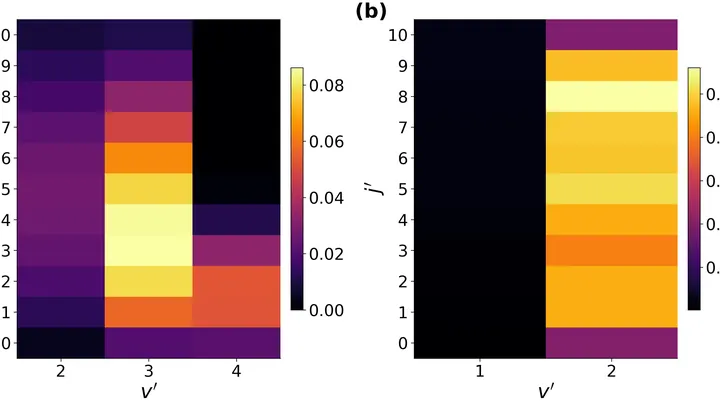
Molecular collisions weave their states into quantum knots. Physicists have learned to measure this entanglement and control it with a magnetic field. This will allow control over quantum processes in chemistry and ultracold gases.
Scientists freeze molecules to near absolute zero and use laser pulses to make an electron vibrate in two states at once. If the charge inside the particle is unevenly distributed, a hypersensitive detector will spot a phase shift — like a false note in a chord. Detecting such a flaw would shake up
Atoms were arranged in a honeycomb pattern, their interactions tuned, turning a magnetic crystal into a flowing, boiling broth. In this chaos, hidden order emerged: excitations race like light. Such a 'spin liquid' could become the foundation for future quantum computers.
An experiment with chilled lithium atoms shows they start emitting light synchronously only at a certain density. The superradiance threshold first drops, then rises, with the minimum coinciding with the condition when the distance between particles equals the light wavelength. This happens because
Interacting, cesium atoms began to oscillate synchronously, like a string. Under the influence of radio waves, the frequency changed, and with strong pumping, a spectrum of multiple overtones appeared — a frequency comb. This brings us closer to ultra-precise clocks and quantum simulators.
The idea that all objects fall equally underpins Einstein's theory. On the Chinese space station, physicists compared the fall of two types of rubidium atoms. The result matched the prediction with an error of a few ten-millionths.
A method for direct detection of axions — dark matter candidates — is proposed. The system, consisting of a layered resonator, a cloud of supersensitive atoms, and a superconducting nanowire, can catch single photons born from axions. This opens up a previously unexplored frequency range for dark ma
By controlling ion rotation, scientists created a skyrmion — a stable magnetic vortex. The full picture of spins has been revealed with 87% accuracy, paving the way to quantum materials and ultra-dense memory.
The quantum world is full of surprises: even in perfect emptiness, ghost particles are born, creating a weak attraction. Using strontium atoms and ultra-precise light analysis, scientists have for the first time captured how this force shifts the 'note' of an atom. The result matched calculations pe
Scientists swapped the electron in a hydrogen atom for a heavy muon. The new 'magnifying glass' revealed a more compact proton, challenging the principle that all light particles are equal. But an old data error was found. The size matched up, and physics held steady.
The article describes a new way to excite the nucleus of thorium-229 using a very weak, steady laser beam. Instead of waiting for the nucleus to glow, the team detected the laser light absorbed by the crystal, making the signal faster and clearer. This opens the door to a solid-state nuclear clock t
Physicists have developed a method to make thorium nuclei emit light signals with record stability. The key element is a crystalline cavity that amplifies light, greatly simplifying the excitation of nuclei with a laser. For the first time, a roadmap for creating all-solid-state nuclear clocks on a
A crystal of charged atoms responds to the slightest jolts, like the calm surface of a pond to a pebble. Quantum squeezing makes it supersensitive, drowning out the noise. This is how we can detect elusive dark matter and gravitational waves, changing our understanding of the Universe.
Quantum fluctuations slightly distort the motion of electrons in atoms. For simple systems, these corrections are known, but for complex ions, calculations have been more difficult. A new approach using smooth bell-shaped functions gives reliable results, paving the way for ultra-precise spectroscop
Physicists have turned unstable molecules into sensitive bloodhounds, picking up the slightest influence of unknown particles and forces. This approach complements experiments at huge accelerators and could lead to the discovery of dark matter.
A new type of gravitational antenna will be built in Antarctica. It will capture low-frequency space vibrations that are inaccessible to current detectors, allowing us to hear the cosmic symphony in previously unheard notes.
The interaction between atom and light has been studied for decades, but only now has a universal conductor’s podium been built. By combining brief energy exchanges with atomic twists, any field state can be set — like a conductor whose baton strokes shift the orchestra’s rhythm and mood. The experi
Energy transfer in plants has long been a mystery. Scientists found a way to recreate it using ions suspended in a vacuum. They track energy movement with unprecedented detail, paving the way for super-efficient solar cells.
In the famous thought experiment between Einstein and Bohr, the atomic slit always trembles due to quantum noise. This noise, like an unceasing whisper, smears the wave pattern. Now, physicists have learned to squeeze this whisper: to hush the part that gives away the particle's path. Fringe contras
For the first time, a quantum-squeezed state has been created in molecules, suppressing noise and improving measurement accuracy threefold. This trick, akin to squeezing a balloon, shifts noise into a harmless form, making molecules ideal sensors for hunting dark matter and testing fundamental theor
Physicists have built a clock where the pendulum is an atomic nucleus. Its ticking is almost immune to disturbances. It's accurate to 10⁻¹⁵ seconds per day, setting new limits on dark matter particles.
Scientists turned a tiny defect in diamond—a nickel atom with missing neighbors—into an all-optical qubit. It's controlled by a laser, emits in the infrared, and holds a quantum state 3400 times longer than usual, running in a standard fridge.
Using Rydberg blockade, physicists linked the motion of two atoms in space: when one received a light push and moved, the other stayed put. This quantum connection opens a path to complex quantum systems for computing and simulation.