Houses and Streets: Why an Eight-Cell Order Emerges in a Superconductor ✛
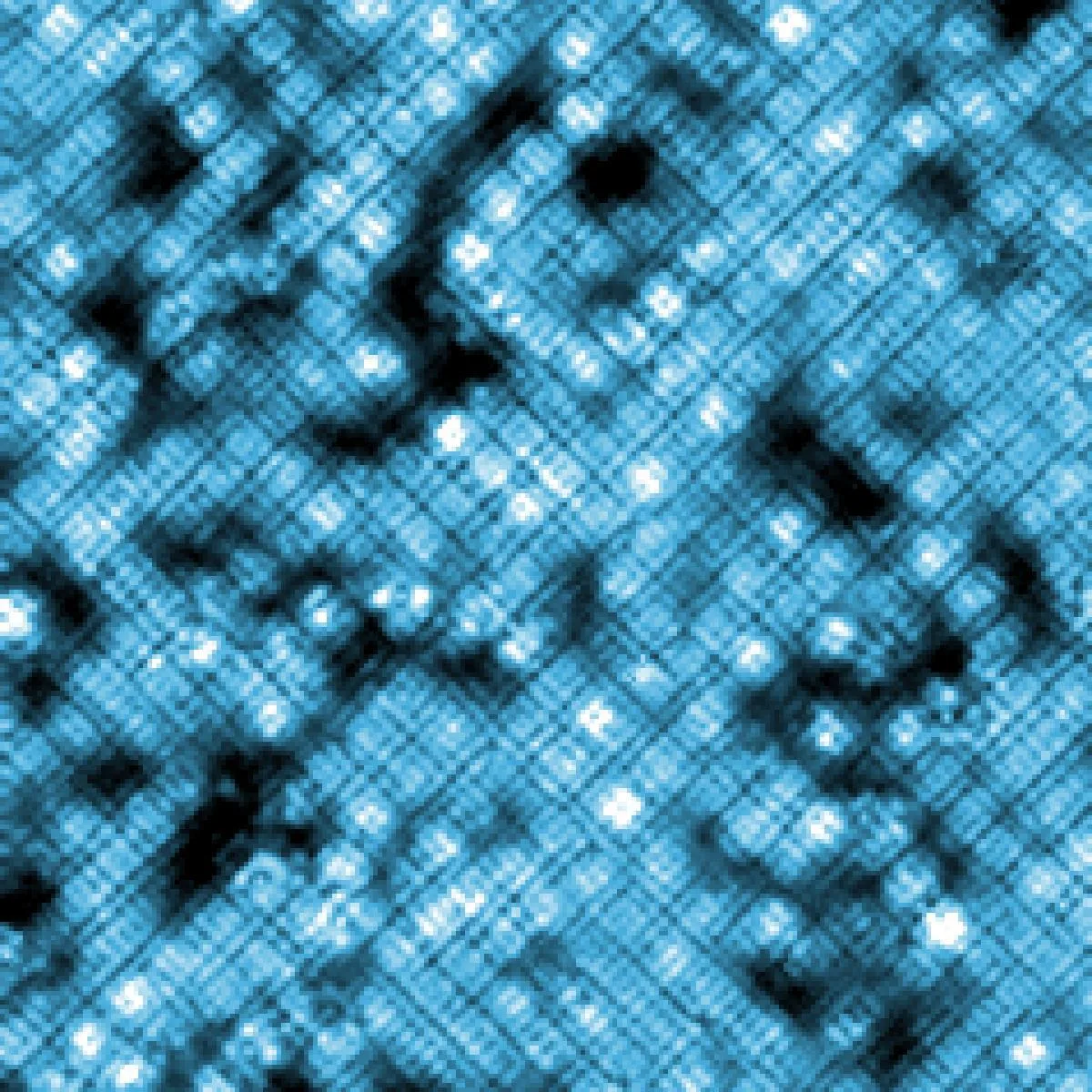
If you look down at a city from above, you can see that buildings stand in clusters, with streets running between them. In a superconducting crystal made of copper and oxygen, scientists noticed a similar pattern: bright square blocks measuring 4 by 4 atomic cells, with dark gaps of roughly the same width in between. Because of this alternation, the whole pattern repeats every 8 cells, even though the blocks themselves are half that size.
Researchers in China used a scanning tunneling microscope to examine the surface of a Ca2CuO2Cl2 crystal. They added varying numbers of "holes" to it, that is, places where an electron is missing. In the sample that conducts current without resistance and in the sample that does not conduct, they saw the same pattern with a period of 8 cells. This means the pattern is not tied to superconductivity; it arises from the way holes gather into 4 by 4 squares.
To test this idea, the scientists built a simple model in which holes spontaneously gather into rigid squares, and ran it on a computer. The model reproduced the observed pattern, confirming that the 8-cell period emerges automatically from the 4 by 4 blocks. Previously, the eight-cell order was thought to be something independent and important for superconductivity. Now it is clear that it is merely the shadow of a finer-scale order, just as streets are the shadow of houses. This knowledge has no practical application yet, but it helps us understand how materials are put together that can conduct current without losses at temperatures that are not especially low.
The 8a0 periodicity in cuprates was first noticed in vortex halos under a magnetic field, but now it has been detected without a field as well, and in an insulator, where superconductivity is entirely absent.