The Secret of Eight Blocks: How Molecular Building Blocks Create Order in Cuprates ✛
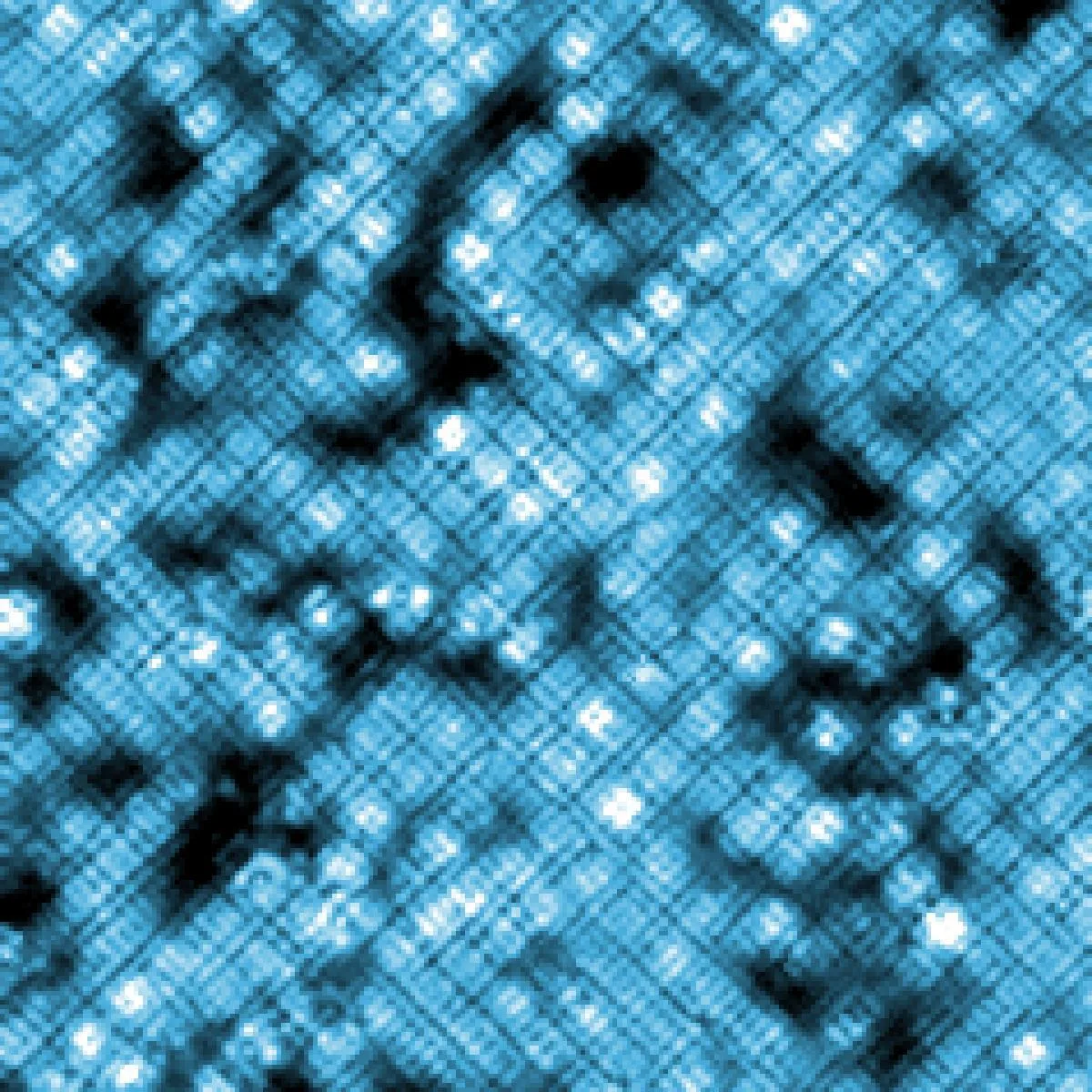
At first glance, a city of blocks looks orderly, but its rhythm is set not by the streets themselves but by the houses that line them. In cuprates, layered copper oxides, a mysterious periodicity of eight unit cells (8a0) has long been observed, as if the streets were laid out with a spacing of 8. But new research shows that the streets are merely the empty spaces between houses, and the houses are 4a0×4a0 plaquettes where doped holes gather.
Scientists from Tsinghua University and the Institute of Physics of the Chinese Academy of Sciences used scanning tunneling microscopy to examine the surface of a Ca2CuO2Cl2 crystal with atomic precision. They varied the number of added holes (doping) and obtained three samples: a superconductor with p = 0.10 and two insulators with p = 0.05 and p = 0.03. On electron density maps at voltages from 10 to 150 mV, bright spots of size 4a0×4a0 appeared, separated by dark gaps of roughly the same width. Fourier analysis of these maps revealed two peaks: at wave vectors q ≈ 1/4 and q ≈ 1/8 (in units of 2π/a0), corresponding to real-space periods of 4a0 and 8a0.
To understand how the 8a0 period arises from 4a0 blocks, the researchers built a minimal model of rigid plaquettes and ran it using the Monte Carlo method. It turned out that if holes gather into 4a0×4a0 squares and the surface coverage is incomplete, the plaquettes alternate with voids about 4a0 in size. Such self-assembly automatically creates an 8a0 periodicity: house, street, house, street. The model reproduced both Fourier peaks, confirming that 8a0 is a spatial subharmonic of the plaquette order, not an independent parameter.
Previously, there was debate over whether the pair density wave is a primary order in cuprates. Now it is clear: the fundamental building block is a molecular orbital of size 4a0×4a0 containing approximately two holes. These blocks stack into a pattern, like houses along a street, and it is their arrangement that generates all observed modulations. This view shifts the focus from momentum space to real space and offers a unified explanation for many experiments.
The city of blocks turned out to be not a chaotic jumble of streets but a regular development of identical houses. The eight-unit-cell modulation that has intrigued physicists for decades now appears as the shadow of a deeper order: molecular orbitals assembling into plaquettes. And if we can understand exactly how holes form these blocks, we may open a path to unraveling the mechanism of high-temperature superconductivity.
The 8a0 periodicity in cuprates was first noticed in vortex halos under a magnetic field, but now it has been detected without a field as well, and in an insulator, where superconductivity is entirely absent.